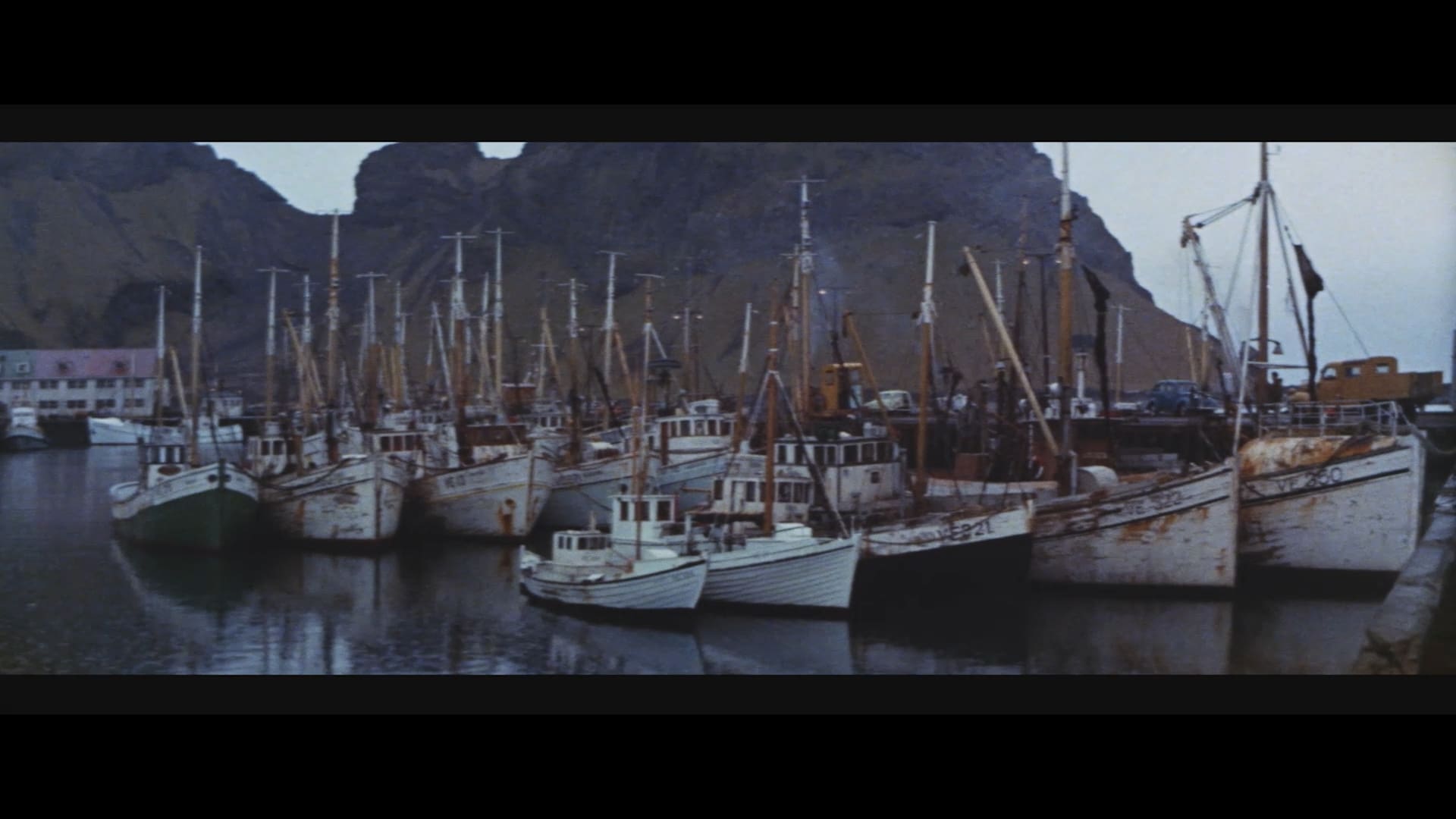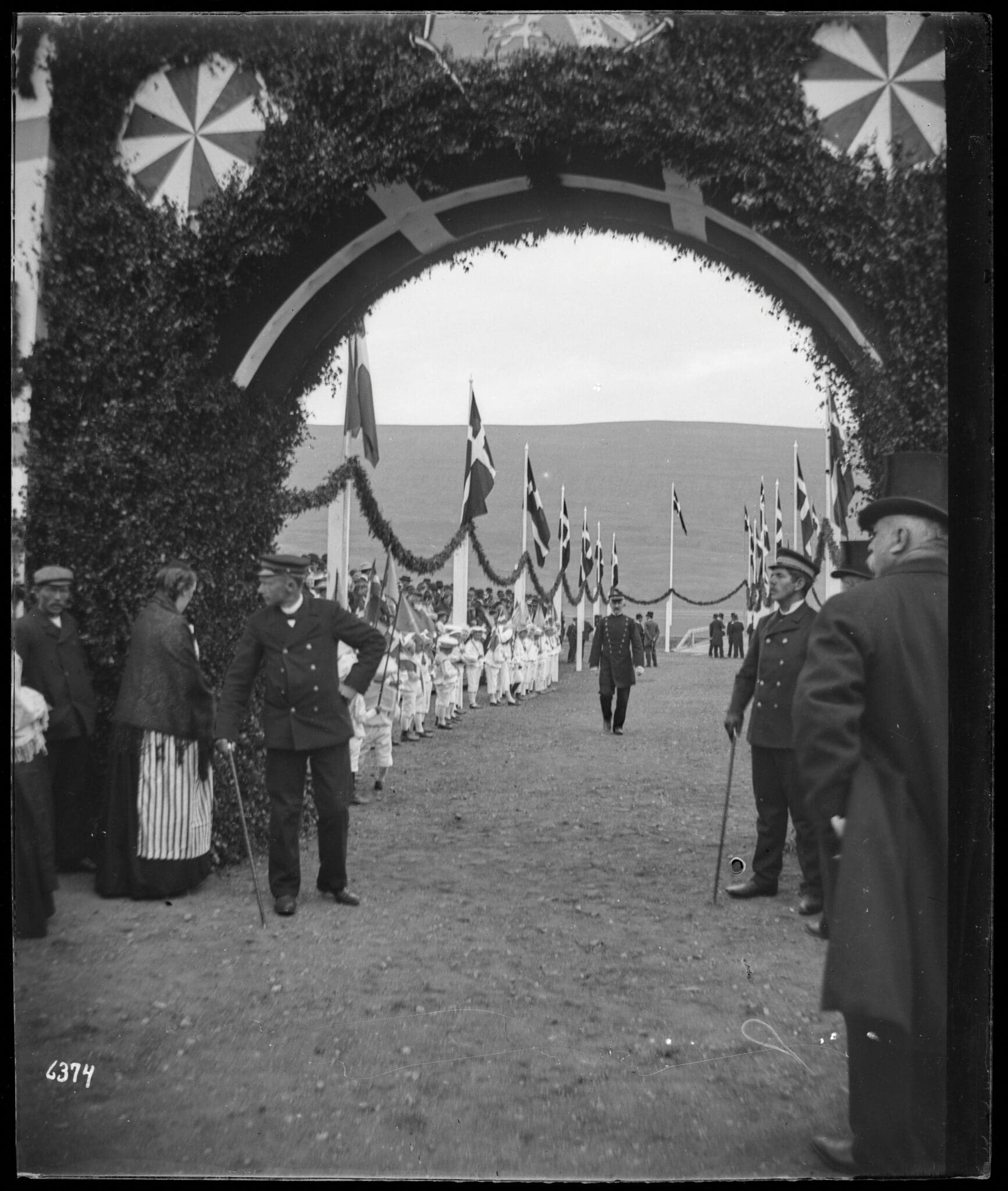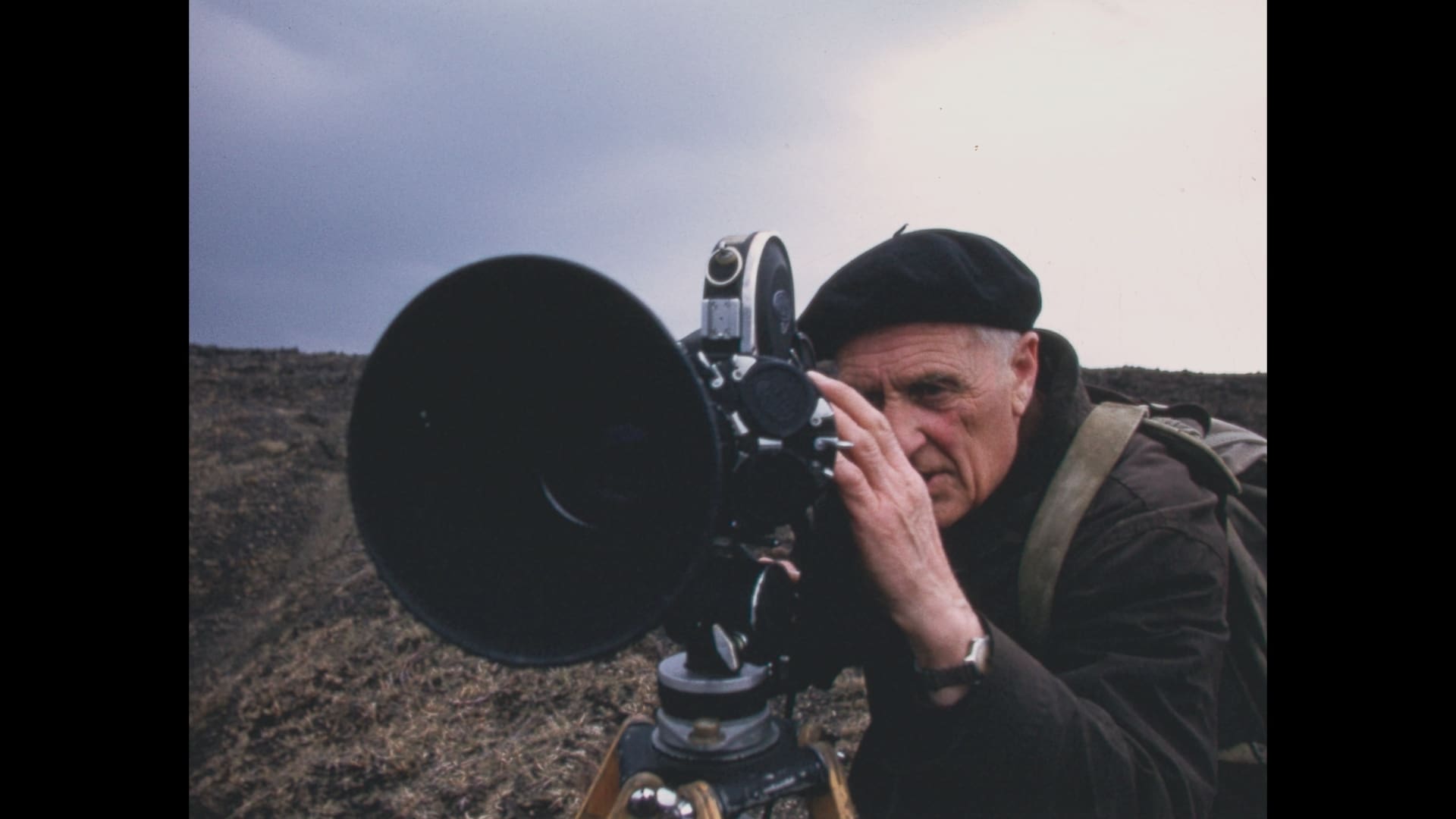
Two dates spanning a three-year period generally mark the beginning of film culture in Iceland. The earlier is 1901, when in September of that year the Dutch cinematographer F. A. Nöggerath came to film the country and its people for an English film company. The second date is 1903, when the Norwegian Rasmus Hallseth and the Swede David Fernander visited the country to show films. These two visits could be called the beginning of the film age in Iceland, as Icelanders had had no contact with the film medium that was gaining ground around the world, if one excludes newspaper coverage of the medium and the accounts of fortunate Icelanders who had experienced film screenings abroad. Eggert Þór Bernharðsson draws attention to this, among other things, and describes it in the article “The Settlement of the Living Image: On Cinema in Iceland until 1930." In it, Eggert meticulously reviews the period when film screenings and filmmaking began in Iceland and discusses, among other things, the visits of the three foreigners and describes the reactions of the country's inhabitants to this first incursion of the medium into the country. (1) Others have also written about the early years of cinema in Iceland, most notably Erlend Sveinsson, whose numerous writings on Icelandic film history and the first decades of film screenings in the country are particularly noteworthy, and it is appropriate to specifically mention the publication Movies in Iceland 75 years old. (2)
Here, the thread will be picked up where Eggert, Erlendur, and others left off, seeking to deepen the understanding of the early years of cinema in Iceland. However, this is not possible without repeating some information that has already been presented, and this is done to create a cohesive narrative and continuity. Special attention will be paid to the aforementioned two dates, and it will be discussed in more detail than before how the journeys of Nöggerath on the one hand, and Hallset and Fernander on the other, were arranged, the reasons for their arrival, and who these men really were. Light will then be shed on the prehistory of the film era with a discussion of the prehistory of film screenings in Iceland and how the new medium was received in the media when knowledge of it was characterized by loose reports and descriptions from Icelandic travelers who had witnessed it abroad. Arguably, the conquest of the moving picture was not complete until their screenings were placed in a somewhat stable operational framework, and the article concludes with a discussion of film screenings in Reykjavík up until the establishment of Nýja bíó in 1913.
The most comprehensive coverage of this period and the first introduction of Icelanders to the art of cinema can be found in the aforementioned article by Eggert Þór. There he discusses, among other things, the arrival of Nöggerath in 1901 as well as the arrival of Hallseth and Fernander in 1903 and how they organized the nation's first film screenings in the capital of Northland, Akureyri, in June 1903. He also discusses attempts at film screenings in Iceland, the public and authorities' reactions to them, the soundtracks of silent films, the advent of sound films, and much more. (3) The importance of Eggert Þór's article can hardly be overstated, and this is not to change that, as only a portion of its subject matter is covered here. But the difference here is that Eggert's main sources are newspapers, magazines, and other printed material, but it is worth keeping in mind that his article was written before the National Library was established. journal.is which has revolutionized the search options for material of the kind Eggert relied on. That is journal.is which has enabled me to fill in the gaps in Eggert's article and better establish the sequence of events. Furthermore, research in foreign databases and communication with scholars in the field of Nordic film history have shed light on previously unknown aspects of this story, especially concerning the backgrounds of Nöggerath, Hallset, and Fernando.
Out of the Shadow
The Magic Lamp (lat. laterna magica) and the entertainment it had to offer have often been called precursors to the motion picture, as both inventions are based on the same basic idea: projecting an image onto a wall for entertainment and information. (4) The magic lantern traces its roots to 17th-century Europe, but the first records of such a lamp in Iceland are much younger. (5) The images produced by the magic lantern were called shadow pictures, and so the entertainment was often advertised under that title. However, shadow shows without magic lamps and silhouettes were also advertised as entertainment, where people created shadow images solely with their hands or with cutouts and a light. Therefore, it is not always clear what is being referred to in the sources when shadow plays are mentioned. Sources about the first shadow play performances in the country can be found in an advertisement in National Flag in 1859, where the Dane C. Boderup is credited for the exhibitions, and Inga Lára Baldvinsdóttir notes in her discussion of shadow-play exhibitions in the book Sigfús Eymundsson: Photographer they were the first slide shows in the country. (6) In Isafold In 1874, it was announced that shadow pictures would be shown to benefit the Sunday School in the assembly hall of the Glasgow House on Sunday, March 1. (7) Tickets were on sale at the home of photographer Sigfús Eymundsson, who was in charge of the exhibition. Sigfús was a dynamic pioneer in photography in the country, but alongside his photography work, he was also involved in retail and import business, and among other things, he founded the store Eymundsson in 1872. According to the book by Inga Lára Baldvinsdóttir Sigfús Eymundsson: Photographer Sigfús had been putting on shadow shows as early as 1870, but she believes that Sigfús was showing shadow images without magic lamps along with other optical illusions, and was not putting on slide shows as has been believed until now. (8) According to Inga Lára's writings, Thorlák Ó. merchant had lived in England for a long time, and in 1879 he advertised a picture show, which was the first in Reykjavík. Therefore, Inga Lára rightly believes that Þorlákur, rather than Sigfús Eymundsson, is the true pioneer of shadow-slide shows in Iceland. (9) Soon, however, Sigfús and Þorlákur began working together on shows, and they became more regular. In National Flag In 1884, they were thanked for providing the residents of Reykjavik with entertainment, as there was little of it available, according to a journalist. (10)
The exhibitions featured various shadow pictures, both paintings and photographs, most of which were from abroad, but there were also a few from Iceland. An advertisement for a November 1884 exhibition specifically mentioned amusing pictures for children, pictures from around the world, and pictures showing “Thingvellir, Almannagjá, the waterfall in Almannagjá, Strokkur erupting, Gullfoss, Bruará, Hvítá in Borgarfjörður, Leirá, Hvítárvellir, Barnafoss, Hvalfjörður Bay, Reykjavík (various views), the harbor in Reykjavík, the museum's interior, etc." (11)
Despite the novelty of the exhibitions, according to Inga Lára's coverage, not everyone was in agreement about their value. (12) In South A harsh criticism by the editor, Gestur Pálsson, of this contribution to the city's entertainment life was published. Little was left untouched, and at the beginning of the article, the saloon itself is likened to a “saloon-kompu," as the shows took place in a small hall in Thorlak's home. Gestur then continued, and next the show itself was addressed:
The entertainment of seeing these shadow pictures is hardly to be envied, for there is very little in the way of construction or information, and the amusement consists mainly in the fact that pictures are shown which are supposed to be funny, but are far more pitifully meager. (13)
Inga Lára discusses how Gestur blames his colleagues for not getting a permit for the shows, and several disputes arose around that. (14) Gestur also uses the exhibition, which costs 50 cents for admission, as a starting point for a discussion about the lack of fish in the town and the poverty that has spread during these difficult times. He considers the practice of picking money from the pockets of the most vulnerable with such an unnecessary act to be completely indefensible. Furthermore, the columnist is astonished that city councilman Thorlakur O. Johnson does not see the error of his ways, as he should be fully aware of the situation. The editor believes that:
that the time is ill-chosen to make a profit from people's desire for entertainment and that the entertainment is now so poorly designed that there is no hope that anyone but those who, due to a lack of education, cannot see, how worthless they are, then there is reason to speak of ”speculating' on the few pennies of the poor, which they so very much need right now to sustain life in themselves and their families. (15)
Needless to say, no ban was placed on the society's exhibitions. (16) Their paths, however, parted the following year, and Thorlakur continued the exhibitions on his own until 1892.
Before Christmas 1889, Thorlákur advertised a particularly large exhibition with pictures from all over Europe. He also specifically stated that a moving picture would be shown. (17) But some shadow pictures for magic lamps were made in such a way that it was possible to turn, lift, or screw the edge of the picture screen, which made it appear to move on the screen. They were not complex movements, but many people still found them impressive. Most of the animations were then painted, not photographs. Judging by the advertisement, Thorlákus had put together a rather extensive program, but in addition to the European tour on canvas, a motion picture, and a special children's and entertainment program, he offered a choir both evenings that was to perform a “concert" for the audience. (18) In 1892, Thorlákus stopped the shows due to a health condition that afflicted him until his death in 1917. Despite the advent of motion pictures, shadow shows thrived well into the 20th century, both for lectures and other educational and entertainment purposes, as evidenced by the many advertisements and press mentions.
The media get a taste for it
At the beginning of coverage of film technology in the Icelandic media, attention was focused on statements by Thomas Alva Edison about a new invention that could show moving pictures. On June 13, 1891, a report discussed Isafold about Edison's invention, where the device was described in the following way:
Edison has now created a new magic machine for the eyes and ears, which will be presented at the Chicago Exposition. It transports a person from their own room to distant theaters, bringing visual scenes, words and tones, images and movements, and the facial expressions of the performers. − And another according to that. (19)
The invention was supposed to be able to record both sound and image and replay it anywhere again for an audience. It seemed to a journalist East so much of the invention that he proposed that Icelanders form an association to purchase such a machine and thus performances could be recorded in the concert halls and theaters of Stockholm, Copenhagen, or Christiania and then shows of world culture could be held in Iceland. (20) A silent version of the invention was premiered in 1893, including at the World's Fair in Chicago, which is mentioned in the quote above, but that machine was called the Kinetoscope and soon became a hugely popular novelty. It does not appear that Edison's machine was successfully brought to the country, and in fact, the beginnings of cinema seem to have received little attention in the Icelandic media when the first films were shown in Paris and Berlin in 1895. In the magazine Iceland However, the invention of the Lumière brothers is discussed in detail in 1897. A journalist describes the French brothers' invention quite accurately, but he says, among other things:
The cinematograph is a tool that shows images of events, not just at a single moment but in a continuous sequence, so that it appears as if the events are actually taking place before our eyes. (21)
It is clear from the description that no prior knowledge of the technology is assumed on the part of the readers. The journalist also compares the invention to Edison's devices, particularly his ideas for sound films:
The device was to be called the „fono-kinetoscope.” It never actually became more than an empty word, and Edison was content to simply put a phonograph in some kind of connection with the kinetoscope. But the pictures the kinetoscope displayed were small and you had to look into the device to see them, so only one person could see them at a time, and the viewer was distracted by an unpleasant vibration. (22)
It is therefore clear that the author was aware of the pros and cons of Edison's invention and considered this new motion picture camera a great improvement over Edison's ideas. In particular, he mentions the difference in size, as the Lumière brothers' films could be projected onto a screen and were therefore large, allowing many people to enjoy them at once, compared to the small images in Edison's box, which could only be enjoyed by one person at a time. It is uncertain whether the author of the article was present at a film screening, but there is an account from 1896 of an Icelandic person at a film screening in London. This was likely the first Icelandic person to witness a film screening for which there is documentation, and it was the editor Hannes Þorsteinsson. Thjóðólfs. He was traveling around the city, and one evening he was with his companions at the Alhambra entertainment venue in Leicester Square when the show began. After clowning antics and other entertainment, a film screening began, and Hannes relates it as follows in his travelogue published in National Flag September 25:
Photographs were also shown using a completely new method, so that all movements were clearly visible. You could see carriages gliding down the streets, and people walking along them so naturally, as if they were alive. There were also horse races, with the horses galloping along at a flying pace, while crowds of people gathered in the streets. It all looked very natural, and the spectators applauded enthusiastically. We were told that this was a completely new invention, and the English were very impressed by it. (23)
The exhibition that Hannes attended was put on by one of England's greatest film pioneers, Robert William Paul (R.W. Paul, 1869-1943), and the projector was his own invention. Paul had become acquainted with film technology through previous projects but decided to build his own camera, which he then improved, and in early 1896 he introduced the so-called Theatrograph, the first machine in the British Isles that could project a 35 mm film onto a wall. (24) He subsequently developed his machine and called it the Animatographe, and under this name, the show that Hannes attended was advertised for August 26, 1896.
The program advertised in the city papers that day matches Hannes's description, but at 9:30 PM the animatographe program began with The Derby, followed by the Henley Regatta and The Royal Wedding, along with other unnamed material. (25)
The films were all shot by Paul's close associate, Birt Acres, and together they designed a movie camera called the Paul-Acres camera. With it, they were among the first to film in the British Isles. (26) Paul and Acres produced films together, but they later went their separate ways, with Paul becoming one of the most prolific film producers in Britain while Acres disappeared from the scene. (27)
By attending this screening, Hannes witnessed an important part of British film history, while also launching Icelandic cinema. After this introduction to the film medium, which still did not have an Icelandic name, screenings abroad were regularly mentioned in the Icelandic media, and the medium had likely become somewhat familiar to Icelanders, if only in name. More people had the good fortune to experience it in person on trips abroad, such as Ólafur Þ. Johnson, son of Þorlákur Ó. Johnson, who had seen them in Copenhagen in 1898 and soon became a pioneer in screenings here at home. (28)
The first cinematographer in Iceland
In 1901, Icelanders experienced filmmaking for the first time when the Dutchman Franz Anton Nöggerath Jr. (1880-1947) came to the country in the fall on behalf of a British film company. His arrival in the country was reported in the newspaper Þjóðólfur on September 20, and he was said to have come on behalf of the British film company Gibbons & Co. However, this is probably not correct, because according to film scholar Ivo Blom, who has researched Nöggerath's work and travels, he worked for Warwick Trading Company and came to the country on their behalf. (29) Eggert Þór mentions that the journalist for Þjóðólfur was extremely concerned about the importance of this new medium for national promotion and regretted that Nöggerath had arrived too late to film the Norwegians' whaling off the coast as well as tourist groups that could have attracted more interested travelers.men to the country. (30) The article about Nöggerath's arrival concludes with familiar words about the medium's value for national promotion:
There is no doubt that if such photographic exhibitions from Iceland were held publicly and widely around the world, they could greatly contribute to an increase in the flow of tourists to the country, and that could then even be a significant matter, that the country's own people support in some way the presentation of the most diverse and best-selected photographs of this kind. (31)
Nöggerath was the son of one of the foremost pioneers of film screenings in the Netherlands; his father, Franz Anton Nöggerath Sr. (1859-1908), was the owner of Flora, Amsterdam's most popular music hall. The first public film screenings in Dutch history were held there in October 1896, just over a year and a half after the Lumière brothers' premiere in Paris. (32) The possibilities of the new medium obviously did not escape Nöggerath Sr., and he continued to incorporate films into his entertainment in Amsterdam.
In 1897, after making a deal with one of Europe's largest film distribution companies, the Warwick Trading Company, Nöggerath sent his son and namesake to learn filmmaking with the company in England. Nöggerath Jr. was given numerous assignments there making documentaries as well as feature films and was, among other things, sent to Iceland in 1901 to capture life on this remote island in the North Atlantic. (33) Nöggerath's journey to Iceland was born out of a great interest among filmmakers and the public to experience exotic places and cultures on the silver screen. (34)
Nöggerath arrived in the country on a British trawler in September. Upon his arrival, he met a teacher who could give him various advice and a brief introduction to the country, and it so happened that the teacher got his student to take on the role of a guide for Nöggerath and serve as an advisor on his travels around the country. Nöggerath got lodging for the next night in what he called the only hotel in town and stayed there for a few days, partly to plan his journey and to get a vehicle. After buying horses and practicing a bit on them, the two set out and headed for Thingvellir together. (35)
Nöggerath described his visit to Iceland in some detail in interviews that appeared in the Dutch magazine De Kinematograf over the period 1918-1919, comprising a total of 16 parts, although not all of them have been found. (36) The scholar Ivo Blom has also summarized the account in an article titled, “The First Filmmaker in Iceland: Travel films and travel literature,“ and he also translated the interviews with Nöggerath into English and published them with an introduction in the article, "Chapters from the life of a camera operator. The recollections of Anton Nöggerath – Filming news and non–fiction, 1897-1908." In his account, Nöggerath says little about his visit to Thingvellir, and it is unlikely that he filmed any material there. The same can be said for Hekla, which he found to be a great disappointment, as everything was calm on that front and there was little of interest to capture on film. A different story is told of Nöggerath's stay at Geysir in Haukadalur, where, on his third day, he captured images of a powerful eruption that he says he narrowly escaped from, nearly losing his life due to the massive cloud of steam that accompanied it. (37)
After the adventure at Geysir, Nöggerath completed the Golden Circle at Gullfoss, but since there were already pictures of Niagara Falls, he knew that audiences would have little interest in Gullfoss as a subject. However, they continued on, and the next leg was a two-day journey to photograph sheepherding. Nöggerath stayed in a cave with hikers and he particularly remembered being served pickled food (which he simply calls sour food in his account), which he did not care for very much. (38) Despite hunger and limited sleep in the cave, Nöggerath woke early the next morning to set up for the arrival from the mountain, but he also photographed the herding of the sheep into the pens, along with the lamb drive and their transport on wagons back to the farms.
After the hikes and the shoots, Nöggerath returned to Reykjavík where he stayed for a few days while he gathered footage on day trips around the city. Among other places, judging by his descriptions, he most likely went to Krýsuvík to photograph geothermal activity; he also took pictures of fish drying and, finally, the salting of whale meat, along with other minor events. Nöggerath then departed after the last passenger ships had already sailed for England, so he had to find passage on a trawler, a spot he got in exchange for two bottles of whiskey and a promise to become the mate for the voyage. (39)
Nöggerath's footage from Iceland was shown in 1902, and it is interesting to examine the titles of the production, as they are quite different from the account of the journey attributed to Nöggerath: Hauling the Nets and Landing the Catch on an Iceland Trawler, Fun on an Iceland Trawler, Landing and Cleaning of a Catch on an Iceland Trawler, Cleaning the Fish and Landing a Shark, Gathering Sheep, Women Cleaning Fish for Curing, and Women Washing Clothes in Hot Wells. (40)
On his way to Iceland with the British trawler Nile, Nöggerath filmed life on board, including the film 'Fun on an Icelandic Trawler,' which, according to sources, shows the sailors enjoying themselves cleaning their gear after work. He specifically mentions this at the beginning of his account, but it is clear that these were not Icelandic sailors, as there were no Icelandic trawlers at that time. The origin of the sailors was of little importance, but Nöggerath said that the picture was one of the most popular from the Iceland trip, as guests were rolling on the floor laughing at the sailors' antics. (41) Geysir is not mentioned in the titles, which does not, however, rule out the possibility that the geyser appeared in some of the films, although this is considered unlikely. The rights, however, did make it in, along with other daily activities of Icelanders, such as washing at the washing troughs and fish processing. There are no records that these films ever made it to Iceland, and today they are considered completely lost.
Shortly after the trip to Iceland, Nöggerath left Warwick and founded his own company that printed and developed negatives for others. He then married, had children, and took on roles in films, as did his children, despite their young age. (42) After the death of the elder Nöggerath, the younger one moved back to the Netherlands, took over the business empire, and expanded it. He placed a greater emphasis on film distribution while also starting to produce films. Despite being one of the most extensive film producers and distributors in the Netherlands, the production arm was not profitable, and he shut it down at the end of 1913. (43) With changing market conditions and financial difficulties, Nöggerath was forced to focus on theater operations in the 1920s, which also proved unsuccessful. The theaters were sold at auction in 1928, and Nöggerath ended his career by opening a travel agency and sellingelling people trips to faraway places. (44)
The projectors are started
After Nöggerath's visit, there is no record of the film medium in Iceland for two years, but in June 1903, two Scandinavians came to the country with their traveling shows, giving the nation's people their first opportunity to see this technological innovation. The Norwegian Rasmus Hallseth (1879-1940) and the Swede David Fernander (1883–1935) began a film exhibition tour of the Nordic countries in 1900. They were extremely successful and continued in this vein until 1906, when they stopped traveling and opened a movie theater in Helsinki. Around the same time, they began to focus on film production in Finland. Hallseth and Fernander are considered among the foremost pioneers of film production in the country with their company Nordiska Biograf Kompaniet, which became the second-largest production company in Finland during the first decade of filmmaking there. (45)
In the introduction to his article, “The Settlement of Living Images: From Films in Iceland to 1930," Eggert Þór Bernharðsson discusses the visit of Hallseth and Fernanders and the reaction of the country's residents to it. (46) He describes their journey through the country, but the visit began on Saturday, June 27, 1903, when an advertisement was published in Norðurland announcing that for the first time in Iceland, picture shows would be held. (47) Hallseth and Fernander were at the forefront of their field and saw opportunities that others missed, coming all the way to Iceland, to the edge of the world, with shows that were destined to attract great attention. Their advertisement in Norðurland appeared the same day the shows were held. It remains unclear why they started their tour in Akureyri, and no indication of their arrival in the country can be found except on the day of the shows themselves. In the newspaper's brief coverage of the advertisement, however, their trips to Norway are mentioned, Sweden and Finland, and that according to coverage of them in local newspapers, much could be expected from the shows. According to the same sources, showgoers in the Nordic countries had been unanimous in their praise of the quality and entertainment value of the shows they put on.
According to a report in Norðurland, screenings were scheduled for several days, or until the steamship Skálholt departed from Akureyri. (48) It so happened that the first movie screenings in Iceland took place at the Good Templar Hall in Akureyri on Saturday, June 27, at 8:00 PM. There was tremendous interest in the screenings and they were very well received, but a week later in Norðurland, the following is said about them:
They did not disappoint. Messrs. Fernander and Hallseth had to show the pictures three times on Sunday and twice on Monday and Tuesday. Otherwise, it was impossible to satisfy the demand. Despite the lack of air and the intense heat—where windows and doors had to be closed to make it dark inside—the house was full every time, and everyone had the best time. Several people even remarked that they had never had a better time in their lives. (49)
After four days of shows in Akureyri, Fernander and Hallseth's journey took them to Ísafjörður on the coastal steamer Skálholt, arriving there on July 7. It is not entirely clear how many shows they held in Ísafjörður, but based on coverage in Vestra and advertisements by Fernander and Hallseth in the newspaper, they likely took place on the 9th. – July 19, with breaks on July 17 and 18, and the audience reviews were extremely positive. (50) Due to high demand, they were able to split the program in two, but after a few days of shows, it was advertised that a “new impressive program" was about to begin, which would include, among other things, *A Trip to the Moon* (Fr. *Le Voyage dans la Lune*, Méliès, 1902). (51)
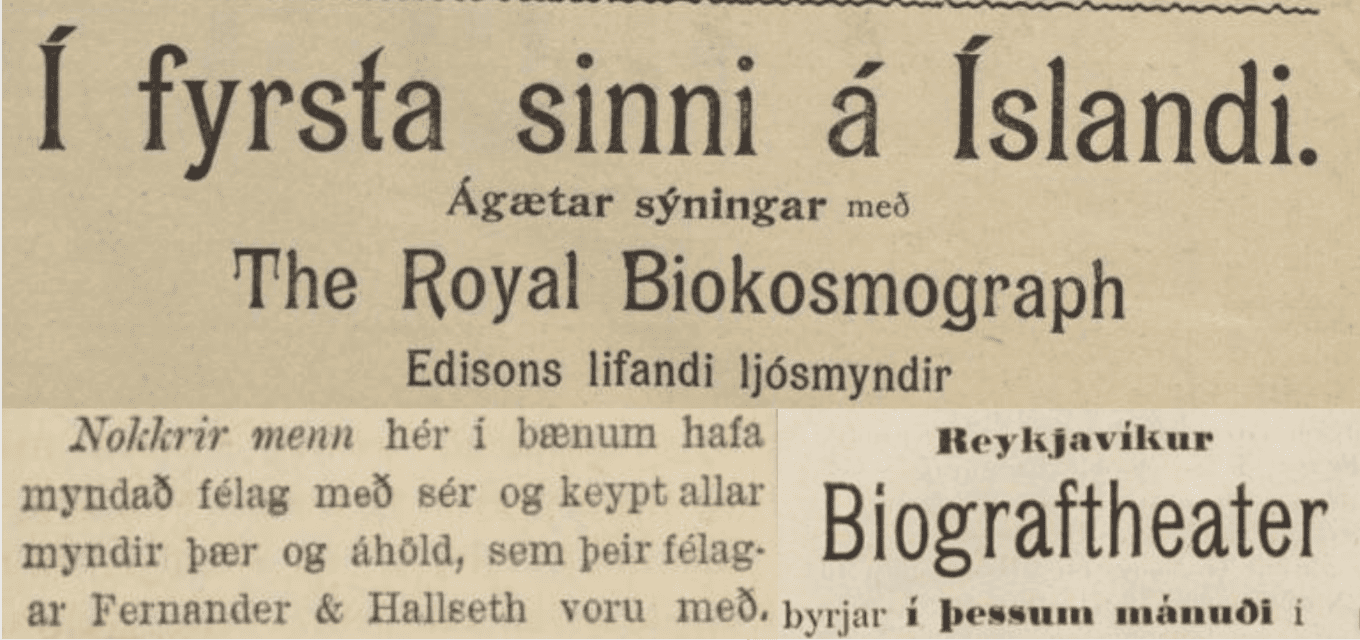
As mentioned above, Hallseth and Fernander were shrewd in business and adept at taking advantage of the opportunities available, and by splitting the program in two, they likely managed to sell the same people two tickets instead of one, had the program been left whole. It is interesting to examine the companies“ advertisements, where they announce that “For the first time in Iceland,“ „excellent shows“ featuring the „Royal Biokosmograph Edisons“ will be held. (52) The name of the projection device sounds as if it is something remarkable, but no records have been found of any such device existing, and so the main conclusion that can be drawn from the name is that Hallseth and Fernander simply made up a name that sounded exciting and referenced Edison to be on the safe side, as Edison was a world-famous inventor of the kof that time. In Norway and Sweden, they advertised the shows in a similar way as in Iceland. The first year it was the „American Kinetograph,“ but later the „Biocosmograph,“ and then they added "Kinematografernes konge," or "King of the Kinetographs," to fuel interest in the shows. (53) But whether or not a device with this name existed, it certainly worked well, and audiences were amazed by this novelty they had the chance to experience firsthand.
According to Eggert Þór, the company went to Reykjavík after the run of performances in Ísafjörður and began performances there one month after the run had started in Akureyri, on July 27, 1903, at the Iðnaðarmannahús (Iðnó). (54) Once again, they were very well received and there was great interest in the shows, so much so that more performances had to be added, just as in Akureyri and Ísafjörður. The shows were advertised in the city's media, but instead of using “For the first time in Iceland,“ as in Akureyri and Ísafjörður, the headline was “For the first time in Reykjavík,“ and under it was not only "Royal Biokosmograph Edisons," but the slogan "living photographs" had been added after the name of the device, as if to explain and simplify it. (55)
Hallseth and Fernanders' program consisted of pictures they had collected, including some commissioned from Britain, as their exhibitions in Iceland featured many images related to the British Isles. According to advertisements and news reports about the exhibitions, the following pictures were on the program and are presented here with the titles under which they were introduced in the media, as it is difficult to find the titles in the original language: The Journey to the Moon, Pictures from the London Zoo, Pictures from the Boer War, The Coronation of King Edward VII, A Funny Story, The Professor and the Chimpanzee, Magnificent Magic World Shows from 1001 Nights, Mephistopheles in the Monastery, Oscar II launched in Glasgow, The Magic Sword, The Snowball and The Bath in Milan, along with many others not specifically mentioned. Shadow pictures were also included, which allowed Hallseth and Fernander to show landscape scenes from Norway and images of notable men, including the poets Matthías Jochumsson, Bjørnstjerne Bjørnson, and Henrik Ibsen, along with King Oscar of Sweden. (56) The exhibitions immediately resonated strongly with Icelanders, and judging by media coverage, it was primarily the humorous pictures that appealed to people, about which the following was written in Fjallkonan: (57)
They seemed to entertain the audience the best, for the theater was shaking with the men's laughter and applause; and not without reason, for they were all better than the other.
Due to popular demand, special children's shows were then held, as the moving pictures captivated the youngest generation, no less than the adults. (59) Eggert Þór reviews the reaction of Icelanders to the visit of the two men and specifically mentions coverage in Ingólfur where it was complained that the footage was beginning to show. (60) The coverage in Ingólfur read:
Many of these images are good, for example, the images from the London Zoo and the Cow War, but some of them are bad. I want to mention an image of a railroad; it's missing all sound, the clatter of cars and the whistle. Besides, it's old and has started to yellow. (61)
Despite these complaints about yellowing and a lack of sound, which must be considered a first-world problem for a country's inaugural film screenings, the reaction to the screenings was otherwise unanimously positive. In a report by a Vestra journalist in Ísafjörður, Hallseth and Fernander were asked if there were any plans for filming in Iceland and whether it would then be shown in other countries afterward, along with lectures:
When Fernander and Hallseth return home, they plan to show pictures from Iceland and give lectures about Iceland and their travels here. They are very pleased with the trip, so it can be expected that they will speak well of Icelanders. (62)
Nothing has been heard about these films. Eggert Þór discusses the recordings in light of the interview excerpt above, but more is not known; they are not mentioned in the itineraries of Hallset and Fernander's later tours of the Nordic countries, and no other journalist mentions recordings by them. (63) Everything therefore points to the fact that they did not film any footage in Iceland during their stay. (64)
Hallseth and Fernander concluded their tour of Iceland in Reykjavík and left the country on the mail steamship Ceres on August 9. It is not clear how many performances there were in Reykjavík, but on Monday, August 3, there was a performance of a program that was likely the last of the tour. (65) Towards the end of their journey on August 11, 1903, a short notice appeared in Fjallkonan, which reads as follows:
Several men here in town have formed a club and bought all the pictures and equipment that the partners Fernander & Hallseth had. (66)
It must therefore be considered likely that Hallseth and Fernander traveled back home without the camera and without any of the pictures they had brought with them. There is no mention of this purchase in other media, and it is not stated anywhere who was involved in it, but the 1903 National Memorial Day was celebrated on September 6 in Keflavík, and moving pictures were part of the program there. The show was not praised, with the images reportedly being poorly seen and appearing either sideways or upside down, and attendees blamed the organizers“ incompetence for the outcome. (67) This suggests that the film screening in Keflavík was held with Hallset's and Fernanders' machine, but that the buyers of the machine had no skill in operating it, and so it ended badly. Eggert Þór then cites a similar experience from a viewer in late September 1903, who reported on half-images from Icelandic exhibitors, either sideways or upside down. (68) According to an article by Hjálmtýr Heiðdal in the Morgunblaðið supplement, "Entertainment for the People: The Movie, 100 Years Old," Ólafur Þ. Johnson founded the first Icelandic film company, O. Johnson & co., in 1903, and their first screenings went particularly badly. It must therefore be considered highly likely that the company bought the equipment from Hallseth and Fernander and put on the unsuccessful show in Keflavík almost a month later. (69)
Hallseth and Fernander continued to travel around the Nordic countries with their film screenings, and although their trip to Iceland went well, at least in terms of ticket sales, they did not see a way to return to the country and stuck to Norway, Sweden, Finland, and Denmark before they settled in Finland and established a movie theater and production company. Many films are still attributed to the duo, but unfortunately, none are known to have been made in Iceland.
Icelanders take up the baton
As previously mentioned, Ólafur Þ. Johnson, son of Þorlákur Ó. Johnson, had become acquainted with the medium of film in Denmark in 1898. Along with photographer Magnús Ólafsson and others, he founded the first film company in Iceland in 1903, likely by purchasing the equipment of Hallseth and Fernander. Although the first screenings did not go as planned, they did not give up. On October 8, 1904, they advertised two screenings to be held at Bárubúð under the name Ól. Johnson and co. (70) A report on them appeared in Reykjavík on October 14, mentioning that their show featured new pictures, different from those shown the year before, and that a few of them were Icelandic, including scenes of laundry girls at the baths and of fish washing. (71) With these shows at Bárubúð, Icelanders got to see moving pictures of their own country for the first time. Eggert Þór describes these film screenings as extremely popular with the general public, as a variety of subjects were regularly imported, including films specifically for children. (72)
Olafur's Society continued its regular screenings at the Bar Room to positive reception and changed its name in 1906, from then on being called the Icelandic Cinematograph Society. The society was responsible for the filming of several moving pictures in Iceland and was therefore credited with more initiative than might be considered appropriate, but on the 28th. November 1906, Lögrétta reported on a film the society showed at Bárubúð in which a certain Jón Jensson tried to do push-ups but was seen “falling flat on his face,“ only to get up “disheveled and bruised“ and then fall again. (73) If this had proven true, it would have been the first Icelandic feature film. But two days later, or November 30, Fjallkonan published a statement from the Icelandic Film Society under the headline "Misrepresentation in Lögrétta," and the statement was due to the "annoyance and outrage" that Lögrétta's coverage had caused in town with its report on the society's film screening:
On the record, we hereby declare that we have not shown any moving pictures from Reykjavík except for the fish-washing at Sjávarborg. Consequently, it is unfounded to claim that we have shown a moving picture of any Jón Jensson, as mentioned in Lögrétta yesterday. (74)
In the next issue of Lögrétta, a correction was published stating that the matter was based on a misunderstanding and that a foreign actor was in question in the aforementioned film. (75)
Despite the initiative of Icelanders in showing films, visits from foreigners were not unheard of. For example, in 1905, a visit from a Norwegian from Flekkebjærg to Akureyri was mentioned, and his film screenings were well-received. (76) Another Norwegian whom Eggert mentions in his article, C. Köpke, came to Reykjavík a year later on behalf of Nordisk Biograf co. and showed films at Iðnó, before he planned to go to Seyðisfjörður to film the arrival of the transatlantic cable. (77) Nothing has been heard of those recordings; neither was there any mention of him filming in Seyðisfjörður in news about the transatlantic cable, nor are these films found advertised in Norwegian newspapers from that time. (78)
In the summer of 1906, the Danish merchant Frederik Warburg sent the cinematographer and carpenter Alfred Lind to the country to establish a new movie theater and get the projection equipment running. The backer of the Reykjavik Biograftheater, Frederik Warburg, was a Danish merchant who had a particularly strong connection to Iceland. Since he was a teenager, he had worked for the firm Thor. E. Tulinius & Co., which was founded by the Icelandic magnate Þórarinn Tulinius. (79) By the time the Reykjavík Biograftheater was founded, Warburg had become a business partner in the company, and through these strong connections to Iceland, it was no coincidence that Reykjavík was chosen for the establishment of a movie theater.
Lind found a venue at 8 Aðalstræti in Fjalakötturinn, the same hall that had housed the Breiðfjörðsleikhúsið until then. (80) The hall needed to be repaired and modified, and for that, Lind hired a young Dane, Peter Petersen, to upholster the seats. Petersen had come to Iceland the previous year to work at Pétur Brynjólfsson's photography studio but quit over a pay dispute. When Lind discovered that Petersen had experience with photography, he was hired as the exhibition manager, and a year later, when Lind had to leave, Petersen was made the manager of the cinema. (81) Lind obviously had a good backer in Warburg and enough money to rent the hall, renovate it, and hire staff without having any income. He knew how to use advertising to create anticipation. For over three weeks before the cinema's opening, newspaper ads announced that the Reykjavik Biograftheater would begin screenings after the premises had been renovated. (82) On November 2, 1906, the city's first movie theater then opened with an exciting program, including The Parliamentary Trip (Islands Altings besøg i København, Peter Elfelt, 1906) where the audience could play a game recognizing the Icelandic parliament members during their visit to Fredensborg. (83) In the cinema's advertisement the day after the opening night, it was claimed that “the house was full for every screening,“ which presumably meets the standards of truthfulness one can expect from an advertisement, but is perhaps not particularly impressive after just one showing. The statement gives a clear picture of the cinema's management's aggressive plans to establish a position in the Icelandic market, something no one had done before. They succeeded, and then some, and a cinema culture was born in Reykjavík. The cinema's clumsy name, Reykjavíkur Biograftheater, was soon shortened in everyday speech to "bíó," which has since remained as the general word for movie theater.
Alfred Lind came to the country with a camera and soon began filming Iceland with the help of Peter Petersen. (84) Only three weeks after the cinema opened, screenings were advertised for a ”Slökkvitóla" exercise. (85) But this is also the oldest preserved Icelandic film and shows the firemen's exercise in Reykjavík and the crowd that watched it. The film has a simple narrative, beginning with the preparations for the exercise, the equipment being gathered, and the exercise being organized. Then a crowd walks up Bankastræti, and it is clear that the onlookers' interest is not least in the camera, and many stop to look at this special device that stares back, or waves to it. The camera is therefore by no means an invisible recorder, but rather the center of attention that people notice and interact with. The exercise itself begins with two men spraying from a hose before cutting to the foamy spray, then a ladder is tested and subsequently they run back down Bankastræti. It's possible that a simulated emergency is taking place, as in the next shot, hoses are being pumped and sprayed, and it's clear that the crowd is keeping to a designated area outside the drill. This is the last shot of the film, so it can be said that the exercise within the film doesn't really have an end. Björn Ægir Norðfjörð has discussed the film and connects it to actualities, like those the Lumière brothers made at the beginning of filmmaking. (86) Björn describes the film's style as documentary rather than an attempt to place the drill in a specific context, and therefore not a great contribution to the art of cinema, but all the more important in the context of Icelandic film history. (87) Lind and Petersen also shot other films of town life, but they are all lost. (88)
With Thráinn, Warburg, Lind, and Petersen at the helm, Ólafur Þ. Johnson and his colleagues at the Icelandic Society of the Living Image could capitalize on nationalism in their advertisements and try to create suspicion toward the newly established cinema. (89) They did just that in an advertisement in October 1906, two weeks before the first screening of the Reykjavík Biograftheater. The advertisement, which was titled “Long live competition!“, stated, "all the shareholders of the company are Icelanders, therefore: No money leaves the country!" (90) The Icelandic Motion Picture Society ceased operations after a fire in early 1907 and sold its equipment to Vilhelm Knudsen, a merchant in Akureyri. (91) The Reykjavík Biograftheater, on the other hand, became an indispensable part of the city's cultural life for nearly 75 years.
New movies give it a try
Despite the strong position of the Reykjavík Biograftheater in the city, several societies tried to create competition, and Eggert discusses some of them in his article. On July 27, 1907, The Scottish and American Living Picture Company began screenings at the Bar Room. (92) According to an advertisement in Hugin, the public was to be given the opportunity to see more and better-presented pictures, as an experienced Englishman was in charge of the screenings. Listed with the advertisement was photographer Kristinn B. Eyjólfsson and The Scottish and American Animated Picture Company, possibly a fictitious company to give the screenings a professional air. (93) Nothing more is heard of the screenings, and it is likely they were not long-lived.
Eggert specifically discusses the Reykjavík International Theatre, which began screenings on October 29, 1909, at Bárubúð. It was part of a Norwegian film company, but an Icelandic merchant, Jón Guðmundsson, managed the cinema here in the country. (94) Despite full houses at the first screenings and generally positive reviews in the papers, the operation does not seem to have gone as planned, and the last news of it is from November 11. December 1909, when tickets to the screenings are given away for free with every purchase of one króna in the textile department of Jón Þórðarson's store. (95) After this announcement, it appears the screenings ceased for good.
It seemed damnably difficult to get regular movie screenings off the ground at the Bar. Wiser for the experience, Ólafur Þ. Johnson returned, this time with photographer Pétur Brynjólfsson, Sveinn Björnsson, the chief justice (and future first president of the republic), Friðrik and Sturla Jónsson, and Carli Sæmundsson, to open a movie theater in the eastern wing of Hotel Ísland. (96) When Peter Petersen at the Bio (Bíópetersen) heard of these plans, he was not about to be outdone by the competition and immediately began renovating his own theater, which was beginning to show its age. The new and improved movie theater opened just over a week before the screenings were scheduled to begin at the new theater. The renovations included an inclined auditorium, better seats, and couches in the lobby where people could lie down if there was a long wait for the next showing. (97) The New Theater was the name of Olaf and his partners“ movie theater, and as a result, the Reykjavik Biograftheater began to be called "The Old Theater," a name that stuck. In fact, its management welcomed the name and soon began advertising under it. (98) Nýja Bíó opened on June 29, 1912, and its first director was Pétur Brynjólfsson, a photographer and former manager of Bíópetursens, who was the reason he came to Iceland in 1905. Both Nýja Bíó and Gamla Bíó thrived, as Reykjavík was a rapidly growing city, and they remained the city's only two movie theaters until the end of World War II, when Tjarnarbíó opened as a major fundraising venture for the University of Iceland.
Final words
The history of film in Iceland up to the establishment of Nýja Bíó is not a grand story of great achievements and inventions, but it is an important foundation for our film culture, and it is important to understand how the history of Icelandic cinema is intertwined with the history of European cinema in a way that is as complex as I have hopefully managed to describe in this article. Entertainment on the edge of the world was scarce, and it was extremely rare for world-class entertainers to make an appearance. Therefore, the medium of film was a godsend for a nation that desires nothing more than to be part of the bigger picture. With the arrival of cinema, the wish of the optimistic journalist from Austra in 1891 had been fulfilled, as he wished for the world's most talented entertainers to be filmed in the continent's most beautiful theaters and brought to film to the edge of the inhabited world, where they could warm the audience as if they were present at the show in person. (99)
References:
1. Eggert Þór Bernharðsson, “The Settlement of Living Images: From Films in Iceland to 1930," *The World of Film*, ed. Guðni Elísson, Reykjavík: Forlagið and art.is, 1999, pp. 803-831.
2. 75 Years of Cinema in Iceland – A Jubilee Publication, ed. Erlendur Sveinsson, Reykjavík: Gamla bíó, Nýja bíó, the National Film Archive of Iceland, 1981, pp. 15-17.
3. Eggert Þór Bernharðsson, “The Settlement of Living Images," pp. 803-831.
4. The magic lantern was based on the principle of projecting light through a lens to create an image on a larger surface; by shining light through a screen with an image, the picture could be displayed on a wall in an enlarged form. For more on the history and function of the magic lantern, see: H. Mark Gosser, “Kircher and the Lanterna Magica – A Re-examination," Journal of the Society of Motion Picture and Television Engineers, October 1981, pp. 972-978, and Laurent Mannoni, The Great Art of Light and Shadow: Archaeology of the Cinema, Exeter: University of Exeter Press, 2000.
5. Charles Musser, The Emergence of Cinema: The American Screen to 1907, New York: Charles Scribner's Sons, 1990, p. 20. Inga Lára Baldvisdóttir, Sigfús Eymundsson: Photographer, Pioneer of Icelandic Photography, Reykjavík: National Museum of Iceland, 2013, p. 35.
6. Inga Lára Baldvinsdóttir, Sigfús Eymundsson, p. 35. Slideshows are mentioned somewhat earlier in an advertisement for a historical lecture at “the old town restaurant“ in 1853. But it says there: "to listen to [the lecture] costs as much as to watch shadow pictures, 4skk. per person." It seems that the entertainment of watching shadow pictures was already known in Reykjavík and that such shows were held for a fee. No other sources have been found for the existence or nature of the shows, and therefore it is not certain whether they were slide shows or simple shadow pictures. Ingólfur, February 12, 1853, p. 12.
7. Víkverji, February 28, 1874, p. 34.
8. Inga Lára Baldvinsdóttir, Sigfús Eymundsson, p. 35. What creates the confusion is that the same word is used for shadow puppets made with light and hand gestures or cutouts that cast shadows on a wall, and for shadow puppets where a magic lamp is used to project silhouettes onto a wall.
9. Same work, p. 35.
10. “Educational and entertaining," Þjóðólfur, November 15, 1884, p. 176. Inga Lára Baldvinsdóttir, Sigfús Eymundsson, p. 35.
11. Inga Lára Baldvisdóttir, Sigfús Eymundsson, p. 35.
12. Same work, pp. 35-36.
13. Gestur Pálsson, “Skuggamyndir," Suðri, November 22, 1884, p. 115. Inga Lára Baldvinsdóttir, Sigfús Eymundsson, pp. 35-36.
14. Inga Lára Baldvinsdóttir, Sigfús Eymundsson, p. 36.
15. Gestur Pálsson, “Shadow Pictures," p. 115.
16. A similar case would prove prominent some 30 years later, directed at the films themselves rather than the shadow shows. Again, the occasion was that hardship was ravaging the country and people were being encouraged to save, and in the eyes of guardians of decency, corrupting entertainment was the last thing the working class needed, or should spend their few pennies on to enjoy. Skarphéðinn Guðmundsson compiled and discussed the defensive and critical rhetoric sparked by movie screenings in his article, “No More Movies: The Attitude of Authorities Towards Movie Screenings in the First Half of the Century.“ In his article, Skarphéðinn discusses, among other things, a 1915 article by Frikirkjupriest Ólafur Ólafsson in Morgunblaðið, which is in many ways similar to the writings of the editor of Suður. Olafur writes, among other things, that if charitable organizations are not allowed to hold a raffle in the city, he finds it hard that others “should be allowed to organize all kinds of ”humbug“ shows solely to pick the pennies from the pockets of the entertainment-seeking fools.” Skarphéðinn says in his article that such criticism of the citizens' "extravagance" was met with a resounding response, and "it was pointed out that people should be completely free to decide for themselves whether they could afford to go to the theater or the movies." Skarphéðinn Guðmundsson, "No More Movie Theaters: The Authorities' Attitude Towards Movie Screenings in the First Half of the Century," *The World of Film*, ed. Guðni Elísson, Reykjavík: Forlagið and art.is, 1999, p. 838-851, here p. 840.
17. Ísafold, November 16, 1889, p. 368.
18. Same work, p. 368.
19. “The United States in North America," Ísafold, 13.06.1891, pp. 186-187, here p. 187.
20. Austri, December 20, 1891, p. 54.
21. Hj. Sig., “Kinematograf", Iceland, September 4, 1897, p. 143.
22. Same work, p. 143.
23. Hannes Þorsteinsson, “Travel Sketches: From the Editor of Þjóðólfur," Þjóðólfur, September 25, 1896, pp. 178-180, here p. 180.
24. John Barnes, “Robert William Paul: British inventor, film producer," Who's Who of Victorian Cinema, eds. Stephen Herbert and Luke Mckernan, 2017, England, accessed February 10, 2019. http://www.victorian-cinema.net/paul. David Bordwell and Kristin Thompson, Film History: An Introduction, second edition, New York: McGraw-Hill, 2003, p. 19. Of these films, only The Rehearsal appears to still exist, while the films of the Thames sailing race and the wedding of Prince Haakon of Norway (later Haakon VII) and Princess Maude of Wales seem to be lost.
25. The Morning Post, August 26, 1896, London, p. 4,
26. Bordwell and Thompson, Film History: An Introduction, p. 19.
27. Barnes, “Robert William Paul".
28. Hjálmtýr Heiðdal, “The Movie 100 Years Old: Entertainment for the People," Morgunblaðið Book Supplement, March 25, 1995, p. 1.
29. Ivo Blom, “The first cameraman in Iceland: Travel film and travel literature,“ Picture Perfect, eds. Laraine Porter and Bryony Dixon, Exeter: University of Exeter Press, 2007, pp. 68-81, here p. 69; During these years, several companies were operating in Britain under the name Gibbons & co., but none of them seems to have been involved in filmmaking. However, Walter Gibbons was quite extensive in his entertainment ventures in the British Isles and owned and operated several music halls. He often showed films at his entertainments and was also involved in film production, including sending men on film expeditions to distant locations, (see for example: Barry Anthony, "Sir Walter Gibbons," Who's Who of Victorian Cinema, eds. Stephen Herbert and Luke Mckernan, 2017, England, accessed November 15, 2018 by http://www.victorian-cinema.net/paul) Whether Nöggerath was in the country on Gibbons“ behalf is not certain, but on August 29, 1901, Gibbons did publish an advertisement in The Stage seeking cinematographers. The Stage, 22nd year, August 29, 1901, p. 22. However, the pictures that Nöggerath took in Iceland appeared in a 1902 Warwick company catalog; see Blom, “The first cameraman in Iceland," p. 75, and "New Picture Shows," Þjóðólfur, September 20, 1901, p. 179.
30. Eggert Þór Bernharðsson, “Landnám lifandi mynda," p. 818.
31. “New Film Screenings," p. 179.
32. Ivo Blom, “Chapters from the Life of a Camera Operator: The Recollections of Anton Nöggerath – Filming News and Non-fiction, 1897-1908," Film History, vol. 11, no. 3, ed. Gregory A. Waller, Bloomington: Indiana University Press, 1999, p. 263.
33. Blom, “Chapters from the Life of a Camera Operator," p. 264.
34. A special category of such films was called Iceland movies, and Iris Ellenberger goes into detail about their history and influence on Icelandic culture in the book *Icelandic Films 1916-1966: Images, Identity, and Power*. According to Iris, there was great international interest in the exotic North, and from the earliest surviving Iceland films, which can be found at the National Film Archive of Iceland from 1916, the same or similar focuses in the portrayal of the country can be seen. According to Iris, hunting, fish processing, geysers, and their utilization were subjects found in most films about Iceland from their inception to the present day, and these were precisely the same focuses that Nöggerath had in his footage of the country and its people. Thus, he set the tone for what would become the international audience's perception of Iceland and, later, the focus of marketing the country and its culture. Íris Ellenberger, *Icelandic Films 1916-1966: Images, Identity, and Power*, Reykjavík: The Institute of Historical Studies, University of Iceland, 2007, p. 171. Björn Ægir Norðfjörð also connects Nöggerath's films to images of Iceland in Björn Ægir Norðfjörð, “Icelandic Filmmaking: National, Transnational, and Finally, International," in *Frændafundur 8*, ed. Turið Sigurðardóttir and María Garðarsdóttir, Reykjavík: Fróðskapur, 2015, pp. 303-324.
35. Blom, “The First Cameraman in Iceland," p. 71.
36. Blom, “Chapters from the Life of a Camera Operator," p. 263.
37. Blom, “The First Cameraman in Iceland," pp. 72-74.
38. Blom, “Chapters from the Life of a Camera Operator," pp. 273-274.
39. Same work, p. 274.
40. Blom, “The First Cameraman in Iceland," p. 75.
41. Blom, “Chapters from the Life of a Camera Operator," p. 272.
42. Same work, p. 265.
43. Same work, pp. 266-267.
44. Same work, p. 267.
45. Outi Hupaniittu, Biografi liiketoiminnan valtakausi: Toimijuus ja kilpailu suomalaisella elokuva-alalla 1900–1920-luvuilla, Annales series of the University of Turku, Turku: Painosalama, 2013, p. 452.
46. Eggert Þór Bernharðsson, “Landnám lifandi mynda," p. 804.
47. Same work, pp. 803-804. Norðurland, June 27, 1903, p. 158.
48. “The Photo Show," Norðurland, June 27, 1903, p. 159.
49. “The Picture Shows," Norðurland, July 4, 1903, p. 163.
50. Eggert Þór Bernharðsson, “The Settlement of Living Images,“ p. 803. "Picture Shows," Vestri, 11.07.1903, pp. 142-143, here p. 142. Vestri, July 20, 1903, p. 147.
51. „Picture Shows,“ Vestri, 07/11/1903, pp. 142-143, here p. 143.
52. “The Photo Show," Norðurland, June 27, 1903, p. 159.
53. Tidningen Kalmar, issue 131, August 25, 1900, p. 2. Frederiksstads tilskuer, issue 102, May 6, 1902, p. 3.
54. Eggert Þór Bernharðsson, “The Settlement of Living Images," p. 803.
55. Ingólfur, July 26, 1903, p. 80.
56. “Picture Shows,“ Vestri, July 11, 1903, pp. 142-143, here p. 142. Spectator, "Picture Show," Fjallkonan, July 28, 1903, p. 119.
57. Eggert Þór Bernharðsson, “Landnám lifandi mynda," p. 803.
58. Fjallkonan, July 28, 1903, p. 119, taken from Eggert Þór Bernharðsson, “Landnám lifandi mynda," p. 803.
59. Ísafold, July 29, 1903, p. 192.
60. Eggert Þór Bernharðsson, “Landnám lifandi mynda," p. 804.
61. P. Z., „Living Images,“ Ingólfur, August 2, 1903, p. 83.
62. Vestri, July 11, 1903, p. 143.
63. See, for example, their advertised program in Denmark in 1904: Vestjyllands social demokrat, issue 264, November 11, 1904, p. 3. Eggert Þór Bernharðsson, “Landnám lifandi mynda," p. 818.
64. This theory is both the result of the undersigned's research, and also, the scholar Outi Hupaniittu, who is most familiar with the work of Hallseth and Fernander, is not aware of them ever advertising images from Iceland on their lecture tours after their visit to Iceland. Furthermore, she is not aware of them having generally filmed elsewhere. Her doctoral dissertation on the early years of Finnish cinema is cited above, and she has thoroughly researched the societies' touring exhibitions.
65. Ísafold, August 1, 1903, p. 196.
66. The Mountain Woman, August 11, 1903, p. 128.
67. „National Memorial Day in Keflavik,“ Reykjavik, September 10, 1903, p. 2.
68. Eggert Þór Bernharðsson, “Landnám lifandi mynda," p. 804.
69. Hjálmtýr Heiðdal, “Entertainment for the People," p. 2.
70. Ísafold, October 8, 1904, p. 264.
71. Reykjavík, October 14, 1904, pp. 183-184, here p. 184.
72. Eggert Þór Bernharðsson, “Landnám lifandi mynda," p. 804.
73. Lögrétta, November 28, 1906, pp. 219-220.
74. Fjallkonan, issue 63, November 30, 1906, p. 251.
75. Lögrétta, issue 56, December 5, 1906, p. 223. It is interesting, however, that only one Jón Jensson was prominent in Icelandic society at that time, and he was the presiding judge in Reykjavík and a former member of parliament and city councilor who had become involved in the home rule issue, and it is therefore possible that the article was a mockery of him, which others then took up.tion, and protested. “Jón Jensson," Parliamentary Biographies: Biographies of Members of Parliament from 1845, retrieved on February 29, 2017, from http://www.althingi.is/altext/cv/is/?nfaerslunr=308.
76. Norðurland, August 26, 1905, p. 199.
77. Ísafold, August 18, 1906, p. 214, and Eggert Þór Bernharðsson, “Landnám lifandi mynda," p. 804.
78. While he was still in Reykjavik, Köpke showed a picture from the coronation of King Haakon in Trondheim, which is not particularly noteworthy except that Franz Anton Nöggerath the Younger was present at that event and filmed it on behalf of a man Nöggerath called Mr. Krause. It is not known if the film shown in Reykjavik was Nöggerath's recording, though this is not particularly likely since many people filmed the coronation. For further fun, this is the same Haakon who, 10 years earlier, married Princess Maude of Wales at a movie screening in London. Recordings of the event have been preserved and can be found on YouTube under: “Kroningen av kong Haakon VII av Norge for 106 aar siden," at this link. https://www.youtube.com/watch?v=US4vvUAVyQ0, as well as under “Konigsferden" on this page https://www.youtube.com/watch?v=M6IRIdBSWDk. Ísafold, August 4, 1906, p. 200. Blom, “Chapters from the Life of a Camera Operator," pp. 274-275.
79. Ísafold, November 22, 1913, p. 268.
80. Ólafur Árnason, “1906-1981: Gamla bíó 75 ára,“ Kvikmyndir á Íslandi 75 ára – Afmælisrit, ed. Erlendur Sveinsson, Reykjavík: Gamla Bíó, Nýja bíó, the National Film Archive of Iceland, 1981, pp. 19-21, p. 19. Eggert Þór Bernharðsson, "Landnám lifandi mynda," p. 806.
81. Erlendur Sveinsson, “The 100th Birthday of Bíópetursson, a Pioneer in Cinema Operation and Filmmaking in Iceland," *Icelandic Cinema 75 Years – A Jubilee Publication*, ed. Erlendur Sveinsson, Reykjavík: Gamla bíó, Nýja bíó, the National Film Archive of Iceland, 1981, pp. 15-17, here pp. 15-16.
82. The Daily Newspaper, October 9, 1906, p. 1.
83. Eggert Þór Bernharðsson, “Landnám lifandi mynda," p. 806.
84. Alfred Lind is yet another link between Iceland and the European film industry. He began his career in the film business as a carpenter before moving behind the camera as a newsreel photographer at many significant events in Denmark and the other Nordic countries. He signed a contract with a film producer in Aarhus in 1909, and his career took off, with Lind landing numerous assignments, including filming Danish feature films. When he began to attract international attention, he founded his own film company and also started taking on projects elsewhere, including in Germany and Italy. After the advent of sound, Lind's career took a nosedive, and he never really recovered, getting little to no work in the sound film era. His courage and perseverance, however, shone through in his plans to establish a pan-European film production to challenge the American blockbusters—a plan that never came to fruition, as it was far ahead of its time. Lind was one of Denmark's most active and respected filmmakers of the silent era but, like so many others, never found his footing in the sound era. Jan Nielsen, A/S Filmfabriken Danmark – SRH/Filmfabriken Danmarks historie og produktion, Copenhagen: Multivers, 2003 and “Alfred Lind," Det danske Filminstitute Database, accessed February 20, 2019, from https://www.dfi.dk/viden-om-film/filmdatabasen/person/alfred-lind.
85. Ísafold, November 24, 1906, p. 309.
86. Björn Ægir Norðfjörð, „Iceland in Living Pictures: A Meeting-Place of Cinema and Nation,“ Studia Humanistyczne AGH, 10/2011, pp. 169-183, here p. 170.
87. Björn Ægir Norðfjörð, „Iceland in Living Pictures,“ pp. 171-172.
88. Erlendur Sveinsson, “Iceland in Moving Pictures: The First Two Decades of the Century in Moving Pictures," Ný saga, eds. Eggert Þór Bernharðsson and Ragnheiður Mósesdóttir, 2nd issue, Reykjavík: Sögufélag, 1988, pp. 88-94, here p. 89.
89. Eggert Þór Bernharðsson, “Landnám lifandi mynda," p. 806.
90. Þjóðólfur, October 19, 1906, p. 177.
91. Hjálmtýr Heiðdal, “Entertainment for the People," p. 2.
92. Eggert Þór Bernharðsson, “Landnám lifandi mynda," p. 807.
93. Huginn, July 29, 1907, p. 4, and Eggert Þór Bernharðsson, “Landnám lifandi mynda," p. 807. The name of the society was advertised with this mixture of Icelandic and English, and later in the same advertisement only in English, which is why it is presented this way here.
94. Lögrétta, November 3, 1909, p. 202. Eggert Þór Bernharðsson, “Landnám lifandi mynda," p. 807.
95. Ísafold, December 11, 1909, p. 327. Eggert Þór Bernharðsson, “Landnám lifandi mynda," p. 807.
96. Erlendur Sveinsson, “NÝJA BÍÓ – in its Seventieth Year of Operation," *Cinema in Iceland 75 Years – Anniversary Book*, ed. Erlendur Sveinsson, Reykjavík: Gamla bíó, Nýja bíó, the National Film Archive of Iceland, 1981, pp. 7-9, here p. 7.
97. „The Movie Theaters,“ Reykjavík, June 22, 1912, p. 99.
98. Reykjavík, July 6, 1912, p. 105. Eggert Þór Bernharðsson, “Landnám lifandi mynda," p. 807.
99. Austri, December 20, 1891, p. 54.