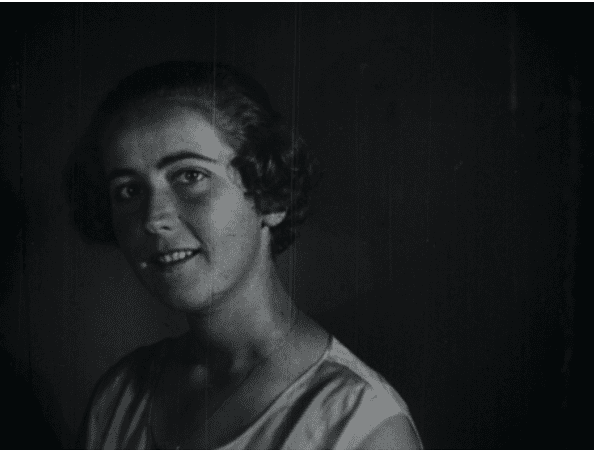
Women are not very visible in the history of Icelandic cinema until after the „cinematic thaw“ in the mid-twentieth century, except as actresses, choreographers, or composers. (1) All of the country's most prominent and talked-about filmmakers were men, and all coverage of films was about them and their involvement in filmmaking. (2) However, this does not mean that women were not involved in filmmaking during the first decades. While researching the history of Icelandic cinema, I came across an interesting film preserved at the National Film Archive of Iceland that has not been discussed before. It is a dance instructional film from 1927 made by the remarkable sportswoman and dance teacher Ruth Hanson in collaboration with Loft Guðmundsson. The film is titled Flat-Charlestone and in it, Ruth is seen with her sister Rigmor Hanson, dancing the Flat Charleston to the audience's delight. With the discovery of the film, the involvement of women in filmmaking in Iceland can be pushed back 25 years, and Ruth can be called a pioneer in Icelandic filmmaking.
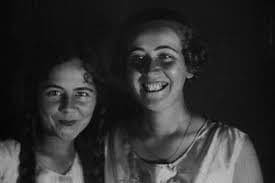
Two images from this remarkable film adorn the cover of Saga. What follows is a discussion of Ruth's filmmaking and a light shed on a chapter of her life, as the sources allow—which are often scarce—from the time she returned home from her studies in Copenhagen until she married in Scotland and disappeared from public view. An attempt will also be made to do justice to the film as a unique document of Icelandic dance culture and the influence of international metropolises on the urban culture found in Reykjavík during the interwar years. The reception of the film by the media and the public will also be examined, but the primary goal of this article is to draw attention to Ruth's cinematic achievements and her impact on Reykjavík's culture during a specific period.
Ruth comes home
Much about Ruth Hanson's life is unknown, which makes her somewhat mysterious. She returned home from Copenhagen in 1926 after studying at Paul Petersen's Institute, where she had learned physical education and dance. (3) Upon her return, Ruth immediately began to attract attention, especially for her great dancing ability and grace, which she and her sisters, Ása and Rigmor, demonstrated in performances throughout the city, but also by establishing a dance school for children and adults and offering regular swimming lessons to the public. (4) Ruth was born in 1906, the daughter of Hannes Snæbjörnsson Hanson, a Reykjavik merchant and former gold miner, and Gerda Hanson, a homemaker. When he was young, Ruth's father, Hannes, went to the New World with his family but returned alone to search for gold in Snæfellsnes in 1905. (5) After those attempts failed, he opened a store at 29 Laugavegur. Ruth's mother, Gerda, was Danish but moved to Iceland after she and Hannes met. A memorial article about Gerda states that the sisters' home was filled with great joy, and their mother took care of their artistic upbringing with great diligence. She taught Ruth, Rigmor, and Ása to dance from a young age, and all of their paths would later be connected to the art of dance in some way. (6)
The position of women in Iceland in the 1920s was, in some respects, contradictory. It was characterized by diligence, foresight, and breaking down barriers, but also by the prevailing ideology that women should perform “women's work" or be housewives. In the book Women who choose For example, the tremendous drive of many women to break into high-ranking positions or simply to find employment is discussed. Some managed to get an education, even abroad, and start their own businesses, and Ruth obviously falls into that category. However, ideas about women's work were narrowly defined, and a key requirement was that women should do jobs „where their „femininity“ could be enjoyed.“ (7) The odds were therefore stacked against Ruth, but she does not seem to have let the „traditional“ role of women in society deter her and forged her own path. To draw attention to the dance school she had founded and to offer exciting events in Reykjavik, Ruth organized dance performances with her sisters, which were unanimously praised in the newspapers, which reported on the thunderous applause and great enjoyment of the audience. The remarkably similar wording of different newspapers about the performances is often noteworthy, and it is therefore likely that Ruth herself sent them press releases to draw attention to her work and thus control her own image-making in society. (8) Ruth also taught swimming, a sport that was very important to her, and she was such an outstanding swimmer that her skill was noted. She participated in a breaststroke competition in the summer of 1927, where she became the Icelandic champion in rescue breaststroke. She saved her sister Rigmor and broke the Icelandic record in the process. (9) Ruth was the first woman and the third swimmer in history to swim the Engey Strait, from Engey to Reykjavik, which she also did in the summer of 1927 in just over an hour. (10) This swim is considered a heroic feat and is regularly remembered when discussing the athletic achievements of Icelanders in the twentieth century.
In the fall of 1927, Ruth traveled to England on the Gullfoss and spent two months on a tour with stops in London, Paris, and Copenhagen, where she learned all the latest and most popular dances and variations, including the Flat Charleston. (11) Upon her return, Ruth announced her engagement to William Murray Anderson, a Scottish man she had likely met during her travels and would later move to Scotland with. (12) Ruth was obviously worldly and well-acquainted with European urban culture, where she traveled and enjoyed life between familiarizing herself with the latest in the city's dance scene. Such freedom and the importation of foreign culture might have made Ruth a target for the old guard in Iceland, who felt that the traditional, rural culture was threatened by foreign fashion trends. Such „Reykjavik girls“ were even criticized for their clothing, appearance, and speech, which traditionalists felt belittled Icelandic customs and traditions. (13)
In the major cities of Europe, popular dance halls and entertainment were growing rapidly in the interwar years, and the same story can be told about Reykjavik. (14) The growth of urban areas brought about major cultural changes. Ruth was at the center of the action both in Iceland and abroad, and on her travels, she brought foreign dance culture with her to Iceland and introduced it to Icelanders. During these years, folk dances were still popular in Iceland, and women like Stefanía Guðmundsdóttir and Sesselja Hansdóttir taught them around the time of the First World War. However, they were also considered a form of rebellion against societal norms regarding the role of women. Sesselja recounts this in an interview with The Morning Paper On the occasion of her 70th birthday:
I wasn't one for stopping to darn my socks and patch them, as the old folks expected all girls to do. I learned to dance from Mrs. Stefanía Guðmundsdóttir and for a while I taught dance at Bárunni … I mainly taught folk dances and then, as now, there was a shortage of boys who wanted to learn to dance, and I often had to have girls dressed as boys. (15)
However, new dances began to gain ground in the 1910s, and their popularity grew, changing dances and dance parties as a result. (16) Not everyone considered this a positive development, and people often expressed negative opinions about Reykjavík girls who would lie in bed until noon after having spent the night out. (17) Such behavior was considered harmful by many, and there were concerned voices about the dissolution of households and the decline of the nation. It was even urged to monitor young people's entertainment to counteract this trend. (18) But young women like Ruth were symbols of a new era and a new mindset about women's duties, as they educated themselves, became economically independent, and rejected limiting themselves to traditional domestic roles.
The movie premiered
On December 4, 1927, appeared in Clue an advertisement for a new Icelandic film titled „Dance Performance at Nýja Bíó.“ It stated that in the film, Ruth and Rigmor Hanson performed the Flat Charleston dance, both the basic steps and „variations.“ (19) In a brief discussion of a planned performance in The Morning newspaper It is stated that Ruth had the picture taken „so that it can be clearly seen how the steps are taken in this dance, but they need to be seen well if they are to be learned correctly.“ (20)
There was little filmmaking in Iceland during these years. Peter Petersen, the director of Gamla bíó, regularly filmed events around Reykjavík and showed them in his movie theater. Photographer Loftur Guðmundsson had also made two short films and one feature-length film. The longer one was the documentary film Iceland in motion (Loftur Guðmundsson, 1925), a landmark film in the history of Icelandic cinema in which he traveled the country and filmed life and work at sea and in the countryside. Loftur was a great pioneer in Icelandic filmmaking but was severely short on funds, as government grants were little more than distant dreams, so he came up with various ways to finance his films. He did this, among other things, through partnerships with companies, and with Ruth's film, it becomes clear that he also sold film production services. Although Loftur is not credited for the film anywhere, my research has revealed that Ruth hired Loftur for the production and used his photography studio to make the film. (21) Only she was credited for the film in the media, and she and her sister appeared at Loft's photography studio, in the basement of the New Bio, to film and introduce to the public the dances that were being performed in the major cities of Europe.
The picture was obviously filmed in a photo studio, most likely to have access to good lighting, but the lights still weren't good enough to illuminate more than just the main characters, and it therefore looks quite dark. Traditional lights, key and fill, are used in the film, but the fill light is quite dim, resulting in sharp light-to-shadow contrasts. A second spotlight is often in the shot; presumably, it was kept close to compensate for the weak light it was producing. This is unusual, considering that Loftur had access to more lights in his studio. Possibly, this was done to direct the audience's attention to the dance and the patterns, letting the background remain dark behind the dancers' illuminated costumes. However, this could also be seen as illustrative of the lack of filmmaking equipment in Iceland and the technical limitations that came with making films in the country at that time.
Immortal dance steps
It is clear that the athlete and dance teacher Ruth Hanson let little stop her from putting things into action, and with the drive that propelled her forward, she also became a pioneer in the field of film. Flat-Charlestone is the first film made by a woman in Iceland, and Ruth Hanson is therefore the nation's first female filmmaker.
The film Ruth is extremely short, only about 3 minutes long, and so another film was shown with it to fill out the screening time. It is not certain which film that was, as it was only referred to as a supporting film in advertisements. Ruth's film begins with the title card „Flat-Charlestone“ on a black background, which then fades into a text card that says:
Primary steps and variations as they are danced in the capitals of Europe and on Ruth Hanson's Dance School Reykjavik — danced by: Rigmor and Ruth Hanson Graduated dance and physical education teacher. (22)
The film consists of three different shots that are taken with a single camera. The film cuts between the following shots: medium shots of the main characters that frame the film and give the audience a chance to get to know and say goodbye to them, long shots of Ruth and Rigmor dancing where they are both seen in their entirety, and close-ups of their footwork to better show their dance steps.
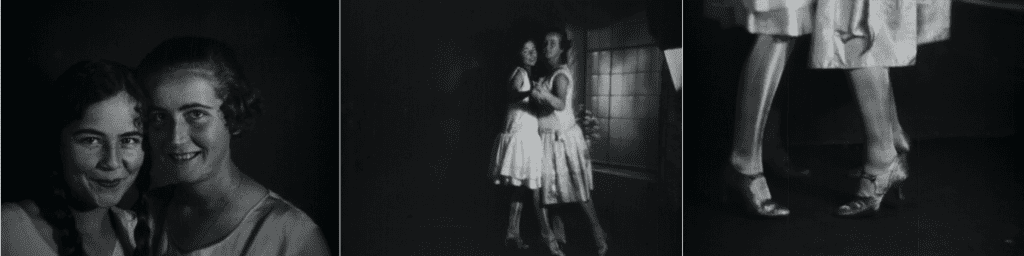
The film begins by introducing the main characters. The first shot is a medium close-up of Ruth as she looks down to the side and is lit in a fairly conventional way with a key light and then a softer fill, she sits slightly to the side as if being photographed, but then looks up at the lens and smiles a confident smile at the audience before she laughs lightly.

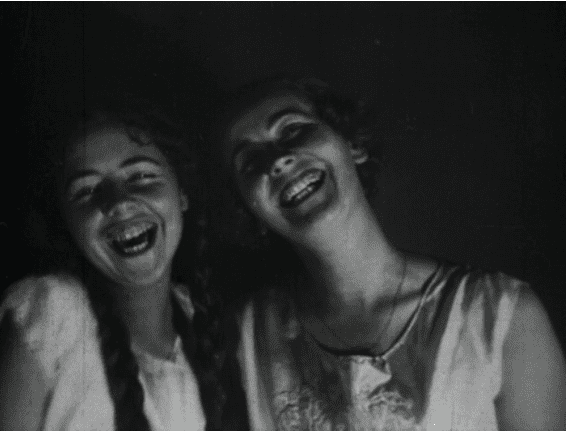
Rigmor, who was only 14 years old when the film was made, appears in a similar way, obviously bursting with joy as she smiles broadly at the camera before tilting her head, and the smile becomes more mischievous. These opening shots of them are unique, as such shots are rare in Icelandic cinema, but they give the audience a chance to get to know Ruth and Rigmor on a personal level. Although the film is set up in a somewhat conventional way with introductory shots where the sisters are meant to be dignified dance instructors, the laughter just below the surface and the playfulness are never far away—qualities rarely captured on film in Iceland, as movies were an expensive medium and not something to be made lightly. This joy is characteristic of Loft Guðmundsson and the spirit that surrounded him, which can be seen in his other films. It is clear that the sisters are enjoying themselves, despite having clear objectives for their dance instruction.
After a close-up of them together, the shot cuts to a wider view and they bow deeply, taking a step back. In the frame, there is an obvious set piece with a window, a window box, and a flower. Rigmor and Ruth are positioned on the left side of the screen, and Rigmor partially steps out of the frame as she steps back to bow. This is a special setup where the dancers almost give way to a beautiful window ornament, which is allowed to be in the shot at Rigmor's expense. The choice of a background with a flower and a window with beautiful curtains was obviously important for the presentation of the image, as it was the first time Icelanders were being introduced to a dance directly from the major cities of Europe in this way. It was therefore only natural to film the scene against a magnificent backdrop, even though only a small part of it is visible.
The dance lesson begins, and we see the sisters in a wide shot taking a few steps together, with the window clearly visible in the background. Then, the camera cuts to close-ups of their footwork, and they show the audience in great detail how the Flat Charleston is danced. When the cut returns to a wide shot of them dancing, it's clear that Ruth is focused on the matter at hand and isn't letting her surroundings outside the frame distract her. Rigmor, on the other hand, stares out of the frame and smiles to herself at something there. Moments like these bring the film to life, making it not only a record of dance in Iceland in the 1920s but also a testament to the unadulterated joy of young Reykjavík girls. Even Ruth, who tries to keep a straight face, gives in and smiles with her sister in the middle of the dance.
The wide shot is a composite of several takes, giving a full but fragmented view of the dance, as the sisters dance back and forth across the stage, smiling and enjoying themselves and even making a few mistakes in their steps, which suggests that film stock wasn't cheap and takes weren't so readily discarded. Then it cuts back to close-ups of their footwork, where we see them from the knees down, showing precise foot movements in beautiful shoes, fine, shiny silk stockings, and elegant dresses. After the close-ups, it cuts back to a wide shot as they finish the dance and take a bow. Then there is a framing shot, a close-up of the sisters as at the beginning. But the shot also sets the tone of the film, as they are laughing heartily and Rigmor looks with a mischievous grin directly at the camera.
Disappearing
In all the coverage of the film, only Ruth and Rigmor were mentioned, and that Ruth had it made or was behind its creation. The cinematographer or where it was filmed are never mentioned, but the film is certainly a collaboration between Ruth and Loft. (23) The media's reaction to the film was mixed. A journalist Indicator said the dance had been good, the picture had been unclear but attendance had nevertheless been good. (24) In The People's Newspaper a journalist said that „the show would have been good if the picture had been clear enough.“ (25) Last show Flat-Charlestone took place on December 10, 1927, and after that, there is no mention of the film in the media. Ruth Hanson, however, continued to run a dance school, perform, travel abroad to learn new dances, engage in charity work, and teach sports and swimming, in addition to getting into a dispute with a Danish dance instructor who came to perform in Iceland. (26) On July 25, 1929, Ruth married the Scotsman William Murray Anderson at the Free Church in Reykjavik and moved with him to Scotland. (27) Aside from a visit to Iceland in 1932, not much more is known of Ruth Hanson, but according to research, she had two children and dedicated herself to being a homemaker in Rutherglen, Scotland, where she died in 2003. (28) Rigmor Hanson took over the dance school from her sister and ran it successfully for decades, becoming well-known in Iceland for dance instruction and entertainment. Rigmor passed away in 2008. Ruth Hanson's life needs to be researched more thoroughly, and an account of the life she led in Scotland must be made, but it is difficult to imagine anything other than that she made her mark there, just as she had so significantly in Iceland during the years 1926–1929. Ruth's legacy is found in the memories of those who took part in her dance classes or attended her balls, in the English Channel swim she completed as the first woman, and in her status as a symbol of the new era and of women's freedom to forge their own paths in Iceland, and especially in Reykjavík. (29) But now, she will hopefully also be remembered as Iceland's first female filmmaker who immortalized her dance steps.
References:
1. The Film Renaissance is a name I use for the period from 1944–1957 when a temporary revival in filmmaking took place in Iceland, and a large number of documentaries, newsreels, short films, and feature films were released. The period is named in reference to the film spring, when continuous filmmaking in Iceland began in the spring of 1980. The film boom is a short and specific period when there was an unusually active film production in Iceland before it „froze“ again. Erlendur Sveinsson divides the period into the documentary years from 1944–1949 and the feature film years from 1949–1957. See: Erlendur Sveinsson, „The 12 Years Before Television and the Film Fund,“ in *The World of Film*, ed. Guðni Elísson (Reykjavík: Forlagið and art.is, 1999), 868–873. The women referred to include composer Jórunn Viðar, who composed a memorable film score for *The Last Town in the Valley* (Óskar Gíslason, 1950), and Sigríður Ármann, who composed dances for the same film. When it comes to actresses, many can be mentioned, including Bryndís Pétursdóttir who played the lead role in Between the Folds of the Sea (Loftur Guðmundsson, 1949), Þóra Borg in The Last Farm in the Valley and Gerður H. Hjörleifsdóttir (A New Role, 1954). Ruth's film was apparently completely unknown until the spring of 2020, when I sent an inquiry to the National Film Archive of Iceland about a rumor I had come across in an article about Svava Hannesdóttir, which mentioned a dance film that Rigmor Hanson had had made in 1930. See: Páll Baldvin Baldvinsson, „The Story of Ágirnd from 1952,“ Fréttablaðið, December 30, 2006, 52. Gunnþóra Halldórsdóttir, a project manager at the archive, then found a 1927 dance film in its vaults which turned out to be this film by Ruth. The Film Archive and its staff have my best thanks for their assistance and cooperation with this research.
2. To understand the position of Icelandic women in filmmaking in a broader context, there is an article by Guðrún Elsa Bragadóttir, “Out in the Cold? Women Filmmakers in Iceland„ is a key text on the subject, where Gudrun Elsa reviews the status and history of women in Icelandic filmmaking and provides, for the first time, a clear picture of both: Gudrun Elsa Bragadottir, “Out in the Cold? Women Filmmakers in Iceland," in *Women in the International Film Industry*, ed. Susan Liddy (London: Palgrave Macmillan, 2020), 179–195.
3. Vísir, September 28, 1926, 2.
4. „Ruth Hanson,“ Reykjavik Sports Club Journal 1, no. 2 (1926), 7. Ruth's younger sisters participated in her performances from the very beginning.
5. New Iceland 2, no. 4 (1905), 21.
6. Thora Friðriksson, „Gerda Hanson – Memorial Oration,“ Morgunblaðið, July 7, 1956, 7.
7. Erla Hulda Halldórsdóttir, Kristín Svava Tómasdóttir, Ragnheiður Kristjánsdóttir and Þorgerður H. Þorvaldsdóttir, *Women Who Choose. A Century of History* (Reykjavík: Sögufélag, 2020), 93–201, direct cit. 152.
8. Examples of this are the reviews of her dance performance that appeared in Morgunblaðið and Vísir on March 14, 1928, which are obviously a rephrasing of the same text, presumably sent to both papers by Ruth: Morgunblaðið, March 14, 1928, 4; Vísir, March 14, 1928, 3.
9. „The Race of the Stacks,“ Weekly Edition of the Alþýðublaðið, July 13, 1927, 2.
10. „A Heroic Swim,“ The Sportsman 2, no. 7–8 (1927), 67.
11. „Ruth Hanson's Dance Performance,“ Vísir, October 13, 1927, 2–3.
12. Vísir, October 6, 1927, 3.
13. Eggert Þór Bernharðsson, „“Oh, you wretched slaves of fashion.„“ On “The Reykjavík Girl„ and Her Role,“ Sagnir 11, no. 1 (1990): 17–18; Guðmundur Kamban, "The Reykjavík Girl," Eimreiðin 35, no. 3 (1929): 215–232.
14. James Nott, Going to the Palais: A Social and Cultural History of Dancing and Dance Halls in Britain, 1918–1960 (Oxford: Oxford University Press, 2015), 1; Mínerva Jónsdóttir and Sigríður Þ. Valgeirsdóttir, The Old Dances for Two Centuries: An Excerpt from Icelandic Cultural History, Volume 1: The History of the Old Dances in Iceland (Reykjavík: No publisher cited, 1994), 170–172.
15. „Dance is my greatest delight,“ Morgunblaðið, July 5, 1963, 17.
16. Mínerva Jónsdóttir and Sigríður Þ. Valgeirsdóttir, The Old Dances in Two Centuries, 170–172.
17. Eggert Þór Bernharðsson, „O you wretched slaves of fashion,“ 18.
18. Erla Hulda Halldórsdóttir, Kristín Svava Tómasdóttir, Ragnheiður Kristjánsdóttir and Þorgerður H. Þorvaldsdóttir, Women Who Choose, 135.
19. Vísir, December 4, 1927, 1 and 2.
20. Morgunblaðið, December 4, 1927, 10. Here is another example of coverage of Ruth that can also be found as an advertisement on the front page of the paper.
21. It was unclear who had taken the picture, but this conclusion is the result of an extensive examination of the backdrops used in photography studios in Iceland during this period and a comparison with the little that is seen of backdrops in the film. Loft's photographs of Rigmor Hanson on postcards eventually led the researcher to the right track, and it is clear that the picture was taken in Loftur Guðmundsson's photography studio. A remarkable book has been written about Loftur Guðmundsson, his life, and his work: *Enginn getur lifað án Lofts* (No One Can Live Without Loftur), ed. Inga Lára Baldvinsdóttir (Reykjavik: National Museum of Iceland, 2002). The book includes an article by Erlendur Sveinsson, “Rather Bend Than Break: On a Pioneer in Icelandic Filmmaking" (19–62), which reviews Loft's career as a filmmaker.
22. Ruth Hanson and Loftur Guðmundsson, Flat-Charlestone, 1927.
23. See e.g.: Vísir, December 4, 1927, 2; Morgunblaðið, December 4, 1927, 1.
24. Vísir, December 6, 1927, 3.
25. Alþýðublaðið, December 5, 1927, 4.
26. I'm not going to go into those disputes in detail here, but Ruth criticized Dan's dancing ability in an article in Alþýðublaðið, he responded in full force, and a debate erupted about the quality of dance performances and instruction, which ended with the newspaper's editor stepping in and banning further publications on the subject. It is clear that Ruth was outspoken, did not hold back her opinions, and was prepared to defend them in the public arena if the occasion arose. See, for example: Ruth Hanson, „Dance Performance,“ Alþýðublaðið, April 30, 1928, 2–3; Viggo Hartmann, „In Response,“ Alþýðublaðið, May 3, 1928, 2–3; Ruth Hanson, „Reply to „Reply to a Farewell,““ Alþýðublaðið, May 9, 1928, 3.
27. „Marriage,“ Vísir, July 27, 1929, 3.
28. „Marriage,“ Vísir, July 27, 1929, 3.
29. See e.g.: „In the export trade, there is no room for romanticism,“ Vísir, April 13, 1967, 9 and 13, here 9; „Telephone Operator Swam to Reykjavík,“ Vísir. Page 2, November 29, 1980, 20.