From the theater to the big screen
The first woman to make a film in Iceland was Ruth Hanson. She made the dance instructional film. Flat Charlestone in 1927 in collaboration with Loft Guðmundsson. (1) Exactly 25 years later, another woman came forward with a film, but it is the first feature film directed by an Icelandic woman, Greed. That woman was named Svala Hannesdóttir.
Greed was premiered in 1952 at a time when women did not have a guarantee of jobs outside the home, although they were certainly beginning to establish themselves better in the labor market and held some high-ranking positions, such as Ásta Magnúsdóttir, the state treasurer, and Teresía Magnússon, the director of the meteorological institute. Increasingly, women questioned the value of „traditional“ homemaking roles and wanted to pursue other paths. But despite increased opportunities and the fighting spirit of women's rights movements around the world, women's rights were still limited, and the prevailing idea was that a woman should take care of the home and leave it to her husband to earn a living outside of it. (2) Ruth and Svala were the first women in Iceland to be directly involved in filmmaking. However, they each only managed to make one film. It was difficult for women to get behind the camera, as almost all those involved in filmmaking were men in steady jobs that could cover the costs of their hobby. Ruth and Svala both chose to make their films in collaboration with pioneers of Icelandic filmmaking, Ruth with Loftur Gudmundsson and Svala with Óskar Gíslason. (3)
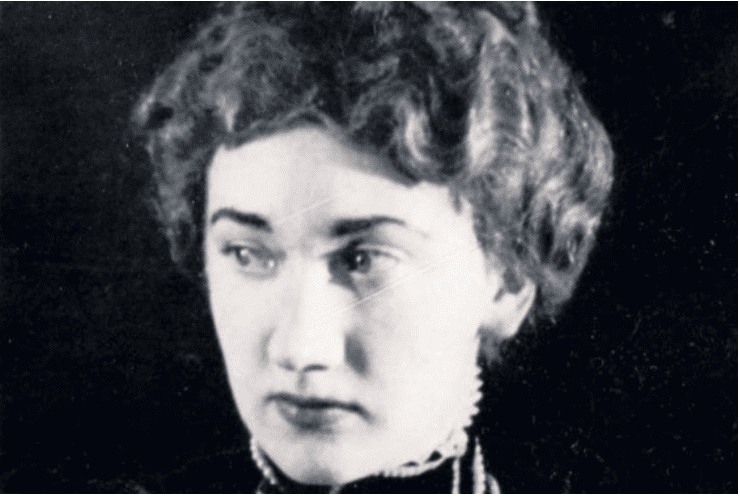
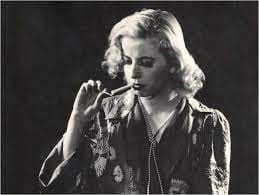
In 1950, Svala Hannesdóttir was studying at Ævar Kvaran's acting school and had landed several roles in radio plays and on stage in productions directed by Ævar. (4) She had talent and wanted to harness it outside of the traditional domestic life; her dream was to work in the theater. While at the acting school, she wrote the mime play Greed which was set up by students and shown at open house events at the school. It so happened that filmmaker Óskar Gíslason expressed interest in filming the mime play. Ævar Kvaran was a good friend of Óskar's, had been involved in the making of some of his biggest films, and was, among other things, credited as director The last house in the valley (1950) and The Reykjavik Adventure of the Bakka Brothers (1951). (5) It was probably through Ævar that Svala and Óskar got together, but Svala acted in his short film, The Magic Bottle (Óskar Gíslason, 1951), which was shown as a featurette with The Reykjavik Adventure of the Bakkabros. The Magic Bottle resembles in many ways Greed since they were both taken on stage in a very minimalist way, but the stylistic devices in Greed were much more aggressive and ventured into the territory of expressionism in description and staging, as will be discussed in more detail below. After their performance in The Magic Bottle Svala acted in a play at the Reykjavik Playhouse and then disappeared almost completely from the scene. (6)
Hereafter, this first feature film directed by a woman in Iceland will be examined and analyzed as an artistic work, the first of its kind made in Iceland. The public and media reaction to the film will then be examined in detail, as it received harsh criticism in the press after its premiere, and also for it, if the case may be. A ban on the film was called for, partly because it depicted officials committing illegal acts, and it was denounced as utter nonsense before the debate quieted down and the film began to be discussed for its artistic merit. Finally, the film's impact on Svala's life and the legacy she left behind in the form of Greed.
A movie about greed
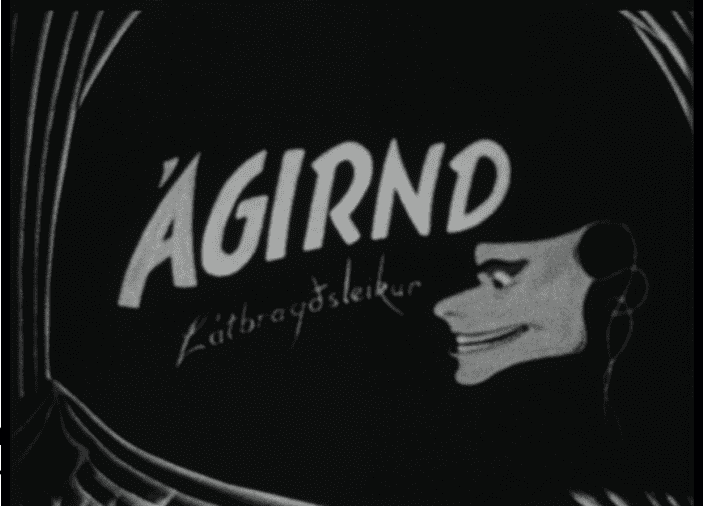
Greed starts with a title card where the film's title is lettered in a slanted and highly stylized font, along with an iconic mask with a cold grin. The underscore is a hard and piercing piano piece, composed by Knut Magnussen, which foreshadows the crime to come without holding anything back. Next comes the cast call sheet, with Svala Hannesdóttir herself at the top, followed by two more sheets with the rest of the cast, all decorated in the film's gloomy spirit with theatrical masks as a prominent motif. The shooting script, a detailed description of how the film is organized, is credited to Thorleif Thorleifsson, Óskar Gíslason's assistant, who was a pioneer in Iceland when it came to creating professional shooting scripts. (7) Svala Hannesdóttir is then credited as the film's director, and finally, Óskar Gíslason is mentioned, who was in charge of almost everything involved in the film's production. When the credits end, a text appears referencing people's greed for pearls and gold, and a voiceover describes this desire and how common it is. That even we, the audience, suffer from an uncontrollable greed for money, even if it is ill-gotten. This is the only speech heard in the film, apart from the same voice that speaks at the end; otherwise, it is all performed through gesture and the powerful music of Knut Magnussen, which guides the audience through its events.
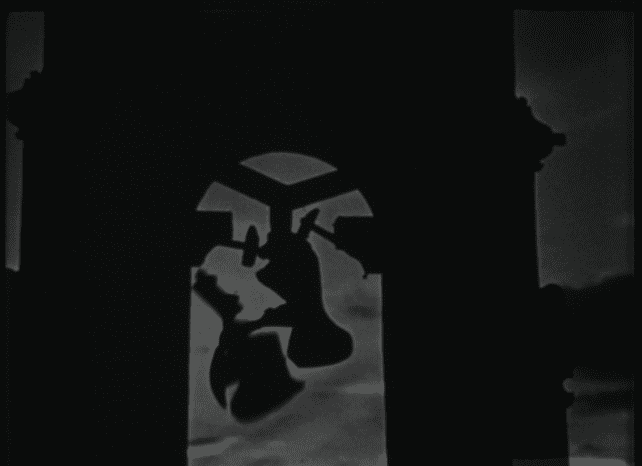
After the words of caution, the scene cuts to a clock tower as the clock strikes eleven in the twilight, but the bell tower is to become an important symbol later in the film and is also the only shot not taken on the stage of the National Theatre, where the rest of the film was otherwise shot. In the next shot, a silhouette of a woman is seen falling onto a canopy bed, and the fabric of the bed is shaped in a very interesting way into a form reminiscent of a female figure.
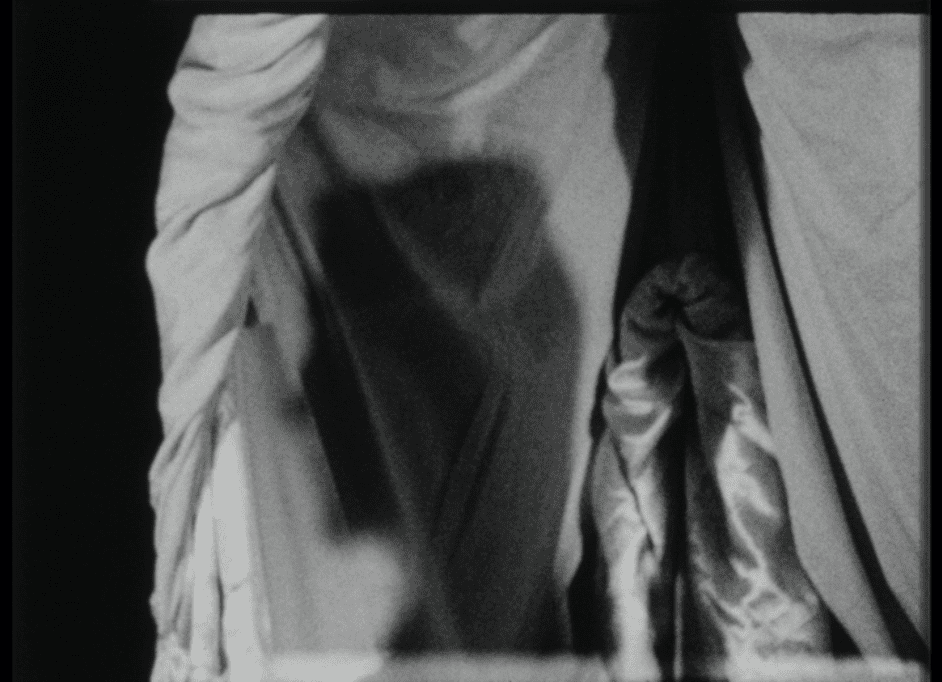
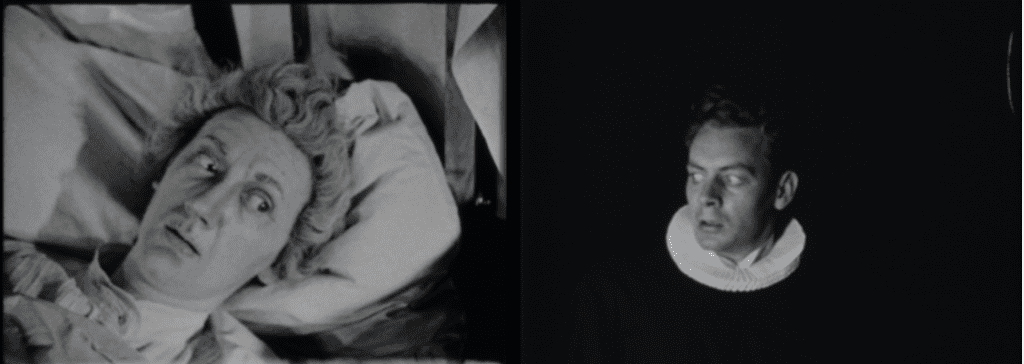
It is exceptionally fitting that the first shot in the first narrative film by an Icelandic woman is with this symbol of femininity, whether consciously or not. Then the camera pans down, and we see an elderly woman lying mortally ill, a light fixture framing her face as a shadow looms over. Self-styled Svala herself plays the woman. She holds a string of pearls in her grasp, the last memory of her deceased husband. Next, we see a nurse standing over her bed, and she obviously covets the string of pearls, but restrains herself and allows the dying woman to hold the string for the last moments of her life. The film's pace is slow and the set design is minimalist, and apart from a few illuminated props, everything is black with high contrasts between light and shadow. Many elements of the set are also arranged diagonally and stylized in a way that clearly references German Expressionism, with strong contrasts of light and shadow, skewed forms, and irregular lines. The exaggerated acting style further enhances both the set design and the emotionally charged narrative. The aesthetics of expressionism were based, in broad strokes, on interpreting characters' intense emotions into the staging in a very dynamic way that often shocked audiences. (8) This fits well with the theme Greed, the human greed for easy money where the light and dark in man clash. The subject matter and style of the film are an excellent match.
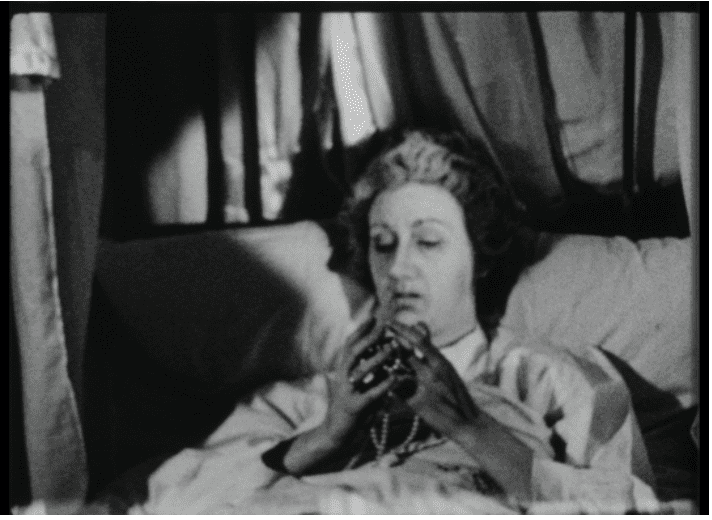
The dying woman holds the pearl necklace, and we are taken back in time with her through memories of her husband, the captain who gave her the necklace. There, she is young and in love, but powerful symbols of death surround her. Her husband's captain's hat is woven together with an image of an hourglass counting down life, and his fate becomes clear to the audience. This is the same hourglass that is nearly empty on the table beside the dying woman. When she receives the news of her husband's death at sea, she, consumed by grief, holds tightly to the pearl necklace as a symbol of the love in her life, and then the camera cuts to her on her deathbed, still holding the necklace. The connection between the present and the past is established through image montage and the deliberate use of symbols.
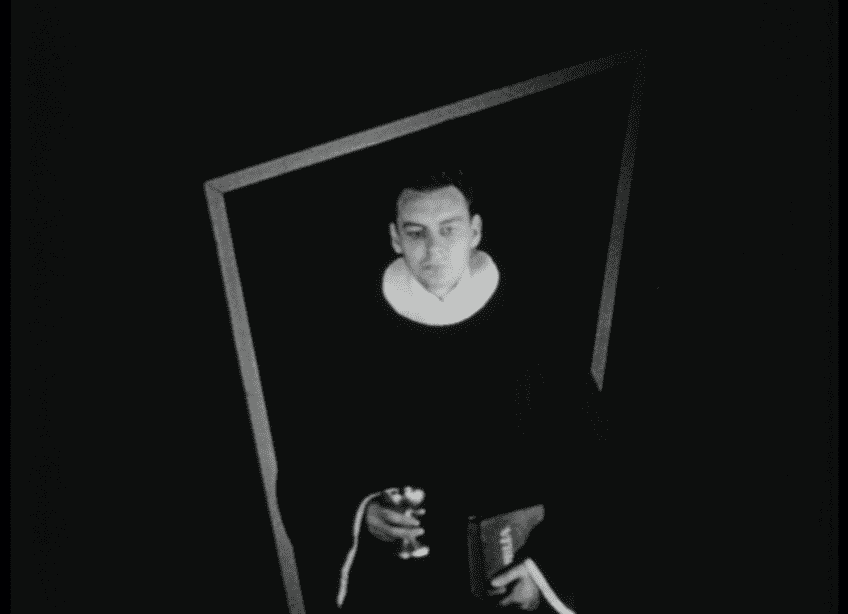
When a priest comes to give the dying woman last rites, it's clear he's not all there. He walks out of the darkness through stylized, askew doors directly toward the camera. He makes the sign of the cross over the woman, but then he sees the rosary and it is clear that he covets it. The film uses a picture-in-picture effect to emphasize the sin dwelling in the priest's heart by juxtaposing the open Bible in his hand with the rosary in the woman's hand. As the hourglass on the table empties and the woman dies, the priest sees his opportunity and takes the rosary from her cold hands, hiding it inside the Bible. Then he walks out quickly, but he looks back as the corpse stares at him, and it is clear that his conscience is gnawing at the priest. Nevertheless, he turns and leaves with the rosary in the holy book.
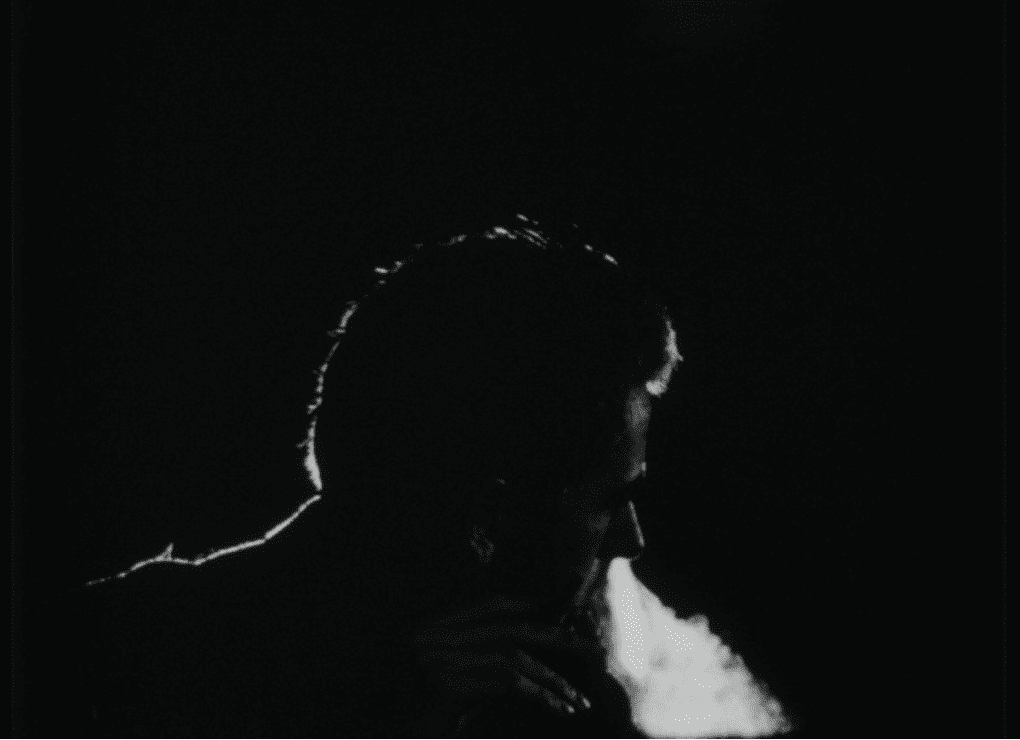
The church steeple from the beginning of the film is seen again, but now in even greater darkness than before, as if the darkness is falling over the world in a literal and symbolic sense. The priest walks through dark streets, where the only light comes from a streetlamp and a crooked, stylized window in the background. A criminal emerges from the darkness, sees the priest admiring the pearls, and kills him with a bare knuckle, robbing him of his faith. It is clear that the priest dies because the camera cuts to the church bell, which is now in complete darkness and we see it shatter. The symbol of faith is broken, the priest is dead.
After the priest is killed, the criminal takes the necklace and wraps it in a page from the Bible. He enters the bar Café Ránardætur where a gambler sits in misery, drinking. A woman offers him her affection, but he drives her away. After that, the men start to play cards, and in a long scene, the gambler cheats the criminal out of the necklace. However, the latter refuses to accept the loss and tries to get the necklace back.
A conflict then ensues that ends with the criminal's death. The player takes the necklace to a jeweler, who buys it for a high price. The necklace is put in a window display, where a woman sees it and asks her husband to buy it for her as a gift. The man says no, but comes back a short time later and buys the necklace.
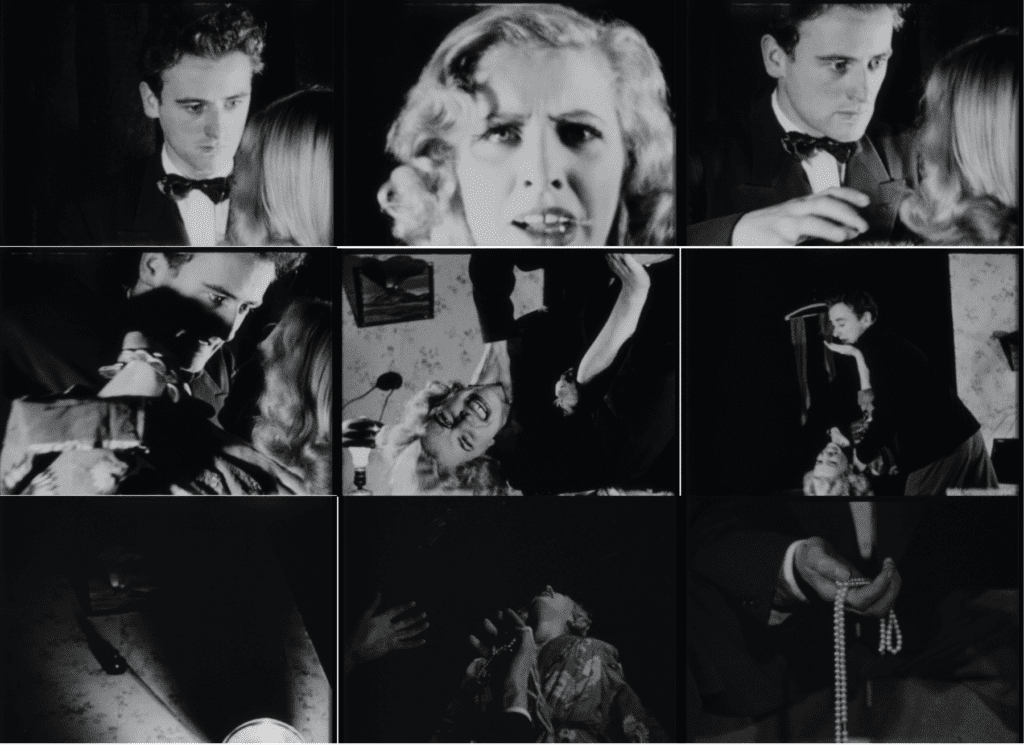
He takes her to his concubine, who is very happy, and they kiss. In a very suggestive cut, we see a picture pasted on the wall above the bed of a volcano erupting a great column of fire and smoke high into the air. Then we see them lying together in bed before a man's hand reaches for a lamp, the lights are turned off, and everything goes black. A woman's hand then turns the light back on, and the woman lies alone and upset in bed with the pearls around her neck, while the man is gone. Her husband, the gambler, then comes home, sees the pearls around her neck, and suspects his wife of cheating. He loses control and walks toward the woman in a very threatening manner. We see her from his perspective, and a close-up of the terrified woman looking fearfully straight into the camera is very powerful. This shot is unsettling and uncomfortably personal. The audience is put in the perpetrator's shoes and participates in the attack on the woman. (9) The man strangles the woman, but instead of us seeing it directly, the death is again alluded to symbolically. A lamp is knocked from a table and swings; hanging by its cord, it casts a dark shadow on the wall, and the strangulation is made clear by the way the lamp hangs like a lifeless body on a gallows. The woman is dead, but the man sits on the bed, regretting his actions, and his crying is symbolically shown by pearls raining from his hand onto a Bible on the floor. He picks up the paper and reads the holy scripture, throws the pearls away, and reflects on the error of his ways. The police eventually arrive and arrest him. A police officer is seen holding the priest's Bible, having thus traced the trail of evidence the necklace left behind. The film ends with a shot of translucent hands trying to grasp the string of pearls, which lies just out of reach, while the voice from the beginning of the film is heard repeating the story's message about humanity's weakness in the face of the temptation of easy money.
The first artistic picture
Working with symbols, metaphors, and artistic expression had not been common in Icelandic cinema until then, as feature films were certainly very few and all driven by conventional plot progression. (10) Greed is in that respect a unique film in an Icelandic context, and one could well say that it is the first artistic film, as it deals more with the ambiguous themes of greed and evil than with a traditional and logical plot. Greed There is no protagonist other than the crucifix and no logical progression other than its corrupting power. The sins of men are presented in the context of religious themes such as the sanctity of priests, the Bible, and a church bell, something that would later greatly offend people after the film's release. The film is different from other films by Óskar Gíslason in this respect, and one can imagine many possible reasons for this. Greed has such a structured symbolic system and artistic vision compared to his other films. One of the most obvious is the participation of Svala Hannesdóttir. Greed can be viewed in the context of another image of Oscar, The magic bottle, which he did a year earlier under similar circumstances, but it was also staged with a minimalist set and special lighting, and Svala even plays a role in it. But it is obviously made on the basis of the narrative, even though Thorleifur Thorleifsson, with his talents, was involved and Óskar directed it. Staging The magic bottle is not stylized and serves a logical plot progression in every respect. It's a shame that Svala and Óskar only made one film together, because if her artistic eye for filmmaking had become as good as Greed Anyone who can testify to that can see how much Icelandic film culture has missed out on.
Media reacts to „immorality“
Chapter from Greed was shown to journalists in late November 1952 and in The Time the film is discussed, where it is called a „horror film“ but its subject matter is also said to be innovative. In a text under a still from the film in the paper, it says:
The picture is from the new Tjarnarbíó horror movie, in which three murders are committed, gambling takes place, and a theft occurs. It shows the bed of one of the murderer's victims, while the others murdered in the movie are a priest, a murderer, and a gambler. (11)
In fact, the movie in question in the quote features Svava Hannesdóttir in the role of the dying woman, and the nurse is standing at her bedside tending to her, so there is no victim. But certainly there were three murders in the movie and other depravity, as a journalist Of time places great emphasis on. This was done, among other things, with the tagline: „3 murders, gambling, and thefts in an Icelandic movie.“ The film, as mentioned, immediately attracted a great deal of attention for its subject matter and for daring to cross boundaries of decency that other Icelandic films had not even come close to. Only in The People's Will Mention was made of how stylized the film was and its distinctive description, but otherwise the focus was on its subject matter. (12)
A very specific and extreme tone was therefore set in all the coverage of the film, as would later become even more apparent. Before the film's premiere, Tjarnarbíó issued a statement saying that although it would be showing the film, the theater had nothing to do with its production. The film would simply be shown there after the film censorship board had reviewed it. (13) On December 5, 1952, Greed so premiered at Tjarnarbíó and had a sixteen-year age restriction for the film. The next day, reviews, opinions, and critiques appeared in the newspapers. In The People's Will the film was described as a doomsday delusion like nothing that had ever been “captured on film, neither here nor elsewhere, neither before nor after, and the less said about it, the better." (14) In The Morning newspaper took nothing better, but the judgment ended with the following words:
There is a perfect reason to investigate whether a picture like „Lust“ does not violate the law, as it pertains to, for example, priests. There is also a perfect reason to consider whether such pictures should be banned, just as is now the practice for the coarser type of pornography. (15)
The idea had thus emerged that the film should be banned, and it was clear that public opinion was not in its favor, and parties connected to the film began to disown it. On December 7, it was published in The Time A press release from National Theatre director Gudlaug Rósinkranz, in which it is made clear that the film has no connection to the theatre; it was filmed there during the theatre's summer vacation. Had it been known what was happening during the film's production, any assistance for its production would have been denied. On the same day, actor Thorgримur Einarsson published a notice in the papers stating that he had not participated in its production, but that it was his namesake who was listed in the playbill. (16) In The Morning newspaper the film was described as nonsense and a fabrication, and it was also asserted that the fact that Tjarnarbíó, which was run by the University of Iceland, would take such an outrage to show could hardly be classified as cultural activity or show such an institution the respect it deserved. It was also not considered likely that Icelandic filmmaking would earn any respect or popularity with such crime films. (17)
On Saturday evening, December 6, the police chief asked Óskar Gíslason to postpone the Sunday screenings of the film, thereby giving the police room to examine it and assess whether it was necessary to either ban or censor it. (18) The film was therefore taken out of circulation on Sunday, December 8, while the police examined its content. On Monday, it was allowed to be shown again, as the conclusion was that it was not worthy of a ban. But Tjarnarbíó had become disinterested in the film and did not want to show it, so it had to suspend screenings for a few days. In an article about Greed which appeared in The Time On Tuesday, December 9, the film was spoken of in extremely ugly terms, and was called at once an unremarkable, corrupting, and disgusting piece of trash that should rightfully be banned, as it is unhealthy for anyone who watches it. Towards the end of the article, the anonymous author then asks how it can be that the film's creator is a young girl, stating that it is surprising that such a girl could be found in Iceland as to be able to put together such a disgrace. (19)
Actors calm down
Obviously, Svala Hannesdóttir took all this harsh criticism to heart. It was a free-for-all, even Ævar Kvaran wrote to the papers disavowing all connection to the film, without, however, criticizing it in any way, as Ævar, Óskar, and Svala were good friends. (20) Svala then resorted to answering her critics in an article she published in Clue on December 11. There she speaks specifically about the campaign that journalists Of time They attacked the film, which Svala describes as the journalists„ “mental disorder.„ She calls their campaign the worst form of tabloid journalism, with lies and innuendo against the film and its makers, without them having seen it. Then, the film's detractors overlooked certain key points in the frenzy. The purpose of the story was not to glorify the man's immorality but rather “the story was intended as a satire on unbridled greed, and its potential consequences." She is sorry that so many seem to be trying to willfully misunderstand and misinterpret its message, which should be relatable to most, because the film ends with the man reading the page from the Bible that had accompanied the feast after he had strangled his wife and taking the message of the holy scripture to heart. Svala also criticizes the anonymity of those who judged the film most harshly, but Time did not want to reveal which journalists had written about the film. (21)
After Svala's response article, the discussion about the movie seems to have fizzled out and in „Evening Thoughts“ Indicator On December 13th, speculation continues as to why the hype surrounding the film became as great as it did. The columnist found the film unremarkable but hardly half as good as many foreign films that theaters regularly showed. The thoughts continue with a more considered look at the film than before:
Considering Icelandic circumstances, the movie is not badly made, although there is some room for criticism. The sets or stages in the film seem decent, and it is completely absurd to try to suggest to the public that there is some malicious element involved with the film. (22)
The journalist then believes the film is being unfairly attacked with writing that is far more tasteless than the film itself could be considered, but that it will likely subsequently become popular with the general public, who will flock to the theaters to see the disaster.
On the same day, calm settled over the discussion with „Evening Thoughts.“ Indicator The film was advertised again for a screening, but not at Tjarnarbíó, rather at Hafnarbíó. (23) Hafnarbíó was known for showing B-movies and other films that other movie theaters were not interested in showing. The theater's advertisements capitalized on the buzz and the film's controversial nature, as it clearly had an appeal, and it was obvious that a certain segment of the population has always been drawn to the tasteless and exciting in movies. (24)
Óskar Gíslason mostly stayed out of this discussion, but he wrote to Velvakandi The Morning Newspaper a letter dated December 10, which was not published until the 18th, in which he discusses the police's involvement with the film and that it would soon be shown in another movie theater. He says the reaction to the film has been „amusing“ and does not seem to be very bothered by it. (25)
A fitting end to the uproar surrounding Greed it then came in the form of a movie review Indicator on St. Thomas Day, where the artistic merit of the film is praised for the first time. There is every reason to publish the review in its entirety:
Then finally after the break, the animated film. Greed, which has scandalized the best citizens. The film was written by a young actress, Svala Hannesdóttir, and she plays one of the roles. Greed is symbolically shown through the story of the necklace, which changes owners; although this happens silently and without a sound, the path of the pearl necklace leads through a casino, and men fall in droves. I could not see that the film needed to become a scandal for our virtuous citizens. As for the casinos, I suppose most people are aware of them, except perhaps for a few men on Pósthússtræti. But the murders—they are, of course, symbolic in nature and show that human nature is always the same. Greed can manifest itself in various forms. In the hands of a more mature author, the plot would undoubtedly have been handled differently. But the film as a whole is a new and bold attempt in the art of interpretation, and it succeeds with many of the actors. Among them are Svava, Þorgrímur Einarsson, and Knútur Magnússon. The usurer was also amusingly portrayed by Óskar Ingimarsson, and needless to say, the film is highly suspenseful. I find this attempt so remarkable that I do not hesitate to encourage the many artists not to be overwhelmed by the vitriol of their furious fellow citizens. However, perhaps the filmmaker could reduce the number of murders in the next film, without the artwork suffering greatly for it. But good artists, try to get yourselves a veteran film director, then half the battle is won. (26)
With these words, the bottom is knocked out of one of the greatest fiascos ever to surround an Icelandic film in history. (27)
The film was not forgotten so easily, because due to popular demand, it was shown again at Hafnarbíó in February 1953, and then Óskar traveled with it to Akureyri in the same month and showed it in the town. (28) Óskar later mentioned it in interviews, and it was clearly memorable to him. (29) The film was next shown when the television channel held a gala screening of it in 1979 with an introduction by Erlendur Sveinsson. (30) The film was shown again in 1980 at the Icelandic Film Week in Reykjavík. (31) In a promotion for the film at the 1985 Women's Film Festival, it was described as a true pioneering work by a woman in filmmaking, as its director and screenwriter were both women. (32) Svala and the film were discussed in detail in a 2006 radio program by Viðar Eggertsson on the National Broadcasting Service, after Kristín Jóhannesdóttir had mentioned Svala in an interview with him, prompting him to create the program. In it, Viðar tries to get to the bottom of the film's production Greed and the story of Svala Hannesdóttir through interviews with those who knew her. (33)
After the frenzy surrounding the film, Svala did not make another movie, and it seems the harsh criticism affected her. Although she had withdrawn from movies and acting, she made occasional appearances. In 1955, she hosted the variety show At the same time on the radio to very good reception. In a letter to The Will of the Nation the question was asked why a woman of such talent as Svala did not get proper opportunities to let her light shine, as she was a versatile actress. (34) But Svala received no other roles on stage or in front of the cameras. She was involved in radio poetry readings, translations, and their narration for decades, but she never had it as her main job. It is clear that Svala's talents were great, and she was a skilled craftswoman when it came to the artistic creation of works, as her translations of poetry and short stories testify. Svala died in 1993 and was unfortunately not mentioned in any obituaries or covered by the media. But with increased coverage of Greed And with awareness of its value as the first artistic image of Icelanders, the name Svava will live on for generations to come.
Final words
By making Iceland's first artistic film, Svala Hannesdóttir established herself among the pioneers of filmmaking in Iceland. She made the film in collaboration with another pioneer, Óskar Gíslason, and the result was as explosive as has been noted above. Women in filmmaking were few and often disappeared into the shadow of their male colleagues, and so it remained for a long time. Greed. The importance of researching the role of women in filmmaking is obvious; women are few in film history, but their place in it needs to be clear and well-researched. Women's participation in filmmaking was quite sporadic early on and after the Greed was the next film by a woman, and the first feature-length film, not made until 1982 when the artist Róska made the film Icelandic Rose (Róska, 1982). Since then, women have directed about 10% of all the films made in the country. (35) This is an extremely low percentage that will hopefully change, but it also makes the role of Svava, as well as that of Ruthar Hanson, all the more important as pioneers in the history of Icelandic cinema.
References:
1. Gunnar Tómas Kristófersson, „Immortal Dance Steps: Ruth Hanson and the Dance Film,“ Saga 54, no. 2 (2021): 7–17.
2. Erla Hulda Halldórsdóttir, Kristín Svava Tómasdóttir, Ragnheiður Kristjánsdóttir and Þorgerður H. Þorvaldsdóttir, Women Who Vote: A Century of History (Reykjavík: Sögufélag, 2020), 278–279.
3. To understand the position of Icelandic women in filmmaking in a broader context, there is an article by Guðrún Elsa Bragadóttir, “Out in the Cold? Women Filmmakers in Iceland„ is a key text on the subject, in which Guðrún Elsa reviews the status and history of women in Icelandic filmmaking and, for the first time, provides a clear picture of both: Guðrún Elsa Bragadóttir, “Out in the Cold? Women Filmmakers in Iceland," in *Women in the International Film Industry*, ed. Susan Liddy (London: Palgrave Macmillan, 2020), 179–195.
4. See, for example: Tíminn, May 19, 1951, 2; „Leikfélag Reykjavíkur: Pi-Pa-Ki or the Song of the Lute,“ Vísir, December 27, 1951, 4 and 6.
5. A tradition has developed of crediting Óskar as the creator of the films he was involved with, as he generally directed the filmmaking, along with his assistant Þorleifur Þorleifsson, while Ævar Kvaran directed the actors and was titled director. It is now difficult to conclude about the making of *Greed*, and various stories circulate about who should be considered its author. It is generally difficult to consider films the work of a single author, as the work of many people goes into a single film, and the same is true in the case of *Greed*. It is clear that the film's stylistic approach is very different from what Óskar had done before, as are its subject matter. The biggest change in that regard is Svala Hannesdóttir in the director's chair. With that in mind, it can be concluded that her contribution is present in the film and that it is the first directorial debut by a woman in the history of Icelandic feature films. This is not intended to diminish Óskar Gíslason's contribution to the film, as he is also credited with its production, but his legacy regarding *Greed* lies in paving the way for the first female director of a feature film in Iceland and working on the film in collaboration with Svava and as a producer, director of photography, and distributor.
6. Vísir, December 27, 1951, 4.
7. Thorleifur Thorleifsson was a great talent, but he left a very small footprint despite having taken an active part in Óskar Gíslason's filmmaking. Thorleifur is a man who needs to be studied more closely, but that will have to wait for a better time.
8. For a very good and general overview of the aesthetics of German Expressionism in film, see: David Bordwell and Kristin Thompson, Film History: An Introduction (New York: McGraw Hill, 2003), 103–109.
9. This can be well placed in the context of Carol J. Clover's theories about women who are punished for crossing sexual decency boundaries in slasher films (which is a subgenre of horror). Clover specifically discusses Marion Crane in Psycho (Alfred Hitchcock 1960), who is killed for crossing these boundaries. In the murder in *Hannibal*, the audience is also put in the killer's shoes with point-of-view shots, as is common in horror films. Post-coital murders are also particularly common in slasher films, as is the case in this scene. See Carol Clover, Men, Women and Chainsaws: Gender in the Modern Horror Film, (Princeton: Princeton University Press, 1992), 32–33 and 62–63. Obviously, *Greed* is not a slasher or a horror film, but it is interesting to see how elements that would later become part of the slasher tradition and horror films in general are used to draw the audience into the role of the perpetrator, thereby intensifying their participation in the film's crimes. All of this is a testament to the avant-garde and innovative methods used in the making of *Hitchcock*.
10. Björn Ægir Norðfjörð, „Light in the Darkness: The History of Filmmaking in Iceland,“ Ritið 19, no. 2 (2019), 19–42, here 24–25.
11. „3 murders, gambling and thefts in an Icelandic movie,“ Tíminn, November 29, 1952, p. 2.
12. „New Films: „Greed“ and „The Universal Champion“,“ The Nation, November 29, 1952, 8.
13. Vísir, December 2, 1952, 2.
14. „The Less—the Better,“ The Worker, December 6, 1952, 6.
15. „Miniature Exhibition at Tjarnarbíó,“ Morgunblaðið, December 6, 1952, p. 5.
16. „The National Theatre Has No Part in the Crime Film,“ Tíminn, December 7, 1952, p. 1.
17. „Velvakandi,“ Morgunblaðið, December 7, 1952, p. 8.
18. „Greed“ examined in more detail, Vísir, December 8, 1952, 8. 30 years later, Óskar discussed the involvement of the church and the bishop in the campaign against the film, but it needed to be researched further, see: “„Rejoices in this growth in Icelandic filmmaking,““ Tíminn, July 20, 1980, 14. See also: Kristín Svava Tómasdóttir, Stund klámsins: Klám á Íslandi á tímum kynlífsbyltingarinnar (Reykjavík: Sögufélag, 2018), 112.
19. „The crime film so insignificant that it is not worth banning,“ Tíminn, December 9, 1952, 1 and 7.
20. Ævar Kvaran, „Ævar Kvaran Denies Involvement in the Crime Film,“ Tíminn, December 10, 1952, 2.
21. Svala Hannesdóttir, „The “Unremarkable“ Picture Provided the Material for the Main Story," Vísir, December 11, 1952, 5.
22. „Evening Thoughts,“ Vísir, December 13, 1952, 5.
23. Alþýðublaðið, December 13, 1952, 2.
24. Tíminn, December 14, 1952, 6. Much has been written about the appeal of films that aim to shock people. One of the most famous articles to have appeared on the subject is probably: Jeffrey Sconce, „´Trashing´ the Academy: Taste, excess and an emerging politics of cinematic style,“ The Cult Film Reader, eds. Ernest Mathijs and Xavier Mendik (New York: McGraw-Hill, 2008), 100–118.
25. „Velvakandi,“ Morgunblaðið, December 18, 1952, p. 8.
26. Sv. B., „Óskars Gíslasonar,“ Vísir A, December 23, 1952, 8.
27. For a discussion of the screenings of controversial films and the reactions to them, see Kristín Svava Tómasdóttir's book *The Age of Pornography*. There, she discusses in detail the reactions of Icelanders to pornography and other „immorality“ in a broader context, and how many films were condemned by society as well as the courts under the banner of moral rectitude. Also, see Björn Þór Vilhjálmsson's article on the film blacklist that emerged in the 1980s: Björn Þór Vilhjálmsson, „“A Lawless Bloodbath Without Artistic Purpose“". The Icelandic Blacklist and the State Film Censorship," Ritið 19, no. 2 (2019), 69–133.
28. Tíminn, February 5, 1953, 6; Verkamaðurinn, February 13, 1953, 3.
29. Gylfi Gröndal, „We Used the Movie Van for Turf,“ Vikan 29, no. 22 (1967), 24–27 and 40–42, here 41.
30. „An Icelandic film from 1952,“ Þjóðviljinn, February 20, 1979, 13.
31. Tíminn, March 28, 1980, 18.
32. NT, October 16, 1985, 26.
33. „The Story of Greed from 1952,“ Fréttablaðið, December 30, 2006, 52.
34. „The Town Post,“ The People's Will, April 23, 1955, 2.
35. Guðrún Elsa Bragadóttir, “Out in the Cold," 180 and 183.