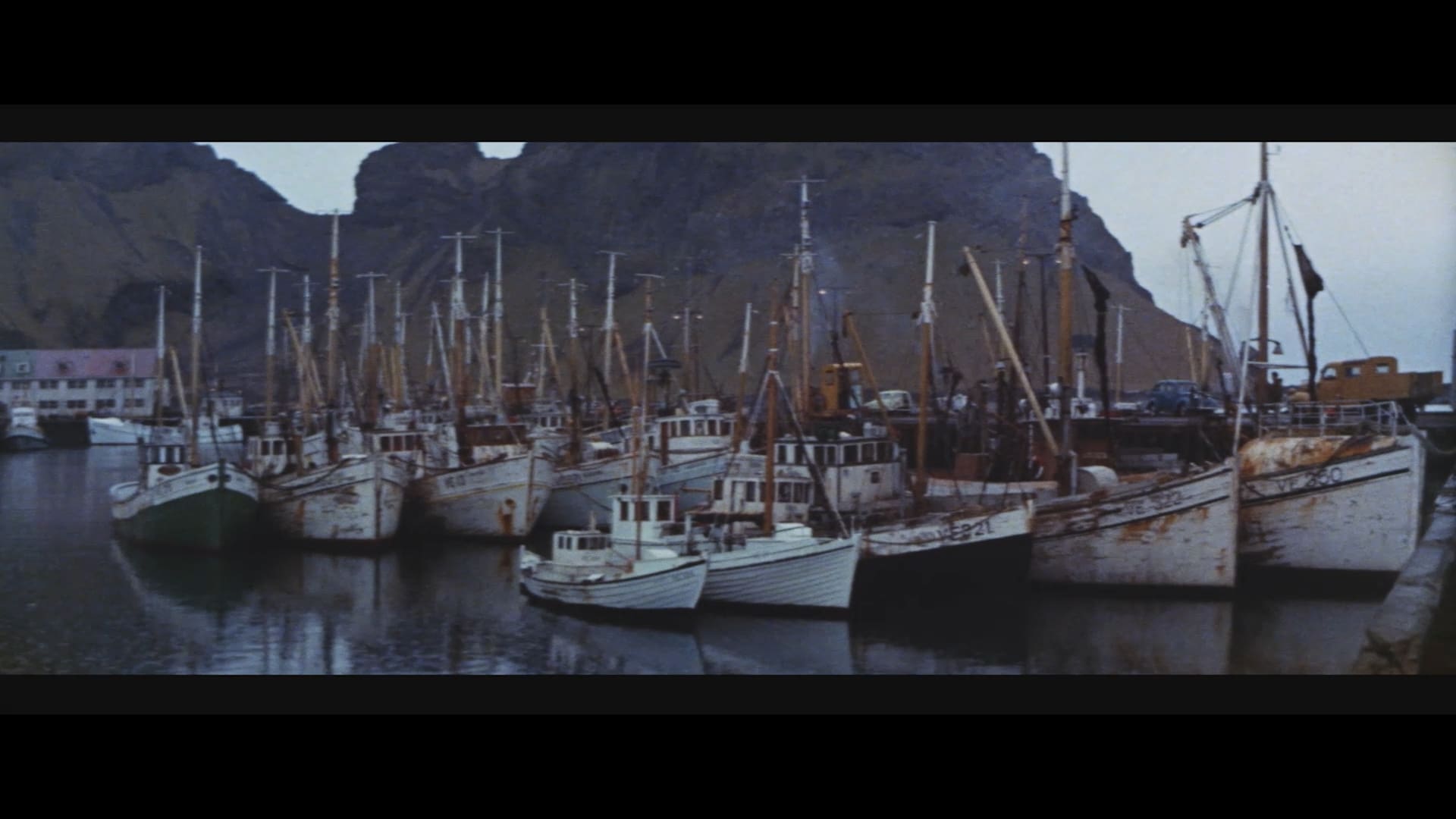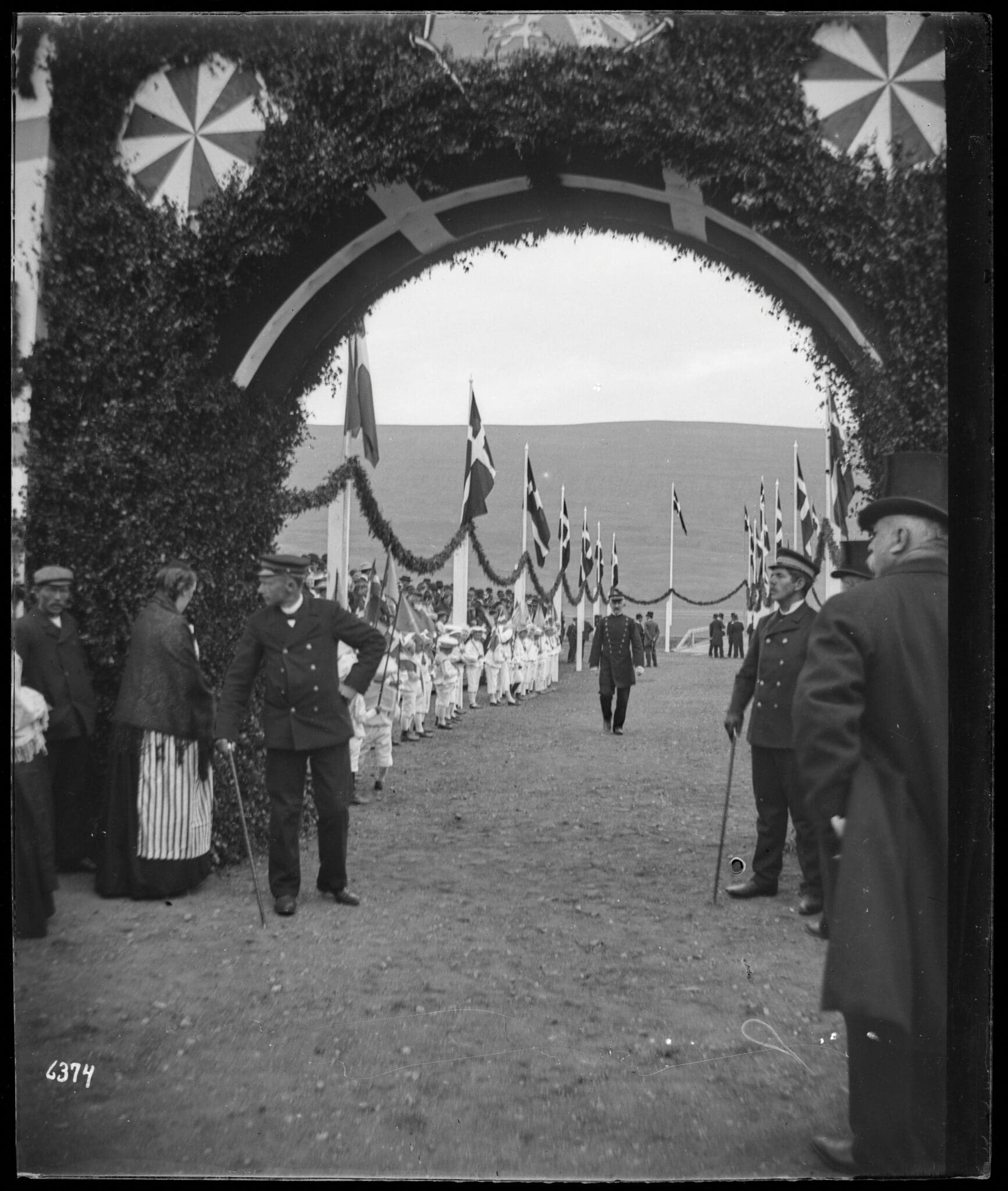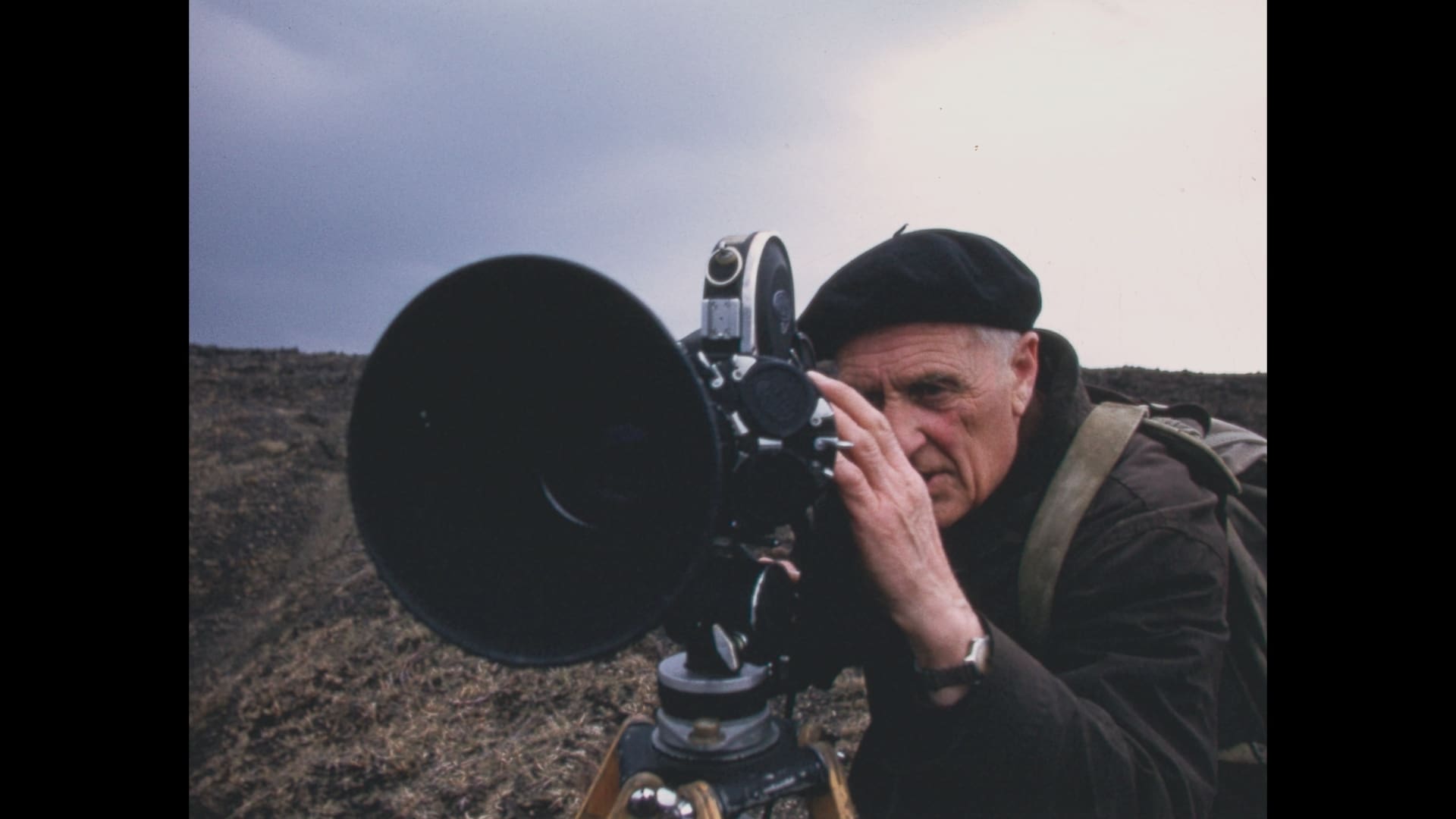
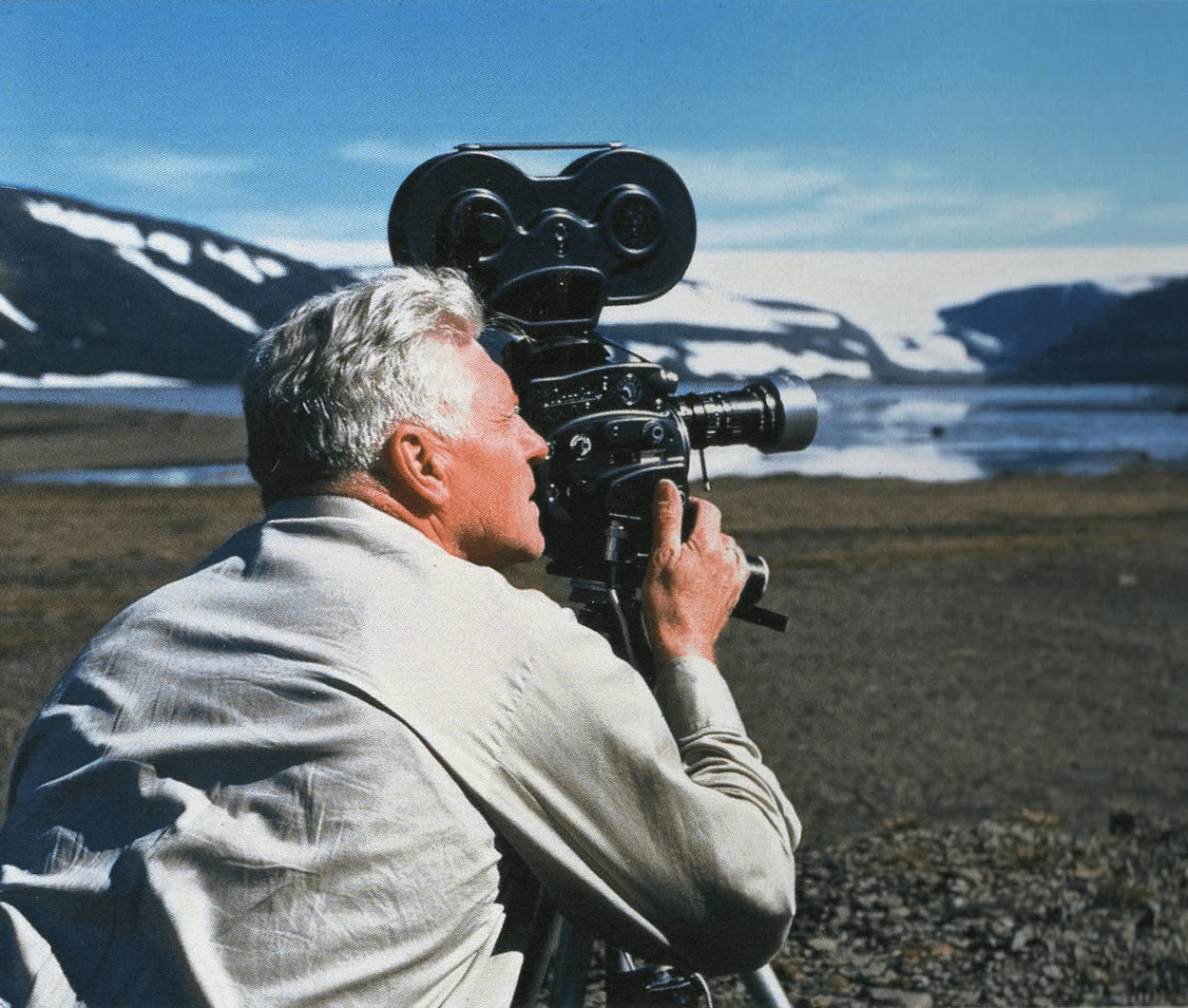
Magnús Jóhannsson (1912-1997), a radio engineer, was a man of great importance to the history of Icelandic cinema. He was a pioneer of film preservation in Iceland, and if not for his pioneering work in that field, the nation's film heritage would likely be much poorer than it is. He was a man of many talents with a wide range of interests, spanning everything from ornithology and glacier research to telecommunications, filmmaking, and its related technical matters. He was a man of many talents and a broad range of interests, spanning everything from ornithology and glacier research to telecommunications, filmmaking, and its related technical aspects. He was artistic and skilled with his hands, drawing both houses and cars, and of course, the logo for his company, Falcon Films.
Magnús founded and ran the Radio & Electronics Institute at Óðinsgata 2 in partnership with Sveinbjörn Egilsson, where the partners worked on technical inventions, created in-house intercom systems for businesses, they handled the modernization of the transcription of parliamentary speeches at the Althingi in 1950, dubbed films, and created educational materials for elementary schools, to name just a few.
Magnús's interest in nature led him to filmmaking, and in 1966 he became the first chairman of the newly founded Association of Filmmakers (FK). He was the first Icelandic filmmaker to have a film shown at the Cannes Film Festival in 1954 (the Cannes Festival was first held in 1946). The following is an overview of his work in different fields, which are partly divided into different periods of his life. Family traditions here.
The Man and the Years at the National Broadcasting Service
Magnús grew up in a remote rural area on the farm Skjaldfönn in the inner part of the Ísafjörður Fjords. It soon became clear that his interests lay elsewhere, and telecommunications technology quickly captured his full attention. He was only a teenager when he ordered walkie-talkie kits from Danish magazines that Sigvaldi Kaldalóns, a fellow villager, doctor, and composer, gave him when he moved away from the countryside, ...and ran wires between the barn and the house on Skjaldfönn in an effort to improve the farm's communications. The die was cast there, for in one way or another, this interest in technology would come to define Magnus's life's work.1
In the fall of 1932, Magnús moved to Reykjavík and learned radio mechanics at the Radio Repair Shop. Immediately afterward, he began working as a station operator at the longwave station on Vatnsendahæð and worked there continuously from 1933 to 1943. There he met Sveinbjörn Egilsson, master radio technician, and his family, as Rannveig, Sveinbjörn's wife, handled the cooking for all the station's staff.2 The friendship that formed between Magnus and Sveinbjörn there was to last a lifetime, and it was not least a shared interest in new technology that bound them together.
In 1942, Magnús passed the final exam as a radio operator.3 and now he was ready to begin a new chapter in his life as an independent businessman in the capital. Reykjavík in the 1930s after the war was characterized by major construction and changing work patterns. The modern era was making its entrance into the city.
Radio & Electronics Shop 1943-1976
Magnús Jóhannsson and Sveinbjörn Egilsson founded the Radio & Electronics Institute in 1943. At that time, the Postal and Telegraph Administration had only granted four private individuals in Reykjavík the right to perform radio and telegraph repairs, and Sveinbjörn was one of them.4 Their competitive position was therefore quite good, as comparable companies were few, although their number was set to increase somewhat in the coming years. They also had good connections with the National Broadcasting Company and its institutions.5
Since the establishment of the State Broadcasting Corporation in 1930, it was authorized by law to operate an appliance business that also had an exclusive sale of radios from its own production.6 There was an import ban in Iceland, and the idea behind the State Appliance Store was to secure good deals on appliances from foreign manufacturers through bulk purchases. The State Equipment Trading Company and the Repair Shop were established, and soon after, the Repair Workshop was added, all run by the state. The purpose of these institutions was to handle repairs and modifications of radio equipment.7
The Device Store was later changed when private individuals were allowed to import devices, but they then paid a so-called exclusive sales tax, 30% of the devices' import value, to the State Device Store.8 The State Repair Shop was abolished in 1960, and a year later the state's monopoly on the importation and sale of radio equipment was abolished, thereby dissolving the State Radio Equipment Store after 37 years of operation.9
1) Radio & Electronics Shop – Operations
In the beginning, the main projects of the Radio & Electronics Institute involved the installation of communication systems (e.g., internal telephones and paging systems).10 in companies on the one hand11 12 and sound recording, sound editing, and equipment repairs on Óðinsgata, however. There was a division of labor within the company, with Sveinbjörn managing the business and installing call systems in institutions and companies, while Magnús handled sound recordings and went on buying trips abroad. Soon, Magnús's film production took up a significant part of the company.13 Later, he was seconded to the Althingi for a time before he was later made a permanent staff member of the parliament. Otherwise, Sveinbjörn and he worked together on most of the projects the company took on and spent countless hours together there.14
They were always quick to secure agency for various film and telecommunications equipment, and they operated an electronics store as well as a repair and maintenance service for the equipment they installed throughout the region.15 At their peak, they also had people working for them.16
They were always at the forefront, i.e., the first to have the latest equipment, and were not afraid to assemble all kinds of electrical, radio, and communication devices. In the beginning, while import restrictions on film production equipment were still in effect, they imported the insides of T.e.g., radios, amplifiers, speakers, and microphones (their operating license actually permitted this import), had cases made for the equipment, e.g., at the Metal Foundry in Hafnarfjörður, and then assembled them themselves.17 Later, Magnus's main film production agencies were: Eclair television cameras, Steenbeck film editing tables and sound equipment, and Shure microphones. Even later came G.B. – Bell & Howell, Revere, Scotch, and Stansil Hoffman. Later, they also imported Danish LL television sets.18
The company's undying technical curiosity was crucial to the development of filmmaking in the country, especially during times of import restrictions, when people who don't let such things stop them from pursuing their ambitions become extremely important. Thus, the company was the first to introduce certain technologies to Icelanders more than once, and Magnús was not sparing in telling about them, both in speech and in writing.19
2) The Radio & Appliance Store and the General Electric steel wire device
Film production is the art form most dependent on equipment and technology. Not only are both needed to present the works, but the change in equipment and technological development has generally had a great impact on the history of filmmaking. The transition from black and white to color and the leap from silent films to sound films are well known, but the equipment was cumbersome and limiting.
It was therefore somewhat newsworthy when audio recorders came to market that offered off-site recording without a connection to a rocket station.20 This new device could be used for both recording and playback. It was Radio & Electronics that took the lead and introduced this innovation to Iceland, the steel wire.21 A press conference was called at the facilities of the Institute of Electrical Engineering on July 12, 1946, to introduce this marvel.22 which was primarily described as the successor to the lacquer plate in terms of strength and durability, but which nevertheless had several advantages over it; for example, its length is limited only by the length of the wire, and it is not uncommon for steel wire coils to have a playback time of about an hour. Additionally, the sound quality is better and free of the hiss of lacquer discs. Another advantage is that the steel wire can be reused, i.e., the recording can be erased from it and reused.23 The device, which was an American invention by engineer Marvin Camras, was not entirely new.24 but the need for in-flight recordings by the U.S. Air Force underpinned the development of steel wire technology and equipment.25 Magnús tells the story as follows:
„In 1945, technical publications reported that a „magnetic wire recorder“—later most often called a steel wire recorder—would soon be on the market and could become a household item. General Electric was among the first to advertise—and we ordered immediately.
The GE steel wire recorder arrived in the country in May 1946. The first important recording was at the 100th anniversary of the Reykjavík High School on June 17 of that year, and then the handover of the Reykjavík Airport on July 6, when Ólafur Thors took the key.
The next significant eruption was then the 1947 eruption of Hekla. On the first day of the eruption, we got a converter from the batteries to provide 110-volt AC and used it in an airplane and a car. We interviewed people near Hekla, and through all of this, the usefulness of steel wire for sound recording came to prominence.„26 27
Various people wrote in the Icelandic newspapers about their experience of Magnús and Sveinbjörn's presentation of the device and the sound recordings they had prepared for it. Thus, Víkverji wrote: ,...a short while ago I saw one of the marvels of modern technology at a private company here in town, and I was surprised that the State Broadcasting System hadn't acquired such a device and put it into use long ago.“28 The device is then praised for its simplicity and small size, while at the same time delivering excellent recordings. In 1948, the National Broadcasting Company finally acquired such a device.29
Víkverji 1947 also writes about passengers on their way to Hekla, a Loftleiðir airplane: ,There was a scientist there with a recording of the Hekla lava flow on a steel wire in one hand and a film canister in a bag in the other. He is going to show his colleagues in the neighboring countries the magnificent natural phenomenon.“30 This comment is particularly noteworthy because it can be interpreted to mean that the scientist in question obtained both the film and the steel wire sound recording here in the country. At that time, several cinematographers were active, but there is no evidence that anyone other than Magnús Jóhannsson could have recorded and provided the man with sound on steel wire.31
Many people thought that the steel wire technology would become widespread and would be widely used, for example by journalists and in schools.32, The device would also be good for all kinds of voice exercises or for re-editing radio material and corporate advertisements.33 In practice, it was not used for very long because another, better invention soon came to light: the magnetic tape. A major drawback of the steel wire was that it tended to break, getting shorter with each repair, and therefore it was not well-suited as a playback track for sound films. An example of this is *The Last Town in the Valley* by Óskar Gíslason, a sound film with original music by Jórunn Viðar. After the wire had worn out from the numerous screenings of this popular film, the entire soundtrack had become distorted. Eventually, at the urging of Jórunn's descendants, who were very unhappy with the fate of the soundtrack, the film was remastered and the audio was placed in the correct spots.34 The last town in the valley It was voiced at the Raftækjastofan in 1950 and was likely one of the last works produced there using that technology.
3) Radio & Electronics Institute – Recording Director of the Althingi
In 1947, 1948, and 1949, Magnús went to America and examined all kinds of sound recording equipment, either for himself (Radio & Raftækjastofuna) or for the Althingi. In the article Technological Development in the Althingi35 He recalls traveling to New York on behalf of the Althingi to select suitable recording equipment, a tape recorder, for recording parliamentary speeches. Previously, an attempt had been made to use a steel wire recorder acquired by the Broadcasting System in 1948, but it was not found to be adequate.
Those radio and electronics engineers had already begun to approach several American companies that produced tape recorders and duplicating machines for magnetic tape and informed the Althingi about that technology. In January 1949, Magnús went to New York to inspect and purchase equipment for testing at the Althingi before a final decision was made on further equipment purchases. He chose Twintrax long-play machines and Shure microphones. Tests went well during the first half of 1949, and the Radio & Electrical Engineering Institute was asked to submit final recommendations on the recording system and duplication equipment, along with a tender specification. However, it was not until March 1952 that progress was made, as it had been decided to begin recordings in October of that same year, as Magnús states verbatim in the aforementioned article:
„At the request of the Joint Committee of the Althingi in the fall of 1950, the Radio and Electrical Equipment Institute, Odinsgata 2, a plan for the mechanical recording of parliamentary speeches in place of parliamentary reporters, and also prepared a tender specification which was sent to the leading manufacturers of such equipment, both in Britain and the United States. In the spring of 1952, a bid was accepted from the Stancil Hoffman Corporation for a sound recording device, transcription machine, amplifier, and switching equipment. Minnesota Mining & Manufacturing Company magnetic tape and reels.“36
A contract was made with the Radio and Electronics Institute for the installation of the system and for all recordings of parliamentary sessions. In the fall of 1952, the Althing of Iceland became the first national parliament in the world to use mechanical recording exclusively for its sessions, thereby abolishing the position of parliamentary reporter. All trust was placed in the technology. Magnús Jóhannsson served as recording director from 1952 to 1989, first part-time as an employee of the Radio and Electrical Equipment Institute, and later full-time until his retirement.
4) Radio & Electronics Shop – The Cassettes/School Materials
Magnús writes the article Magnetic recording in Education in 1955 where he simply explains the development of magnetic recording devices from the stiff steel wire to modern magnetic tapes. He reviews what happens when sound is recorded on magnetic tape and mentions the pros and cons of different recording speeds. The equipment should be simple, and the tape head is what matters most. It is essential to properly maintain the equipment and clean it with approved methods, as dust and other particles can greatly affect the sound quality. The tape head has a dual function, i.e., it can both record and erase, so that it is possible to record over what has previously been recorded on the tape. Magnús points out that some training is needed to properly adjust the tape head, and it is best to have professionals do this and other repairs. Magnetic recording is now spreading rapidly and is already being used in education. The technology is also beginning to be used for video recordings for television, and it is expected that more interesting applications will emerge with its use. Therefore, it is timely, writes Magnús, to generate interest in the practical application of these innovations.37 The Sveinbjarnars then set about presenting to school officials the possibilities they envisioned for using magnetic tapes in teaching, and in a short time, the widespread adoption of such devices became common in children's- and junior high school divisions of the schools in Reykjavik and were particularly used for teaching foreign languages.38 At the Radio and Electronics Institute, the audio clips of the beginner's books used for teaching English and Danish were recorded, and foreign pronunciation instructors were brought in to read them.39 The devices were also used for both recording and listening in other subjects, and there was a considerable supply of listening material. The tape recorders were considered a good fit for schools, and there was great confidence in the future use of the devices within school activities.40
In addition to providing material for playback, Radio & Appliance Company sold tape recorders, as this 1952 advertisement shows:
The Radio & Electronics Company announces: „The first shipment of tape recorders is on its way to the country. Schools and institutions have the right of first refusal on the purchase of these devices. Those who have placed orders should contact us as soon as possible. Other parties who intend to acquire such devices should send us a written request with information about the intended use of the device. Our pioneering work in magnetic recording in this country guarantees that we will procure only the most advanced and suitable equipment available. Samples are on hand.“41
This advertisement and others like it appeared several times in the newspapers during the first half of the 1950s, but in the years that followed, more parties began to establish themselves in this field, and the seeds of competition began to form.42
5) Radio & Electronics Workshop – Audio Recording and Sound Production
Film sound editing began very early in the operations of the Radio & Electronics Institute, in 1947.43. That year, many people were filming the eruption of Mount Hekla, and Magnús himself was on the scene with his steel wire recorder, recording. There is no exhaustive list of the filmmakers for whom Radio & Raftækjastofan provided sound recording during this period, as film credits were not as detailed as they are today, but it is known that there was close collaboration between Ósvaldur Knudsen and Magnús and Sveinbjörn.44 Both Óskar Gíslason and Loftur Guðmundsson were also frequent guests on Óðinsgata. However, several of the songs that Magnús arranged for others, rather than for himself, are known with certainty from the 1940s and 1950s.
The 1947 eruption of Mount Hekla by Ósvald Knudsen.45
By the streams (1948) by Kjartan Ó. Bjarnason.46
Reykjavik of our days, second part (1948) by Óskar Gíslason.47
National Scout Jamboree at Thingvöllur (1949) by Óskar Gíslason.48
The Rescue at Látrabjarg (1949) by Óskar Gíslason.49
The last town in the valley (1950) by Óskar Gíslason.50 51
Secret Meadow 13 (1950) directed by Gunnar Robert Hansen and Indriði Waage.52
In the shelter of the glaciers (film segments 1956 and 57) by Vigfús Sigurgeirsson.
In the Busyness of the Day – A Trip to Town (1974) by Vigfús Sigurgeirsson.53
As this short list shows, they came to the main films of the period, in addition to which Magnús made his own films.
As previously mentioned, a considerable amount of educational material was recorded for the elementary schools in the Radio & Appliance Shop studio, but records were also recorded there from as early as 1950, when Magnús and Sveinbjörn bought a record-cutting machine at a briar shop.54 Musicians such as Alfreð Clausen, Haukur Mortens, and the pianists Rögnvaldur Sigurjónsson and Jórunn Viðar came there. The recordings were then delivered to the publisher on metal plates that were cut in the workshop.
The soundtracks of the films, which at that time were all on film, were however sent by Magnús to film laboratories abroad where the sound was recorded on a magnetic tape that was attached to the film. This meant that the sound could be played from the 16mm film during a screening, and did not need to be played from a separate device alongside the film as had been the case before.
Magnús published a four-page pamphlet with an article that he called Educational films and audiotapes and also appeared in Industrial Affairs in 1956.55 In the article, the author reviews the development of sound recording, its use, and how it has been possible to add a special soundtrack to feature films. He notes that for Icelanders, this option must be very important for being able to show all kinds of educational material in Icelandic. Unfortunately, there is no basis for doing this domestically because the equipment needed is so expensive that it would be absurd to think such an enterprise could be profitable here. The situation will be different when it becomes possible to stick a magnetic strip onto the film, then it might be considered to do the dubbing locally. Magnus foresees that international films dubbed into Icelandic with magnetic audio tracks will be able to be shown on a large portion of the movie projectors already in use in the country. At the end of his article, Magnus says: „As the use of film begins to increase for these reasons, it is worth raising the question of whether the time has not come to promote organized film production here at home.“
In the years before, and in fact later that same year (1956), the Industrial Materials Institute of Iceland (IMSÍ) receives a good post-war grant. „for the purchase of films and visual materials for a proposed technical film archive and to cover the costs of translations and magnetic recording of Icelandic film subtitles.56 For several years, the newly established institution (founded 1953) had enjoyed grants for the purchase of projection equipment, shadowgraph cameras, and tape recorders, and an IMSI advertisement from 1957 lists the films that are available with either Icelandic or foreign narration, noting that more films are forthcoming.57 Since 1962, the film collection has grown to nearly one hundred films, and the IMSI encourages the heads of Icelandic educational and educational institutions to use the film because it is one of the most effective teaching tools available, and many of these films have been equipped with Icelandic narration by using the so-called magnetic recording method.58 It is not being said here that Radio & Electronics has worked on all of these films, but it is clear that gradually, film production is becoming more prominent in Reykjavik.
6) Radio & Electronics Institute – Film Preservation
Magnús had a unique vision of the cultural importance of preserving film material and was far ahead of his time in this country in that regard. It is worth noting that the idea of an Icelandic film archive had not yet been conceived at the time, but the National Film Archive of Iceland was established in 1978, the same year as the Film Fund, or the current Icelandic Film Centre.
Institutions such as the National Film Archive, the Ministry of Foreign Affairs on behalf of Iceland's embassies abroad, and the National Tourist Office had the task of distributing or lending out films, but they were not preservation institutions.
Magnús realized that in the footage shot in Iceland before and around the middle of the last century, valuable cultural records of a time were hidden, a time that was about to give way to new customs and new knowledge of work and technology. In 1951, he bought, in partnership with Sveinbjörn Egilsson59 and Magnus Jósefsson60 Material from photographer Lofti Gudmundsson, his film footage from the years 1921-1938, and more from his archives. These were the pictures. Globetrotting (1924), Iceland in motion (1925), The Althingi Festival of 1930 (1930), Icelandic industry (1931), Marine Power, Reykjavik Heat and more, but also a copy of the picture The King's Arrival 1921 by Magnús Ólafsson and Bíó-Petersen61 and more material from the latter.
Loftur often had business at the Radio & Electronics Shop, which, as previously mentioned, offered various sound recording and sound editing services to filmmakers. It's likely that the issue of preservation came up in their conversation. There were also strong friendships between Loftur's sister, Fríða Guðmundsdóttir, and Venný (Rannveig Helgadóttir), the wife of Sveinbjörn Eyjólfsson.62, so that these people knew well what the others were up to. At this time, Loftur was working on his second animated film, The settlement (1951), and had embarked on the renovation of equipment and the installation of a film studio in Hækingsdal in Kjós, where film shoots were to take place.63 He mortgaged all his assets to finance the project and has therefore presumably intended to monetize his old footage.64 Loftur died a year later.
Magnús worked to find funding for the restoration and future preservation of this old film material, and in 1968, when he had become its sole owner,65 He made an agreement with the National Broadcasting Company – Television for 16 mm film duplication of Loft's oldest material and for the storage of the films at the Television facility.66 Perhaps it would have been more appropriate for the duplication to have been done on 35mm film for the sake of picture quality, but that would have been considerably more expensive, and Magnus didn't dare to do it. In addition, Radio & Electronics Service specialized in servicing 16mm films and projectors. The agreement with the National Broadcasting Service stipulated that he could develop screenings and television programs from the material, which he did with the programs. There is so much which were shown on television in the years around 1970. It was around this time that Sveinbjörn began to split up his company and the ownership of the old film material,67 as well as everything else related to filmmaking, fell to Magnus.68
To Magnus's credit, he did not tire of drawing attention to the value of this old film material, as a news article in Morgunblaðið in July 1976 attests.69 As he explains to a reporter how, with the help of his acquaintance, Bjarni Guðmundsson, the press officer for the Ministry of Foreign Affairs, he managed to obtain a copy of the film The Coronation of 1921, about King Christian X's visit to Iceland, he points out that photographer Loftur Guðmundsson also filmed the royal visit, but that material is lost. Magnús appeals to the newspaper's readers to contact him if they either know anything about the fate of the film or have old films in their possession.70 Magnús took the lead in the effort to actively collect films in Iceland, the first Icelander to do so, and it is clear that his contemporaries regarded him as a pioneer in this field.71 Magnús tried quite a bit to sell his film material, both his own and material from others that he had acquired, e.g., to various municipalities, temporarily to RÚV, the Althingi, Ölgerðin Egill Skallagrímsson, and Smjörlíki hf.,72 But in the end, the films were entrusted to the National Film Archive of Iceland after his death.
List of the footage that Magnus saved from oblivion:
- The History of Civil Rights (1920 – the first feature film to be shot in Iceland.
- Films by Loftur Guðmundsson from 1921-1938 – the oldest Icelandic films showing the country and its people, landscape, and way of life.
- The Coronation of 1921 (P. Petersen) and other film material from him – the beginning of filmmaking in Iceland.
- The Coronation of 1921 (Pétur Brynjólfsson) – with the oldest films shot in Iceland.
- Ola in the Movies – with the oldest films shot in Iceland.
- Pictures of Captain Dam; Pictures from Iceland (1939) – The most remarkable film the Danes made about Iceland.
7) Radio & Electronics Shop – The production company will be Falcon Films
Magnús made several documentaries, most of which are not very long, ranging from 5 to 25 minutes in length, and also film segments that he called such, but which are shorter films, more or less edited, yet with credit information and a promotional logo at the beginning and end of each film. The films he was most pleased with, and which he discussed in a newspaper article and a television interview, were the films Salmon Cakes, Highlands of Iceland, Reykjavik 1957, Our Birds, The Glacier Adventure73 and Eagles' cliffs.74
Salmon cluster *In Elliðaárnar (1950)* is a 19-minute sound color film.75
The opening title card of the film says: Radio & Electronics Institute presents one of several programs released under the Iceland Falcon Films label.76 The film was made by: Magnús Jóhannsson, Kristján Sólmundsson, Sveinbjörn Egilsson.
The film shows salmon spawning at Laxalón: it shows how the salmon at the spawning station by Elliðaár were caught, their roe and milt were squeezed out, they were mixed together, the eggs were hatched, and finally, the fry were reared. The process of collecting roe and hatching salmon fry is followed, which are then raised until they are mature enough to be moved to new habitats across the country and even to more distant locations.
Magnús doesn't pull any punches in making this film, which may not look like much but is informative about the practice of salmon farming. Two things are particularly noteworthy: the use of a kind of wing that sweeps across the frame instead of cutting to separate the footage, and the close-ups of live eggs and fry, which show life in its smallest form. He manages to capture this despite having extremely limited equipment.
The database of the National Film Archive of Iceland shows that three films about salmon farming and fishing were made in Iceland in 1950. These are films by Ósvald Knudsen about fishing and fishing lakes, a film on the same subject made by Kjartan Ó. Bjarnason, and the aforementioned film, Salmon cluster, about the ice in the Elliðaár River by Magnús Jóhannsson. That film was rented out from the Educational Film Archive for a long time to schools and others.77
Magnús himself said in a television interview about this photograph that, in hindsight, it was remarkable that he had managed to photograph the eggs and fry with the technology he had access to. After some testing with the camera, which he had recently acquired, he positioned it about an inch away from the hatching roe. He then lit them with powerful lights and calculated the aperture, but because of the heat from the lights, he only had a few minutes to capture the subject before the fry were essentially fried.78
Highlands of Iceland (1951) or The Highlands of Iceland It is a lovely little promotional film where beautiful cinematography envelops a delightfully composed text. The picture and sound manage to weave together everything that is still considered interesting today for foreign visitors to the country, namely its diverse nature and natural phenomena such as wilderness areas, mountains, glaciers, rivers and waterfalls, hot springs, both geysers and volcanic eruptions, as well as wild birds and salmon. It is 13 minutes long, in color, in English, and dramatically scored in the style of American action films of the time. The film is based on footage by Magnús taken from all over the country, except that it is suspected a clip of glowing lava was obtained from Ósvaldur Knudsen.79 More than 50 film copies were in circulation at the Ministry of Foreign Affairs and other parties.80 so it has traveled far and wide. As far as can be determined, it is the first Icelandic film to be shown at the Cannes Film Festival. That was in 1954, and it competed in the short film category., Short films, along with 55 other photos from all over the world.81
The movie was not available in Icelandic until it was prepared for the television show. There is so much which Magnus had with the National Television in the 1970s. It states that he is aware that the film has attracted attention abroad, and it begins with the following words:
„Highlands of Iceland is a promotional film made to attract the attention of foreigners to the stark contrasts of Icelandic nature and to present Iceland as a remarkable destination for tourists from out of this world. The film is being shown here for the first time with Icelandic subtitles, but it will, of course, have a somewhat different feel than would be appropriate for domestic use. The film has attracted attention abroad, which is why it is being shown here.“
It is not clear, however, whether he knew about the film's presence at Cannes in 1954, or if he was aware of it but didn't think Cannes was any more remarkable than any other screening venue, since the festival was still young (founded in 1946) and its reputation perhaps had not yet grown as great as it later became.
Magnús's text in Icelandic, which he uses in There is so much: The Highlands of Iceland and Arnarstapi, It largely follows the English text, but omits obvious explanations for those unfamiliar with Iceland, instead adding vivid natural descriptions and more precise locations than are found in the English narrator's text.
The film was Magnús's response to the lack of patriotic films of the period, as he felt that Icelanders were driven by a sense of duty to make such films rather than leaving it to foreigners.82
Arnarstapar (1964) is a 14-minute documentary film in color with narration and music. The film premiered at the Independence Hall during an evening program for the Ferðafélag Íslands.83 It describes the lifestyle of an eagle pair at Kaldalón in Ísafjörður Bay. It contains unique photos of raising chicks in a nest.84
The film's narration is both an ode to the eagle and an educational piece for the public. The author is concerned about the decline of the bird that was once called the king of Icelandic birds, but the desolate landscape suggests how long that kingdom will last. The text generally discusses the eagle, its loyalty and longevity, and how the parents help each other raise their young. Magnús points out the trend that nature is now considered a given for man; the eagle had its claim to nature before farmers began to exploit it, for example, by taking nesting materials. The declining population of the eagle is a major concern, as there were only 6-8 pairs in the Westfjords and 2-3 in the Breiðafjörður region.85
The film segments and movie clips he left behind are of various kinds, and many of them have great documentary value, serving as a record of a long-gone era, events, and practices that are no longer seen. Examples include Money transfers 1950, a black-and-white photograph showing the Icelandic Air Lines Douglas DC-3 TF-ISA aircraft transporting sheep from the Öræfar in East Skaftafell County to Borgarfjörður. Another example is the photograph. Whale hunting from 1958.
A review of Magnus's films makes it clear that they were most often shown outside of movie theaters, as was common for documentaries.86 Many versions of these exist, some of which are not necessarily dubbed, and it's easy to imagine that with such cuts or versions, Magnús either spoke himself on-site or played it from the steel wire recorder as the film was rolling on the screen or wall onto which it was projected. The occasion for the screening has then called for something specific, and the respective edit has been the answer to that.
Initially, the films were credited to Radio & Raftækjastofan, but soon also or exclusively to Icelandic Falcon Films. The opening title card of the film *Winter Journey* (1952) reads: Radio & Electrical Company presents one of several programs released under the label – then the Iceland Falcon Films logo appears, with an eagle spinning on its own axis, but in the film *Highlands of Iceland*, only the Falcon Films logo is used. It is not clear whether Falcon Films was always the sole property of Magnús, but there are indications that it was a division within the company, at least at first. However, it is clear that Magnús bore the brunt of the filmmaking, and this was crystallized in how he and Sveinbjörn parted ways when they split their company as adults; Sveinbjörn took the workshop and everything that came with it, while Magnús took everything related to filmmaking and sound editing.87
Magnús's filmmaking mostly spans the years 1950-1967, with the exception of the television series. There is so much in the 1970s, where he reused all of his footage, as well as footage he had saved from oblivion and his various recordings from, for example, the Greenland Ice Sheet. This was a one-man operation, and Magnús designed, crafted, or filmed all the logos, opening and closing credits for his films himself.88 In the television series There's So Much, he even got his wife to join him, and she plays the show's theme song on the piano in their living room. A more detailed description of Magnús's films can be read here.
8. Association of Filmmakers
Magnús was critical of foreigners being hired to make promotional films about Iceland and was an advocate for giving those jobs to Icelanders. It is likely that the film of his that was seen the most widely, The Highlands of Iceland (1953), was made as a reaction to this, e.g. to the film Northern Story, a promotional film that the British film company Ryant Pictures shot locally in the summer of 1950.89 In a 1967 interview with Tíminn, he looks back on the past and recalls that he felt those who managed Icelandic tourism in this context praised foreigners but were not interested in collaborating with Icelanders. He had, for example, approached the State Tourist Office for support for his film The Highlands of Iceland But they met with indifference, so Sveinbjörn just released it themselves. The film was then purchased in dozens of copies by the Ministry of Foreign Affairs.90
Magnús had publicly called for it as far back as 1956 in the final words of his article. Educational films and audiotapes that systematic filmmaking in the country should be promoted91 But when it became clear that the Television would begin broadcasting in the second half of 1966, he and several other independent filmmakers were concerned about their position vis-à-vis that institution. As an industry, filmmaking was not viable, and in an effort to improve their position in the market, several filmmakers founded Filmmakers' interest group on May 25, 1966, later FK (Association of Filmmakers). The association's purpose was to act as a negotiating party for its members and a protector of their copyright. The main driving force would be to negotiate with the Television and to encourage Icelandic companies and government agencies to hire Icelandic filmmakers for the production of films about Iceland. The first board of the association consisted of: Magnús Jóhannsson, radio engineer, chairman; Óskar Gíslason, cinematographer, treasurer; and Ásgeir Long, engineer, secretary. The alternates were Ósvaldur Knudsen, painter, and Vigfús Sigurgeirsson, photographer.92 Several decades later, the society honored its first chairman, and the honorary scroll reads:
The Association of Filmmakers makes the association's first president, Magnús Jóhannsson, an honorary member for his pioneering work in the service of cinema in Iceland.93
Broadcast engineer Magnúsar Jóhannsson will be remembered for his significant contribution to filmmaking in Iceland, especially his relentless technical enthusiasm and resourcefulness in procuring all kinds of filmmaking equipment during a time of restrictions, for the post-production of films from the early years of filmmaking in Iceland, his enthusiasm for sharing his knowledge, and for the beautiful nature films of his era. Last but not least, we owe him the foresight to advocate for the preservation of the oldest Icelandic film material, thus preserving the origins of filmmaking in Iceland.
Sources
[1] The People of the Land; Magnús Jóhannsson, television program on RÚV, July 20, 1991.
[2] Morgunblaðið – Issue 299 (12/31/1995), pp. 34-35.
[3] the National Film Archive of Iceland, Gpl 24-3, 1 (master's thesis).
[4] the National Film Archive of Iceland, Gym 03-3, 19 (copy of a letter from the Director of Postal and Telegraph Affairs, March 28, 1944. This also contains information on how a group of radio technicians forms an association and tries to have the radio technician profession recognized. The Director of Television opposed this, even though the ministry had given its consent. This is presumably the beginning of a dispute between the aforementioned radio technicians, who wanted to have a monopoly on the profession and the establishment of companies, and the Director of Postal and Telegraph Affairs, who also did not want to recognize this group.
[5] The connections of Magnus and Sveinbjörn with the State Broadcasting Corporation, on the one hand as employees of the institution, and on the other hand with the Radio Sales Company, the Repair Shop, and the Repair Workshop through Jón Egilsson, Sveinbjörn's brother, and nephew, Svein Jónsson, radio technician and master craftsman, their connection to the National Broadcasting Service as employees of the institution, and their connection to the Radio Sales Company, the Repair Shop, and the Repair Workshop through Sveinbjörn's brother, Jón Egilsson, and nephew, Svein Jónsson, made them well aware of the opportunities arising for operating an electronics shop in Reykjavík and made it relatively easy for them to assess the need for either repairs or the „assembly“ of radios.
[6] https://ferlir.is/islensku-utvorpin-sigurdur-hardarson/
[7] Thorsteinn J. Oskarsson, 150 Years of Electronics, and Elements from the History of Electricians, p. 121.
[8] https://www.althingi.is/altext/87/r_txt/0558.txt
[9] https://ferlir.is/islensku-utvorpin-sigurdur-hardarson/
[10] Industrial Affairs, Issue 5 (May 1, 1956), pp. 80-81.
[11] Health Protection, Volume 3 (15.11.1957) p. VII.
[12] In 1955, Radio & Electronics Institute advertised that nearly fifty companies had commissioned them to design and install amplifiers and custom public address systems (Health Protection, Issue 4 (12/01/1955), p. XV), but only two years later, a similar advertisement mentions one hundred companies that have utilized this service (Heilsuvernd – 3rd issue (11.15. 1957) p. VII).
[13] Magnús got his first movie camera in 1950 and made several films that same year, see the article "Movies – Magnús Jóhannsson".
[14] Morgunblaðið – Issue 299 (12/31/1995), pp. 34-35.
[15] Such systems were installed, for example, at the Héðinn steel mill, the Selfoss Dairy (1955), and at the Natural Healing Society in Hveragerði (1955). Interview with Úlfar Sveinbjörnsson, August 3, 2022.
[16] At the Radio & Electronics Shop, the only other employees were radio technician apprentices, mainly Gunnar Sörensen and Þorgeir Baldur Skaftfell. One of them worked for a while in film production, but the other continued to work at the Radio & Electronics Workshop. They did all the jobs. Úlfar Sveinbjörnsson, August 3, 2022.
[17] Ulfar, son of Sveinbjörn, maintains that the partners often bought equipment, e.g., a device for writing LP records, purely out of curiosity and then later found uses for it in their operations.
[18] Thorsteinn J. Óskarsson, 150 Years of Electronics, and Aspects of the History of Electricians, p. 73.
[19] For example, the articles Magnetic Recording and Educational Films and Magnetic Recording and Technological Development in the Althingi.
[20] A missile station is telecommunications equipment that is used for communication with radio waves. This usually refers to equipment for sending and receiving radio signals, antennas, and various additional equipment needed for the telecommunications equipment to function. Radio stations are an important communication tool worldwide.
In short, the steel wire pickup works by sliding a very thin steel wire between the poles of the magnet. Sound waves generated in the microphone cause corresponding wave changes in the electrical current in the magnet. The wire, which continuously moves between the poles of the magnet, becomes magnetized to varying degrees according to the strength of the current at any given moment. The magnetic flux generated in this way in the steel wire is in perfect accordance with the sound that entered the microphone. When the electromagnet is then connected to a loudspeaker and the wire is made to pass again between its poles (of the electromagnet), the magnetism of the wire creates a current change which reproduces the sound. (03.08. 1946), p. 2.
[22] Lögberg – Issue 43 (October 31, 1946), p. 2.
[23] Morgunblaðið – Issue 172 (August 3, 1946), p. 2.
[24] This idea was nearly half a century old – Valdemar Poulsen, a Danish inventor, abandoned it in 1898. Morgunblaðið – Issue 195 (September 4, 1945), p. 7.
[25] Same.
[26] Ármann Staff Magazine – Issue 2 (June 2, 1992), pp. 7-14, Technological Development at the Althingi by Magnús Jóhannsson.
[27] It is interesting to note that two of the three oldest steel wire recordings were discovered in 2023 while being searched for in connection with this study and are now preserved at the National Film Archive of Iceland.
[28] Morgunblaðið – Issue 168 (July 30, 1946), p. 6.
[29] Magnus must have been very hurt when, during a radio broadcast in the 1970s, he was accused of fabricating his claim to have brought steel wire technology to Iceland. This summary has revealed the truth.
[30] Morgunblaðið – Issue 231 (October 11, 1947), p. 6.
[31] In the television program *The People of the Land* on July 20, 1991, Magnus is quoted as saying that the sounds from the 1947 Hekla eruption were used in films about eruptions by Ósvaldur Knudsen and others.
[32] The Falcon – Issue 32 (August 9, 1946), p. 14.
[33] Broadcasting News – Issue 14 (August 19, 1946), p. 328.
[34] The National Film Archive of Iceland restored the film in 2018.
[35] Ármann Staff Magazine – Issue 2 (June 2, 1992), pp. 7-14, Technological Development at the Althingi by Magnús Jóhannsson.
[36] Ármann Staff Magazine – Issue 2 (June 2, 1992), pp. 7-14, Technological Development at the Althingi by Magnús Jóhannsson.
[37] Education – Issue 2 (June 1, 1955), pp. 114-119, Sound recording by Magnús Jóhannsson.
[38] Previously, some schools had used steel wire devices, especially for correcting children's lisp, but the use of magnetic tape devices in schools can be traced all the way back to March 1953, Menntamál – Issue 2 (01.06. 1955) p. 112-113, "Magnetic Tapes in Reykjavik Schools" by Ragnar Georgsson.
[39] Úlfar Sveinbjörnsson says he has always remembered that the Radio & Electronics Institute was used to record educational material for the schools. He specifically mentions Elsa Hansen reading Danish and Jórunn Viðar playing the piano for physical education classes.
[40] Education – Issue 2 (June 1, 1955), pp. 112-113, Magnetic Tapes in Reykjavík Schools by Ragnar Georgsson.
[41] Morgunblaðið – Issue 243 (October 25, 1953), p. 15.
[42] Education – Issue 2 (June 1, 1955), p. 185, Georg Ámundason; Department Store and Workshop.
[43] Magnús himself says in a letter to the National Film Archive of Iceland in 1984: I began composing music for filmmaking in 1947 and worked on many of the films of that era, but I began filming in 1950. NFA of Iceland, Gki 18-15, 11.
[44] It is interesting to compare the sound world of the first films by Magnús and Ósvald, i.e. Ósvald's The Hekla Picture (1947-48) and Magnús's The Highlands of Iceland (1951), as both films use the same kind of American film music that was released on records and used by sound studios. Magnús had traveled to America several times in the years before 1950, among other things to shop for the Radio & Appliance Company.
[45] The 1947 Eruption of Hekla, a film by Ósvald Knudsen. Radio & Raftækjasalan recorded the audio for this film, both the narration and the sounds of the eruption. Tíminn – Issue 19 (05/21/1967), p. 446 which were in fact also used in the footage of several other cinematographers who filmed the Hekla eruption, The People of the Land; Magnús Jóhannsson, television program on RÚV, July 20, 1991.
[46] By the Streams (1948), a one-hour film by Kjartan Ó. Bjarnason. Sveinbjörn Egilsson and Magnús Jóhannsson were responsible for the recording of voice and music in the film. Tíminn – Issue 43 (02/25/1949), p. 8.
[47] Reykjavík of Our Days, Part Two (1948) by Óskar Gíslason. Newspapers state that the Radio & Electrical Appliance Company handled the sound recordings. Morgunblaðið – Issue 229 (September 29, 1948), p. 16.
[48] The National Scout Jamboree at Thingvellir, (1949) by Óskar Gíslason. The narrator and author of the text is Helgi S. Jónsson, and Radio & Raftækjastofan has added the text to the film, which will only be shown a few times because it is going abroad to be copied. Alþýðublaðið – Issue 55 (March 9, 1949), p. 8.
[49] The Rescue at Látrabjarg (1949) by Óskar Gíslason. Thórður Jónsson, leader of the Bræðrabandi rescue team, is the author of the text and narrator, while the Radio & Electrical Equipment Company handled the audio recording. The People's Will – Issue 80 (April 9, 1949), p. 6.
[50] The Last Farm in the Valley (1950) by Óskar Gíslason. The recording was handled by Magnús Jóhannsson and Sveinbjörn Egilsson, Alþýðublaðið – Issue 56 (March 10, 1950), p. 8. A review of the film states: „The Last Farm in the Valley is therefore an example of what can be achieved with inadequate equipment and poor conditions, if taste, sound judgment, and the artist's eye are present. A great feat has been accomplished there with good and often excellent results. That is to say, the feat of fitting dialogue, sound, and musical score together with the film's action in post-production. It can be safely stated that the men, Magnús Jóhannsson and Sveinbjörn Egilsson, who carried this out, performed their roles with great honor and possess brilliant technical skill.“ Alþýðublaðið – Issue 59 (March 12, 1950), p. 3. In the program *The People of the Land*, a television program on RÚV on July 20, 1991, Magnús recounts that it was extremely expensive to put the sound on the film, so the sound recordings were done on magnetic tape. The actors did a dubbing job, but Jórunn Viðar's music was recorded at the radio station, and they got it on a record. All the sound was then put onto magnetic tape and copied onto steel wire, which Óskar used for playback at screenings all over the country. No other technology was available.
[51] Looking back on this time, Magnús says he then saw himself first and foremost as a technician who was carrying out a specific assignment and therefore had no claim to the audio material. He therefore handed over to the director Óskar all the sound recordings on phonograph records, which were probably destroyed when his film studio burned down. So when all was said and done, the sound on the steel wire was the only thing that was preserved. The People of the Land; television program on RÚV, July 20, 1991.
[52] Alþýðublaðið – Issue 56 (March 10, 1950), p. 8, The Saga Film Society and Tjarnarbíó are now filming the comedy "Leynimel 13" (1950), directed by Gunnar Róbert Hansen and Indriði Waage. Sound recording by Sveinbjörn Egilsson and Magnús Jóhannsson.
[53] The Film Archive's database states about *In the Daily Rush*: Copies in packaging from Colour Film Services marked for the Radio & Electronics Shop. One of the films is clearly the same one that has been preserved in the collection of Magnús Jóhannsson as a very complete print. It can be concluded that the film series was dubbed by Radio & Raftækjastofan.
[54] Úlfar Sveinbjörnsson, son of Sveinbjörn, says his father and Magnus were completely gadget-obsessed, and that interest bound them together forever because their other hobbies were different. Úlfar even thinks that the large record-cutting machine was originally ordered because Sveinbjörn thought it was a fun idea to preserve recordings of his children's birthday parties on a record, and that he and Magnús then turned it into a business. He continues, saying that Sveinbjörn and Magnús were very innovative, and that at his home, there was definitely the first dishwasher in Iceland, the first KitchenAid mixer, and so on. He clearly remembers the record-cutting machine from when he was a boy and the iron curls that were everywhere when the records were being cut.
[55] Industrial Affairs – Issue 1 (01.01.1956), pp. 6-7.
[56] Industrial Affairs – Issue 4 (April 1, 1956), p. 69.
[57] Industrial Affairs – Issue 6 (June 1, 1957), p. 124.
[58] Industrial Affairs – Issue 1-2 (February 1, 1962), p. 3.
[59] Sveinbjörn Egilsson was a colleague of Magnus and a partner in R&R.
[60] Loftur Guðmundsson was the maternal uncle of Magnus Jósefsson, a showman par excellence. Vísir newspaper – Issue 296 – Weekend edition (12/28/1991), p. 51.
[61] Morgunblaðið – Issue 140 (July 1, 1976), p. 3.
[62] Interview with Úlfar Sveinbjörnsson, August 3, 2022.
[63] No One Can Live Without Air, National Museum of Iceland, p. 55.
[64] Sama, p. 56, Loftur mortgaged all his assets but started by selling the home's Persian rugs to finance the film.
[65] KVSÍ, Gki 81-15, 12 Statement of Magnús Jóhannsson's ownership of photographs by Loftur Guðmundsson from the years 1924-1938
[66] Alþýðublaðið – Issue 160 (August 18, 1968), p. 3.
[67] KVSÍ, Gki 81-15, 12.
[68] Interview with Úlfar Sveinbjörnsson.
[69] Morgunblaðið – Issue 140 (July 1, 1976), p. 3.
[70] Same.
[71] NFI, Gki 18-15, 13 In letters related to Magnús's attempts to sell his film collection, both Erlendur Sveinsson, former director of the National Film Archive of Iceland, and Gudbrandur Gíslason, then-director of the Film Fund and Archive, cited Magnus's pioneering work in sound processing, filmmaking, and film preservation and collection.
[72] KVSÍ, 81-15.
[73] KVSÍ, Gr 22-17, 14.
[74] Tíminn – Issue 20 (May 28, 1967), pp. 468-473.
[75] Magnus got his first movie camera in 1950 and immediately set out to make a full-fledged film.
[76] One of many opening credits for R&R; a still of the falcon in color with a landscape in the background.
[77] The Hunter – Issue 141 (June 1, 1993), p. 57.
[78] The People of the Land; Magnús Jóhannsson, television program on RÚV, July 20, 1991.
[79] The close relationship between Magnus and Ósvald is well known. The latter used Hekla sound recordings in his film *The Hekla Eruption of 1947*. The lava flow in question is so similar to such images in Ósvald's film that the resemblance cannot be overlooked.
[80] KVSÍ, Gki 81-15, 11 letters to the Film Archive.
[81] Wikipedia https://en.wikipedia.org/wiki/1954_Cannes_Film_Festival#Short_film_competition
[82] Tíminn – Issue 19 (05/21/1967), p. 446.
[83] Vísir – Issue 238 (October 17, 1964), p. 16
[84] Tíminn Sunday Supplement – Issue 20 (05/28/1967), p. 468.
[85] Same.
[86] Visir – Issue 80 (04/07/1954), p. 10.
[87] Interview with Úlfar Sveinbjörnsson, August 3, 2022.
[88] Possibly also for more see e.g. Kr 22-1, 813 In the Shelter of the Glaciers – a coal production film by Vigfús Sigurgeirsson and a request in the archives at the Film Archive to insert an opening title card on the film East Húnathing KVSÍ – Gr 24-12.
[89] The connection to this particular film studio is interesting because a year later, an Icelandic photographer, Eiríkur Hagan, went there to train. He knew Magnús and Sveinbjörn and, for example, was one of the narrators on Magnús's wire recordings of the 1947 eruption of Hekla. Eiríkur is mentioned in Icelandic newspapers as receiving, on the one hand, a journalist referred to him by Bjarni Guðmundsson, the press attaché of the embassy, and on the other hand, his childhood friend, Sigurður Skúlason, who writes a description of the film studio and the work that goes on there in Samtíðin in May 1952. https://timarit.is/page/5062343?iabr=on#page/n9/mode/2up/search/EirkurHagan
One might wonder if the same Erik also facilitated the connections of the Radio & Electronics Institute with the English film studio, for example, when films needed to be duplicated or have a soundtrack added.
[90] Tíminn Sunday Newspaper – Issue 19 (05/21/1967), p. 446.
[91] Industrial Affairs – Issue 1 (January 1, 1956), p. 14.
[92] Tíminn – Issue 127 (June 8, 1966), p. 19.
[93] KVSÍ, Sr 24-1, 1.
Footnotes
- The People of the Land; Magnús Jóhannsson, television program on RÚV, July 20, 1991. ↩
- The Morning Newspaper – Issue 299 (12/31/1995), pp. 34-35. ↩
- National Film Archive of Iceland, Gpl 24-3, 1 (Master's thesis). ↩
- National Film Archive of Iceland, Gym 03-3, 19 (copy of a letter from the Director of Postal and Telegraph Affairs, March 28, 1944. It also contains information on how a group of radio technicians forms an association and attempts to have the radio technician profession recognized. The Director of Television opposed this, even though the ministry had given its approval. This is presumably the beginning of a dispute between the aforementioned radio technicians, who wanted to have an exclusive monopoly on the profession, and the Postmaster General, who also did not want to recognize this group. ↩
- The connections of Magnus and Sveinbjörn with the National Broadcasting Company, on the one hand as employees of the institution, and on the other hand with the Radio Sales Company, the Repair Shop, and the Repair Workshop through Jón Egilsson, Sveinbjörn's brother, and nephew, Svein Jónsson, radio technician and master craftsman, their connection to the National Broadcasting Service as employees of the institution, and their connection to the Radio Sales Company, the Repair Shop, and the Repair Workshop through Sveinbjörn's brother, Jón Egilsson, and nephew, Svein Jónsson, made them well aware of the opportunities arising for operating an electronics repair shop in Reykjavík and made it relatively easy for them to assess the need for both repairs and the „assembly“ of radios. ↩
- https://ferlir.is/islensku-utvorpin-sigurdur-hardarson/ ↩
- Thorsteinn J. Óskarsson, 150 Years of Electronics, and Aspects of the History of Electricians, p. 121. ↩
- https://www.althingi.is/altext/87/r_txt/0558.txt ↩
- https://ferlir.is/islensku-utvorpin-sigurdur-hardarson/ ↩
- Industrial Affairs, Issue 5 (May 1, 1956), pp. 80-81. ↩
- Health Protection, Volume 3 (15.11.1957), p. VII. ↩
- In 1955, the Radio & Electronics Institute advertises that nearly fifty companies have entrusted them to design and install amplifiers and custom talk systems (Health Protection, Vol. 4 (01.12. 1955) p. XV), but only two years later, a similar advertisement mentions one hundred companies that have utilized this service (Heilsuvernd – 3rd issue (11.15. 1957) p. VII). ↩
- Magnús got his first movie camera in 1950 and made several films that same year; see the article "Movies – Magnús Jóhannsson". ↩
- The Morning Newspaper – Issue 299 (12/31/1995), pp. 34-35. ↩
- Such systems were installed, for example, at the Héðinn steel mill, the Selfoss Dairy (1955), and at the Natural Healing Society in Hveragerði (1955). Interview with Úlfar Sveinbjörnsson, August 3, 2022. ↩
- At the Radio & Electronics Shop, the only other employees were radio mechanics, mainly Gunnar Sörensen and Thorgeir Baldur Skaftfell. One of them worked somewhat in filmmaking, but the other continued to work at the Radio & Electrical Appliance Shop. They did all the jobs. Úlfar Sveinbjörnsson, August 3, 2022. ↩
- Ulfar, son of Sveinbjörn, claims that the two of them often bought equipment, e.g., a device for writing LP records, purely out of curiosity and then found uses for it in their work later. ↩
- Thorsteinn J. Oskarsson, 150 Years of Electronics, and Elements from the History of Electricians, p. 73. ↩
- For example, the articles Magnetic Recording and Educational Films and Magnetic Recording and Technological Development in the Althingi. ↩
- A rocket station is telecommunications equipment that is used for communication via radio waves. This usually refers to equipment for sending and receiving radio signals, antennas, and various additional equipment needed for the telecommunications equipment to work. Radio stations are an important communication tool worldwide. ↩
- In short, the steel wire pickup works by sliding a very thin steel wire between the poles of the magnet. Sound waves generated in the microphone cause corresponding waveform changes in the electrical current in the magnet. The wire, which continuously moves between the poles of the magnet, becomes more or less magnetized depending on the instantaneous strength of the current. The magnetic flux generated in this way in the steel wire is in perfect accordance with the sound that entered the microphone. When the electromagnet is then connected to a loudspeaker and the wire is made to pass again between its poles, the magnetism of the wire creates a current variation which reproduces the sound. (03.08. 1946), p. 2. ↩
- Lögberg – Issue 43 (October 31, 1946), p. 2. ↩
- The Morning Newspaper – Issue 172 (August 3, 1946), p. 2. ↩
- This idea was nearly half a century old – Valdemar Poulsen, a Danish inventor, abandoned it in 1898. Morgunblaðið – Issue 195 (September 4, 1945), p. 7. ↩
- Same. ↩
- Armann Staff Magazine – Issue 2 (June 2, 1992), pp. 7-14, Technological Development at the Althingi by Magnús Jóhannsson. ↩
- Interestingly, two of the three oldest steel wire recordings were discovered in 2023 while being searched for in connection with this study and are now preserved at the National Film Archive of Iceland. ↩
- The Morning Newspaper – Issue 168 (July 30, 1946), p. 6. ↩
- Magnús must have been very hurt when, during a radio broadcast in the 1970s, he was accused of fabricating his claim to have brought steel wire technology to Iceland. This summary has revealed the truth. ↩
- The Morning Newspaper – Issue 231 (October 11, 1947), p. 6. ↩
- In the television program "The People of the Land" on July 20, 1991, Magnus is quoted as saying that the sounds from the 1947 Hekla eruption were used in films about eruptions by Ósvaldur Knudsen and others. ↩
- The Falcon – Issue 32 (August 9, 1946), p. 14. ↩
- Radio News – Issue 14 (August 19, 1946), p. 328. ↩
- The National Film Archive of Iceland restored the film in 2018. ↩
- Armann Staff Magazine – Issue 2 (June 2, 1992), pp. 7-14, Technological Development at the Althingi by Magnús Jóhannsson. ↩
- Armann Staff Magazine – Issue 2 (June 2, 1992), pp. 7-14, Technological Development at the Althingi by Magnús Jóhannsson. ↩
- Education – Issue 2 (June 1, 1955), pp. 114-119, Sound recording by Magnús Jóhannsson. ↩
- Previously, some schools had used steel wire devices, especially for correcting children's lisp, but the use of magnetic tape devices in schools can be traced all the way back to March 1953, Education – Issue 2 (06/01/1955) p. 112-113, "Magnetic Tapes in Reykjavik Schools" by Ragnar Georgsson. ↩
- Úlfar Sveinbjörnsson says he has always remembered that recordings for educational materials for the schools were made at the Radio & Electronics Institute. He specifically mentions Elsa Hansen reading Danish and Jórunn Viðar playing the piano for physical education classes. ↩
- Education – Issue 2 (June 1, 1955), pp. 112-113, Magnetic Tapes in Reykjavík Schools by Ragnar Georgsson. ↩
- The Morning Newspaper – Issue 243 (October 25, 1953), p. 15. ↩
- Education – Issue 2 (June 1, 1955), p. 185, Georg Ámundason; Appliance Store and Workshop. ↩
- Magnús himself says in a letter to the National Film Archive of Iceland in 1984: I began composing music for filmmaking in 1947 and worked on many of the films of that era, but I began shooting films in 1950. KVSÍ, Gki 18-15, 11. ↩
- It is interesting to compare the sound worlds of the first films by Magnús and Ósvald, i.e., Ósvald's The Hekla Picture (1947-48) and Magnús's The Highlands of Iceland (1951), as both films use the same kind of American film music that was released on records and used by sound studios. Magnús had traveled to America several times in the years before 1950, among other things to buy equipment for the Radio & Electrical Appliance Company. ↩
- The 1947 Eruption of Mount Hekla, a film by Ósvald Knudsen. Radio & Raftækjasalan did the sound for this film, both the recording of the narrator's text and the recording of eruption sounds. Tíminn – Issue 19 (05/21/1967), p. 446, which were in fact also used in footage by several other cinematographers who filmed the eruption of Hekla, The People of the Land; Magnús Jóhannsson, a television program on RÚV, July 20, 1991. ↩
- By the Streams (1948), a one-hour film by Kjartan Ó. Bjarnason. Sveinbjörn Egilsson and Magnús Jóhannsson were responsible for the recording of sound and music in the film. Tíminn – Issue 43 (02/25/1949), p. 8. ↩
- Reykjavík of Our Days, Part Two (1948) by Óskar Gíslason. Newspapers state that Radio & Electrical Service handled the sound recordings. Morgunblaðið – Issue 229 (September 29, 1948), p. 16. ↩
- National Scout Jamboree at Thingvöllur, (1949) by Óskar Gíslason. The narrator and author of the text is Helgi S. Jónsson, and Radio & Raftækjastofan has added the text to the film, which will only be shown a few times as it is on its way out of the country to be copied. Alþýðublaðið – Issue 55 (March 9, 1949), p. 8. ↩
- The Rescue at Látrabjarg (1949) by Óskar Gíslason. Thórður Jónsson, leader of the Bræðrabandi rescue team, is the author of the text and narrator, while the Radio & Electrical Equipment Company handled the audio recording. The People's Will – Issue 80 (April 9, 1949), p. 6. ↩
- The Last Farm in the Valley (1950) by Óskar Gíslason. The sound recording was handled by Magnús Jóhannsson and Sveinbjörn Egilsson, Alþýðublaðið – Issue 56 (March 10, 1950), p. 8. A review of the film states; „“The Last Farm in the Valley' is therefore an example of what can be achieved with inadequate equipment and poor conditions, provided there is good taste, sound judgment, and the artist's eye. A great challenge is met there with good and often excellent results. That is to say, the challenge of fitting dialogue, sound, and musical scoring into the film's rhythm in post-production. It is safe to say that the men, Magnús Jóhannsson and Sveinbjörn Egilsson, who carried this out, performed their roles with great honor and possess brilliant technical skill." Alþýðublaðið – Issue 59 (March 12, 1950), p. 3. In the program *The People of the Land*, a television program on RÚV on July 20, 1991, Magnús recounts that it was extremely expensive to put the sound on the film, so the sound recordings were done on magnetic tape. The actors did a dubbing job, but Jórunn Viðar's music was recorded at the radio station, and they got it on a record. All the sound was then put onto magnetic tape and a copy was made onto steel wire, which Óskar used for playback at shows all over the country. No other technology was available. ↩
- Looking back on this time, Magnús says he then saw himself first and foremost as a technician who was carrying out a specific assignment and therefore had no claim to the audio material. He therefore handed over to director Óskar all the audio recordings on phonograph records, which were probably destroyed when his film studio burned down. So when all was said and done, the sound on the steel wire was the only thing that was preserved. The People of the Land; television program on RÚV, July 20, 1991. ↩
- Alþýðublaðið – Issue 56 (March 10, 1950), p. 8, The Saga Film Society and Tjarnarbíó are now filming the comedy "Leynimel 13" (1950), directed by Gunnar Róbert Hansen and Indriði Waage. Sound recording is by Sveinbjörn Egilsson and Magnús Jóhannsson. ↩
- The Film Archive's database states about In the Daily Rush: Copies in packaging from Colour Film Services marked for the Radio & Electronics Service. One of the films is clearly the same one that has been preserved in the collection of Magnús Jóhannsson as a very complete copy. It can be concluded that the series of films was dubbed at Radio & Raftækjastofan. ↩
- Úlfar Sveinbjörnsson, Sveinbjörn's son, says his father and Magnús were completely gadget-obsessed, and that interest bonded them together forever, as their other hobbies were different. Úlfar even thinks that the large record-cutting machine was originally ordered because Sveinbjörn thought it was a fun idea to preserve recordings of his children's birthday parties on a record, and that he and Magnús then turned it into a business. He continues, saying that Sveinbjörn and Magnús were very innovative, and that his home definitely had the first dishwasher in Iceland, the first KitchenAid mixer, and so on. He clearly remembers the record-cutting machine from when he was a boy and the iron curls that were everywhere when the records were being cut. ↩
- Industrial Affairs – Issue 1 (January 1, 1956), pp. 6-7. ↩
- Industrial Affairs – Issue 4 (April 1, 1956), p. 69. ↩
- Industrial Affairs – Issue 6 (June 1, 1957), p. 124. ↩
- Industrial Affairs – Issue 1-2 (February 1, 1962), p. 3. ↩
- Sveinbjörn Egilsson was a colleague of Magnus and a co-owner of R&R. ↩
- Loftur Guðmundsson was the maternal uncle of Magnus Jósefsson, a showman par excellence. Dagblaðið Vísir – Issue 296 – Weekend Edition (12/28/1991), p. 51. ↩
- The Morning Newspaper – Issue 140 (July 1, 1976), p. 3. ↩
- Interview with Úlfar Sveinbjörnsson, August 3, 2022. ↩
- No One Can Live Without Air, National Museum of Iceland, p. 55. ↩
- Same, p. 56, Loftur mortgaged all his assets but started by selling the home's Persian rugs to finance the film. ↩
- KVSÍ, Gki 81-15, 12 Statement of Magnus Jóhannsson's ownership of photographs by Loftur Guðmundsson from the years 1924-1938 ↩
- The People's Newspaper – Issue 160 (August 18, 1968), p. 3. ↩
- KVSÍ, Gki 81-15, 12. ↩
- Interview with Úlfar Sveinbjörnsson. ↩
- The Morning Newspaper – Issue 140 (July 1, 1976), p. 3. ↩
- Same. ↩
- KVSÍ, Gki 18-15, 13 In letters related to Magnús's attempts to sell his film collection, both Erlendur Sveinsson, former director of the National Film Archive of Iceland, and Gudbrandur Gíslason, then-director of the Film Fund and Archive, cited Magnus's pioneering work in sound processing, filmmaking, and film preservation and collection. ↩
- KVSÍ, 81-15. ↩
- KVSÍ, Gr 22-17, 14. ↩
- Tíminn – Issue 20 (May 28, 1967), pp. 468-473. ↩
- Magnús got his first movie camera in 1950 and immediately set out to make a full-fledged film. ↩
- One of the many opening credits for R&R; a still of the falcon in color with a landscape in the background. ↩
- The Hunter – Issue 141 (June 1, 1993), p. 57. ↩
- The People of the Land; Magnús Jóhannsson, television program on RÚV, July 20, 1991. ↩
- The close relationship between Magnus and Ósvald is well known. The latter used Hekla sound recordings in his film *The Eruption of Hekla* (1947). The lava flow in question is so similar to such images in Ósvald's film that the resemblance cannot be overlooked. ↩
- KVSÍ, Gki 81-15, 11 letters to the Film Archive. ↩
- Wikipedia https://en.wikipedia.org/wiki/1954_Cannes_Film_Festival#Short_film_competition ↩
- Tíminn – Issue 19 (05/21/1967), p. 446. ↩
- Vísir – Issue 238 (October 17, 1964), p. 16 ↩
- Tíminn Sunday Newspaper – Issue 20 (05/28/1967), p. 468. ↩
- Same. ↩
- Vísir – Issue 80 (April 7, 1954), p. 10. ↩
- Interview with Úlfar Sveinbjörnsson, August 3, 2022. ↩
- Possibly also for more, see e.g. Kr 22-1, 813 In the Shelter of the Glaciers – a coal documentary by Vigfús Sigurgeirsson, and a request in the archives at the Film Archive to insert an opening title card on the film East Húnaþing KVSÍ – Gr 24-12. ↩
- The connection to this particular film studio is interesting because a year later, an Icelandic photographer, Eiríkur Hagan, went there to train. He knew Magnús and Sveinbjörn and, for example, was one of the narrators on Magnús's wire recordings of the 1947 Hekla eruption. Eiríkur is mentioned in Icelandic newspapers as receiving, on the one hand, a journalist referred to him by Bjarni Guðmundsson, the press attaché of the embassy, and on the other hand, his childhood friend, Sigurður Skúlason, who writes a description of the film studio and the work that goes on there in Samtíðin in May 1952. https://timarit.is/page/5062343?iabr=on#page/n9/mode/2up/search/EirkurHagan One might wonder if the same Eiríkur also facilitated the connections of the Radio & Electrical Equipment Company with the English film studio, e.g., when it was necessary to duplicate films or add a soundtrack. ↩
- Tíminn Sunday Newspaper – Issue 19 (05/21/1967), p. 446. ↩
- Industrial Affairs – Issue 1 (January 1, 1956), p. 14. ↩
- Tíminn – Issue 127 (June 8, 1966), p. 19. ↩
- KVSÍ, Sr 24-1, 1. ↩