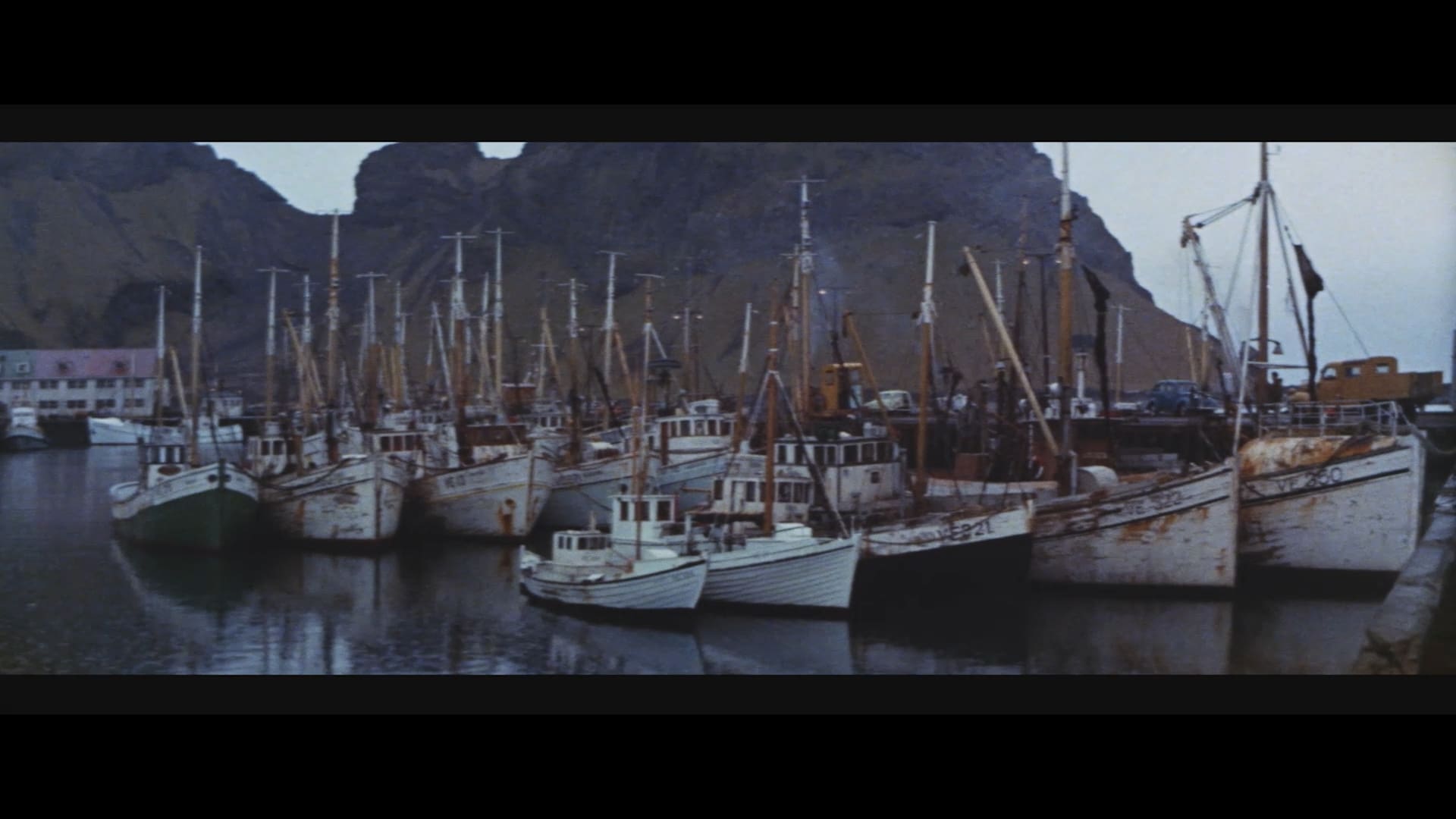
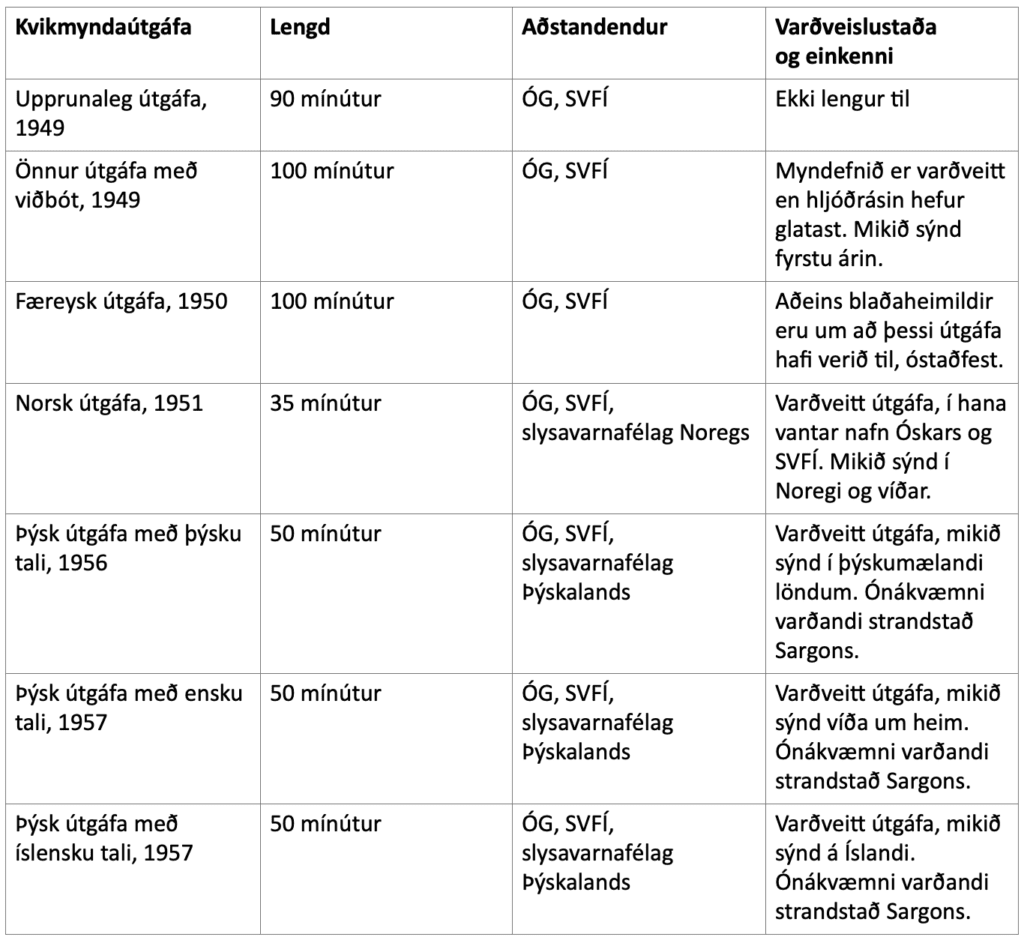
The movie The Rescue at Látrabjarg Oskar Gíslason recounts the heroic deeds of members of the Rescue Society Bræðrabandið who rescued 12 of the 15 survivors of the British trawler Dhoon, which had run aground below Geldingardalur near Látrabjarg on December 12, 1947. The rescue team's achievement drew widespread attention both at home and abroad, and members of the Brotherhood were specially honored by the British for their great feat. It was soon decided that a film needed to be made about the feat, and it was produced by Óskar Gíslason and the rescue men, who reenacted the rescue for the cameras under dangerous conditions at Látrabjarg and on the shore below the cliffs. A remarkable coincidence occurred during the filming when another ship ran aground nearby, and the rescue team had to spring into action. Óskar followed them and captured unique footage of the rescuers at work in a stormy, rocky fjord. Óskar Gíslason managed to weave the staged shots of the rescuers with the actual rescue, creating one of the most powerful documentaries in film history. The film attracted international attention, and various parties gained access to its material and made their own versions. Since then, the original version has become unwatchable. This certainly complicates any attempts to understand which versions of the film exist and which version could be considered the original, but when all is said and done, the film was released in six different versions in four different combinations. This article will discuss the film's production and exhibition history, with a special focus on its preservation and the different versions created by various parties at different times. The handling and preservation of Icelandic film archives has had a chequered history, but the story of the Rescue at Látrabjarg is in some ways particularly convoluted, and this is not least due to the film's success abroad. There are few examples of an Icelandic film from the first half of the twentieth century that has traveled as widely and been shown as often. (1)
The rescue captured on film
The feat accomplished at Látrabjarg in December 1947 attracted great attention in Iceland as well as abroad. At the 1948 national convention of the Icelandic Accident Prevention Society, Thórður Jónsson of Látrabjarg, chairman of the Brotherhood, proposed the idea of staging and filming the rescue. A resolution to that effect was passed at the congress, deciding to film the rescue feat and other such events if possible and if funding could be obtained. (2) Gudbjartur Ólafsson, chairman of the Accident Prevention Society, recounts the events leading to the film's production, stating that following the meeting, the matter was discussed at a board meeting of the Accident Prevention Society, which was attended by Óskar Gíslason. It was agreed to send him west to assess the conditions for such a film production. (3) However, the matter was not quite so simple, and the project was about to be abandoned due to anticipated costs, but Óskar then offered to make the film for free, with the Red Cross Society only covering his expenses and living expenses, as well as some pay for the rescue personnel who would be acting in the film. When screenings began, Óskar was to be paid for his work from the film's proceeds. In doing so, Óskar took a significant financial risk, but he was that enthusiastic about making the film. (4)
During the summer, Óskar went west, and the Morgunblaðið reporter in Patreksfjörður reported that he had arrived with his assistant, Thorleifur Thorleifsson, and that they had started filming the rescue from the previous year, along with rescue personnel from the Accident Prevention Society, which was covering the costs and organizing the trip. Thorður at Látrar had prepared for the filming and gathered the rescue men who were to appear in the movie, and it was decided to start with the most dangerous scenes, for example, when the shipwrecked men were rescued up past Flaugarnef, as it would be dangerous to film such scenes in the winter. (5) A journalist said the group was planning to return in the fall or winter to film the winter scenes. (6) During the summer shoot, Oscar descended the sheer cliff into the cove where the rescue had taken place, and nearly all of the rescuers from the previous year took part in staging the scenes, with a whole week being spent on filming this important part of the movie. (7) It was clear that Óskar intended to do the rescue justice. However, it was not entirely clear how he planned to stage the actual shipwreck, as such a task would be incredibly complex and expensive. Ideas were floated to use other shipwrecks found off the coast of Iceland, but such an operation would have been complicated and risky to execute. (8) A stranded trawler near Grindavík was strongly considered, and rubber dummies were to be used instead of crew members in staging the rescue. It never came to pass that the idea was put into practice in front of the cameras, and that may have been for the best. (9)
There was considerable interest in the film production by Óskar and the Accident Prevention Association, but not everyone was equally excited about the venture. For example, „The Seaman“ felt compelled to write to the anonymous „Hannes on the Corner“ column in the Alþýðublaðið newspaper, where he criticized the making of the film. He says that the rescuers are made to reenact their actions and relive events they would rather forget than take pride in, especially since they do not see the rescue as a heroic act. (10) These writings were answered by Guðbjartur Ólafsson, chairman of the Icelandic Red Cross Society, in the Alþýðublaðið newspaper on August 19, and he recounted the circumstances of why the events were filmed. In his article, Gudbjartur defended the making of the film and said he believed it could be important as an educational film about rescue, in addition to stating that it was made in full consultation with the Brotherhood, which had come up with the idea for it. (11)
Another beach
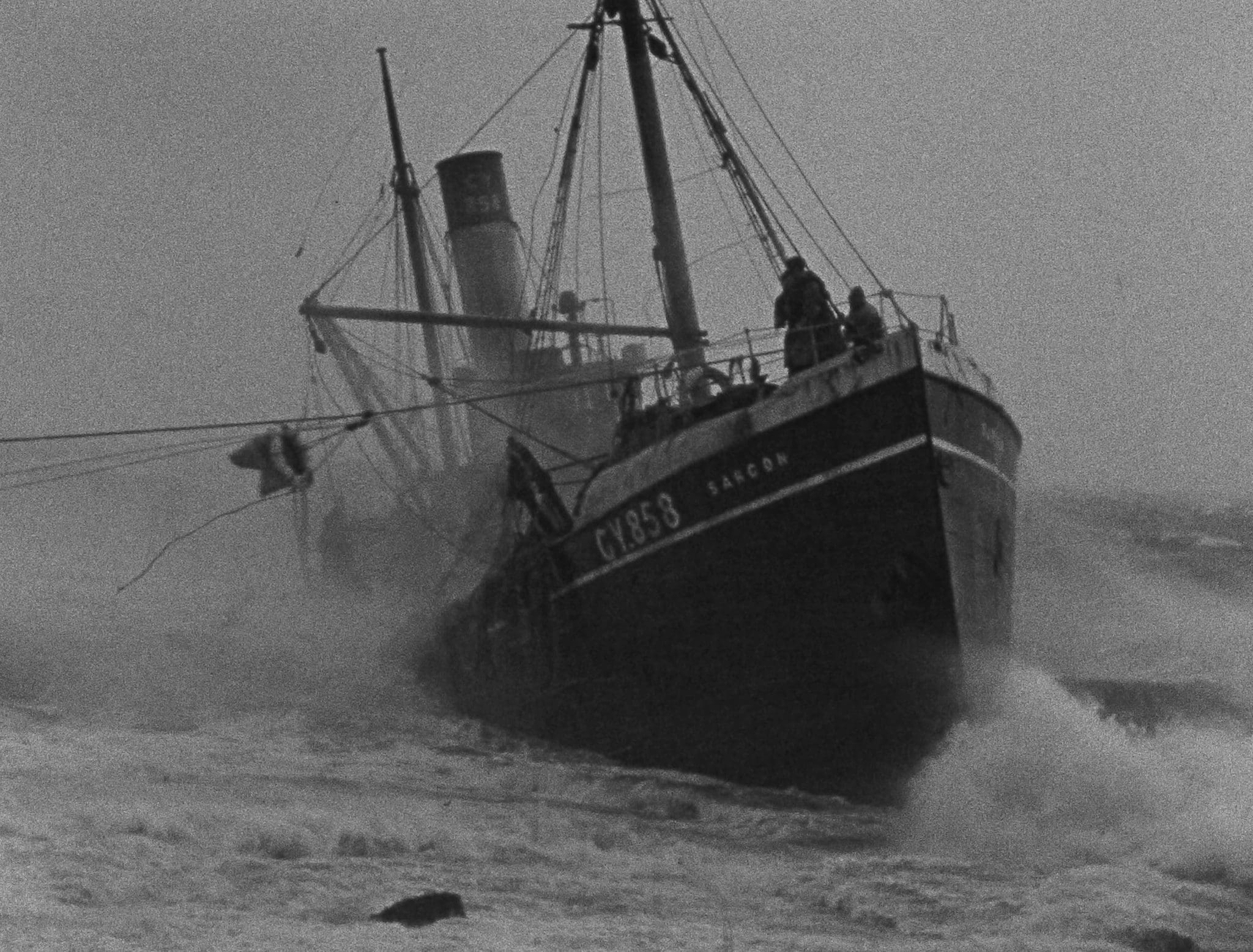
In December 1948, Thórður of Látrar called Óskar back west to continue filming the movie. Several men from the Brotherhood were there to support him and acted out the rescue, with some even taking on the roles of exhausted shipwreck survivors. Filming was going well, but had to be paused briefly when the weather worsened, and it was then that a distress call came in from another British trawler, the Sargon, which had run aground off Hafnarmúli in Patreksfjörður. The men sprang into action and prepared to assist with the rescue, which was underway but progressing slowly due to the stormy weather and challenging conditions at the scene. Thórður at Látrar then recounts the circumstances of how Óskar became caught up in the uncertainty in the 1949 yearbook of the Icelandic Society for Accident Prevention:
When I had finished making the call, I saw that Óskar Gíslason, a photographer from Reykjavík who was present, had quickly gotten dressed and was preparing to leave. I was about to tell Óskar that such a journey was not for him, but suddenly I remembered, that last summer I had tested both Óskar's courage and audacity, and so it would be now, I let it be. (12)
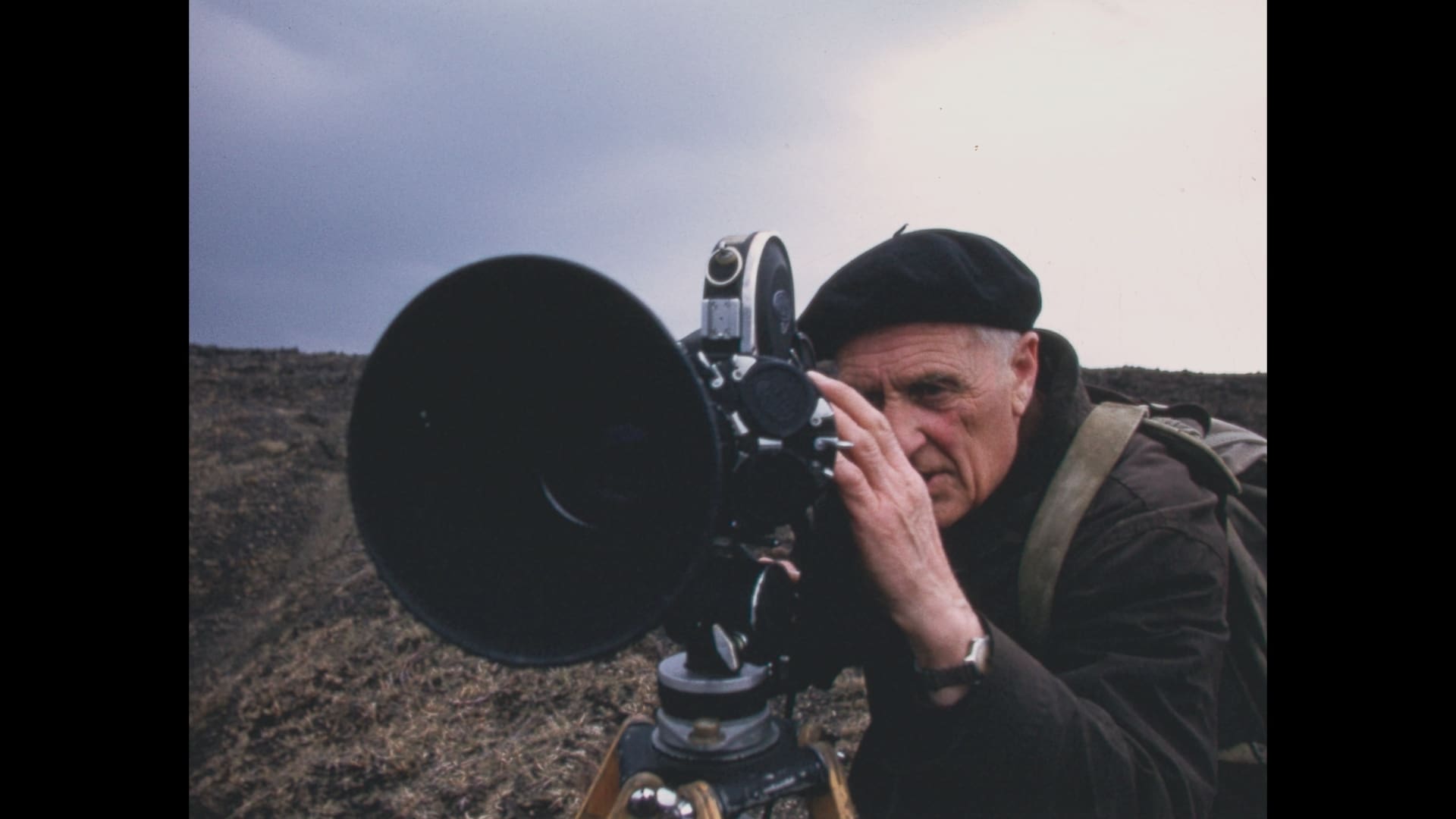
Oskar followed the rescuers into the storm; he got a special guide to navigate out to the headland while the other rescuers hurried ahead. (13) After a strenuous walk into the morning, Óskar reached the headland, and after the storm eased a bit and it brightened, he did his best to set up his camera on a tripod to get the best possible shots of the events. The weather wouldn't allow it, so he held the camera while filming. The photos show the sea crashing violently against the ship, which is stuck in the surf a short distance from shore. Oskar's hands had gone numb from the cold, and if the camera hadn't jammed, he would have been in serious trouble. Rescuers, who struggled to navigate the slippery rocks, managed to shoot a line out to the boat, which the castaways secured, and then pulled a rescue chair out to the ship. One by one, the castaways made their way to shore through high waves and over rugged rocks, and the photographs of the event are some of the most remarkable ever taken in this country. Of the Sargon, only six of the 16 crew members survived.
There was great interest in the footage of Sargon's rescue abroad, but Óskar seems to have been stranded by bad weather in the west for some time after the rescue and therefore was unable to respond to the calls from news agencies that contacted him about purchasing the footage. He also wanted to finish the film and make it as good as possible. Thórður á Látrum wrote the narration for Óskar's footage and recorded it, and part of the script is still preserved at the National Film Archive of Iceland. The recording took place at the Radio and Electrical Engineering Institute, and composer Jón Þórarinsson selected the music for the film. The final product, which was about 90 minutes long, premiered on April 8, 1949, and was very well-received; by mid-November, over 30,000 people had seen it. In the meantime, it had been sent abroad for duplication, and a scene was added to the film of the arrival of British dignitaries to the country to honor the rescue personnel. (14)
Many versions
Soon, there was interest in the film from abroad, and in December 1949, a copy of it was circulating in Denmark, where Bjarni M. Gíslason managed the screenings. (15) The film was also shown in the Faroe Islands in January 1950, as Oscar's ties there were strong through his Faroese wife, Edith Bech. (16) In May 1951, a Norwegian version of the film was completed, but the Norwegian accident prevention association had acquired the rights to show the film in its chapters and also gave the Icelandic Accident Prevention Society four copies of it. In Norway, the film was shortened to 35 minutes and dubbed into Norwegian with new music. Unfortunately, Oscar's name was missing from the film's credits, and it was also claimed that it had been made with a grant from the British Navy, both of which were malicious errors. The shorter version was very well received in Norway. (17) By 1953, the film had also been shown in England, where it was well received. Likewise, the film was shown very often by chapters of the Icelandic Road Safety Association, at meetings, for fundraising, or simply for entertainment and educational purposes. (18) The Norwegian version was then shown in West Germany and was so well received that the chairman of the German accident prevention association, Captain Berber-Credner, came to Iceland to negotiate the worldwide rights to the film. The film had received special recognition from a film review board of the Federal Republic of Germany and had attracted great attention. (19) The Germans had borrowed the Norwegian version of the film and thought highly of it, but the print had become too worn out. They therefore requested to borrow the original film and make a German version from it, but in exchange, the Accident Prevention Society would receive a new copy of the film. This was agreed to, but the original film was also considered quite worn out after numerous screenings in Iceland. The Alþýðublaðið newspaper, on May 22, 1957, reported on the making of the German version:
Capt. Berber-Credner now worked wholeheartedly to make the German version the best it could be. The original was not a conventional negative film, and it took a great deal of effort to make a so-called Dup-Negativ from it and to avoid having to cut the original, he had a Dup-Negative made of the entire original and had it developed with the appropriate gradation. He then spent many nights himself editing this Dup-Negative to create the condensed German version, which has since received much praise and the highest recognition as an educational and cultural film in Germany. Capt. Berber-Credner himself wrote the German text for the film and had two of Germany's leading radio announcers narrate for it. (20)
It is clear that no expense was spared in the making of the German version of the film; for example, new music was added to the film with permission from Die Deutsche Grammophon Gesellschaft. The German version was considerably shorter than the original but longer than the Norwegian one, at about 50 minutes. Icelanders received a copy of the film as a gift from Germany and screened it in Iceland to a very positive reception. Subsequently, an English and an Icelandic version of the film were produced in Germany. To create the Icelandic version, Ludwig H. Siemsen, the Consul General for Iceland in Hamburg, was brought in to oversee the project, and Björn Sv. Björnsson handled the Icelandic subtitles. (21) The Icelandic text was more or less a direct translation of the German, and the same was true for the English text. However, an error crept in at the beginning of the film when it is claimed that Sargon was stranded in the same place as Dhoon, which is not entirely correct, as Hafnarmúli is in Patreksfjörður and not at Látrabjarg. (22)
A German version of the film with Icelandic narration and new music arrived in Iceland around the turn of 1956–1957 and was shown by the Accident Prevention Society and its chapters across the country for fundraising and entertainment. The film received great praise here at home and also abroad. It received an award for outstanding documentary in Germany and was accompanied by a detailed booklet about the rescue and the making of the film, which was produced by Berber-Credner. The film was shown widely in Germany, especially in schools, and attracted attention everywhere. (23) An English version of the film also toured widely, and in 1967 it was still being distributed to far-flung corners of the world. The chairman of the Icelandic Society for Accident Prevention believed it had then been shown on most continents, on television in most European countries, and had carried the reputation of Iceland, the Society for Accident Prevention, and Óskar around the world. (24)
Preservation of the images
Several versions of The Rescue are preserved at the National Film Archive of Iceland in very different conditions, ranging from being in poor condition and silent to being very intact and having a soundtrack. Most copies are of the version that was put together in 1956 by the German Accident Prevention Association and its chairman, Berber-Credner. That version is preserved with German, English, and Icelandic voice-overs. That is the version that has been shown most often here in recent decades, with Icelandic dubbing by Björn Sv. Björnsson. The original version of the film, 90 minutes long with dubbing by Thorður Jónsson, was actually only shown a few times in Iceland before it was sent abroad for duplication, where a short section was added to the end of the film. The first version of the film therefore no longer exists. Its second version, with the addition, was around 100 minutes long and was shown most often in Iceland in the years following its premiere. It is considerably different from the German version, with a different focus on the heroic deeds of the rescuers. The film is preserved at the National Film Archive of Iceland and is in good condition, but the soundtrack, which most likely was on a steel wire that accompanied the film, has been lost or destroyed during screenings. (25)
The German version of the film soon replaced the other Oscar version in screenings. It is not clear when the switch occurred, but after 1957, the German version was shown worldwide in English and German, while its Icelandic version was shown by the Icelandic Road Safety Association and its affiliated groups in Iceland, as well as being shown on television in 1967. (26) An agreement appears to have been made for the Germans to acquire worldwide rights to their version of the film outside of Iceland, while the Icelandic Red Cross Society retained them. (27) Óskar did not profit from the film but charged the Icelandic Road Safety Association for the agreed-upon out-of-pocket expenses and maintenance, which amounted to 20,000 krónur. The association then increased that payment to 30,000 kr. because of the great success and because he had captured the rescue of Sargon on film. The association greatly benefited from owning the rights to the film, as it broke box office records nationwide and was a major draw for fundraising screenings for the branches of the Accident Prevention Society. Óskar said he had given the company his rights to the film and had received nothing but this one payment to cover his out-of-pocket expenses, but he also said he was happy to have done well by the company. (28)
The Norwegian version of the film is preserved at the National Film Archive of Iceland. It premiered in Iceland in May 1951 and was shown in, among other places, Denmark, Norway, and Germany. A year earlier, the original version of The Rescue was shown in the Faroe Islands, and the Icelandic media reported that this was the first time Faroese had been heard spoken in a film. (29) However, this has not yet been confirmed, and those familiar with the matter say it is likely that the film was shown with live commentary in Faroese, and the audio was therefore not played from a recording. The film, along with various rescue equipment, was then donated to the Faroese Fishermen's Association at the beginning of 1957, as it was intended to be shown for educational and fundraising purposes for rescue work abroad. After the screening of the film on February 21, 1957, one of the first rescue societies in the Faroe Islands, the Havnar Bjargingarfélag, was founded. (30)
The history of the rescue at Látrabjarg and the state of preservation.
Anything for the art to survive
The rescue feat at Látrabjarg is a unique documentary and a historical record of the activities of rescue societies in Iceland. The rescue work is demanding, but the rescuers go even further by volunteering to reenact the great ordeals they experienced so that future generations can learn from their experience. Óskar Gíslason deserves the greatest credit for the film, as he repeatedly put himself in danger to film it under precarious conditions. All those who were involved in the making of the film share its credit with Óskar: Þórður Jónsson of Látrar, the other rescuers, Þorleifur Þorleifsson, Óskar's assistant, and the accident prevention societies. It is fitting to end the article with the words of Þórður, in which he praises Óskar and Þorleifur for their conduct in making the film:
„If you have anything to say about me in the paper,“ says Thorður, „you might mention the diligence and enthusiasm that Óskar Gíslason has shown in making the film. – He has worked very hard and spared no effort to make the film a success. And I must say, I admire the courage of him and his assistant, Thorleif, as they climbed into Látrabjarg to shoot the film there.“ (31)
References:
1. The rescue itself will be discussed little here, but it has been well documented elsewhere. See, for example: Magnús Gestsson, Látrabjarg: Nytjar, björgun, sögur og sagnir. Skuggsjá, 1971; Óttar Sveinsson, Útkall: Björgunarafrekið við Látrabjarg. Útkall bókaútgáfa, 2009.
2. „I never became a millionaire from the movies.“ Visir 8.8.1976, p. 4.
3. Alþýðublaðið, August 19, 1948, p. 4.
4. Gudrún Sigríður Óskarsdóttir, Óskar's great-granddaughter, wrote a BA thesis in history in 2016 about his filmmaking. In the thesis, she references documents in the family's possession, as well as an interview she conducted with her grandfather, Óskar's son, who was also often his assistant. This provides a unique insight into his filmmaking. National Library-University Library, Guðríður Svava Óskarsdóttir, *Heavy Footsteps of a Pioneer: A Study of Óskar Gíslason's Film Career from 1944–1957*, BA thesis in History at the University of Iceland 2016, https://skemman.is/handle/1946/24459, p. 18.
5. In an interview with Vikublaðið in 1967, Óskar says of Þórður's involvement in the film: „Þórður Jónsson of Látrar, chairman of the Bræðrabandið rescue squad, was in fact both the author of the film's screenplay and its director. He also wrote and read the narration for the film, and did so with great distinction.“ (Gylfi Gröndal, „We Used the Movie Wagon for Turf“. Vikan, issue 22, June 1, 1967, pp. 24–27 and 40–43; p. 41.) The word director is used here in the sense that Þórður directed the actors. Óskar was in charge of making the film and, as the nature of filmmaking demands, he was assisted by Þórður and a host of others.
6. Morgunblaðið, July 15, 1948, p. 12.
7. „The Dhoon Beach Filmed.“ Vísir, August 4, 1948, p. 1.
8. Same.
9. „I never became a millionaire from the movies,“ pp. 4–5.
10. Alþýðublaðið, August 13, 1948, p. 4.
11. Alþýðublaðið, August 19, 1948, p. 4.
12. Thórður Jónsson, „Report on the Rescue of the Crew of the British Trawler „Sargon“ from Hull, which Wrecked on the Evening of December 1, 1948“. Annual Report of the Icelandic Society for Accident Prevention 1949. Alþýðuprentsmiðjan, 1949, pp. 23–29, here pp. 26–27.
13. Thórður Jónsson, „Report on the Rescue of the Ship's Crew,“ p. 27.
14. „The Rescue Heroism at Látrabjarg: Exhibitions to Open After the Weekend.“ The People's Will, October 8, 1949.
15. „Record Crowd at S.V.F.I. Rescue Film.“ Vísir, December 8, 1949, p. 8.
16. „The movie „The Last Village in the Valley“ shown in the Faroe Islands.“ Alþýðublaðið, May 10, 1950, p. 5; „Rescue film from Iceland to be shown in Tórshavn and a village.“ September 14, 1950, p. 1.
17. „The movie is now available from Norway in a shorter version with dialogue and music.“ Alþýðublaðið, May 25, 1951, p. 3.
18. „The famous SVF band „The Brotherhood“ 20 years old this month.“ Vísir, July 17, 1953, p. 1.
19. „SVFÍ Film on the World Market.“ The People's Will, December 20, 1956, p. 12.
20. „Producer of the German film about the rescue feat at Látrabjarg has arrived.“ Alþýðublaðið, May 22, 1957, p. 12.
21. „The movie about the rescue feat at Látrabjarg shown in Germany.“ Tíminn, August 25, 1957, p. 2.
22. This is not a serious mistake, however, as Óskar himself has said that Sargon's beach was in „similar locations“ to Dhoon's, and Sargon's beach is generally spoken of as an incredible coincidence due to its proximity to Dhoon's beach. See: „„I enjoy good detective stories““. DV March 21, 1987, p. 52.
23. Morgunblaðið, September 6, 1957, p. 9.
24. „The Látrabjarg film is being shown in Australia.“ Tíminn, December 10, 1967, p. 1.
25. Steel wire was a method for preserving sound with magnetization on a long, fine wire, but it was extremely unreliable as the wire tended to break or tangle, and therefore, parts of soundtracks stored in this way were regularly lost. It is most likely that the film's original soundtrack was on steel wire, and due to the focus on other versions of the film in the 1950s, it has been lost.
26. The Monday Paper, December 19, 1967, p. 8.
27. „The Látrabjarg film is being shown in Australia,“ p. 1.
28. „I have always been interested in movies.“ The National Herald, April 15, 1981, pp. 8–9; „I never became a millionaire from the movies,“ p. 4.
29. „The movie „The Last Village in the Valley“ shown in the Faroe Islands,“ p. 5.
30. „Faroemen Give Thanks.“ Tíminn, January 30, 1957, p. 12; „Faroemen Establish an Accident Prevention Society.“ Tíminn, February 26, 1957, p. 4; Sosialurin, February 16, 1957, p. 1.
31. „Walkie-talkies are essential for rescue teams in the countryside.“ Morgunblaðið, April 8, 1949, p. 5.