Until now, the history of Icelandic cinema has almost exclusively revolved around a group of men who are rightfully considered the pioneers of Icelandic filmmaking. Óskar Gíslason, Loftur Guðmundsson, and Ósvaldur Knudsen are most often mentioned when talking about films from the mid-20th century, and much good has been written about them. However, there is still much to research, and not everything is clear regarding our film history and those who were involved in filmmaking in Iceland in the mid-century. (1)
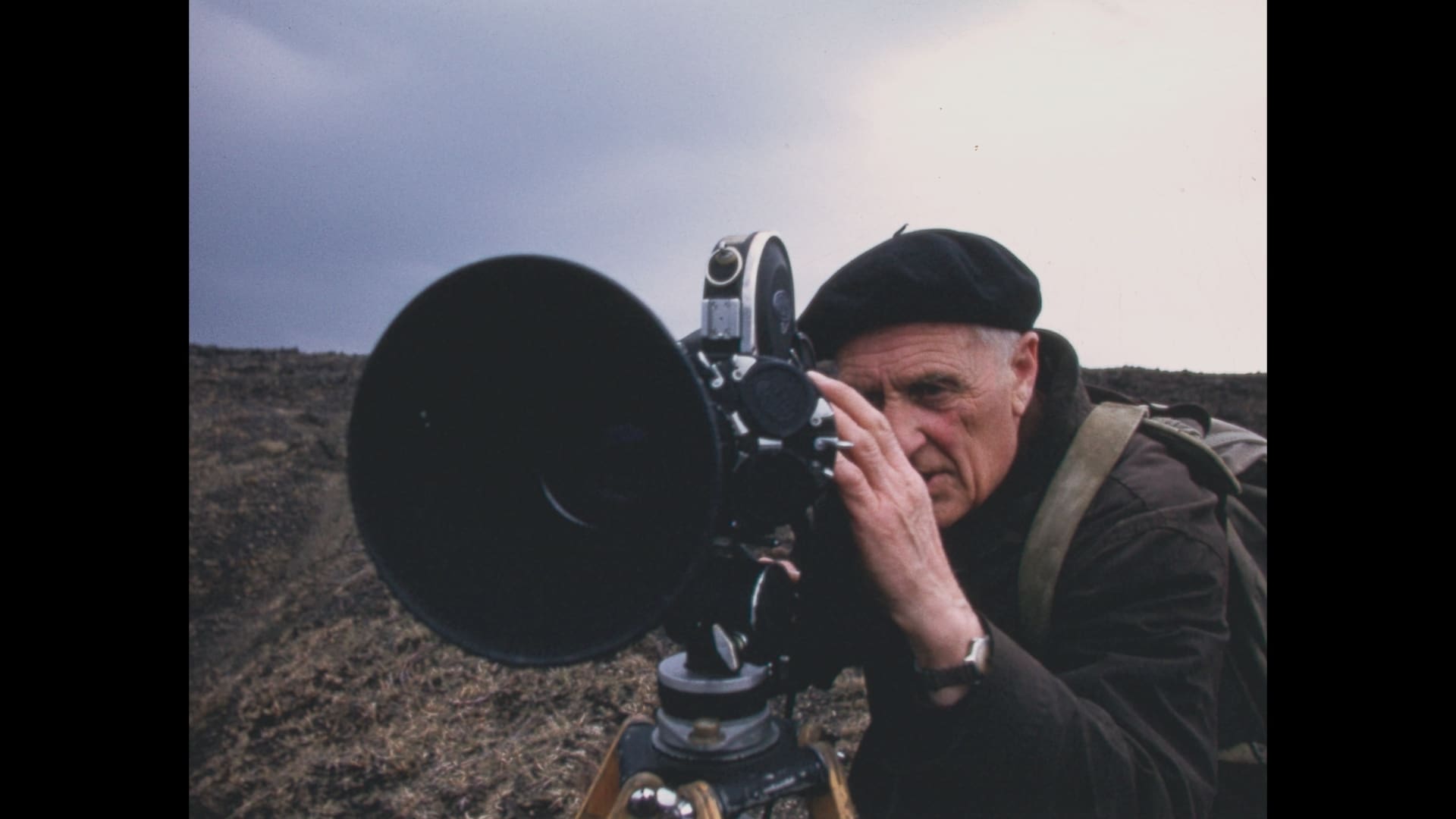
This article will attempt to shed some light on the life and work of Kjartan Ó. Bjarnason, a printer and filmmaker. Kjartan was involved in many aspects of Icelandic filmmaking during the roughly three decades he worked in the field. The art form came naturally to Kjartan, and he had obvious talent in that area. He had been an amateur photographer for several years before getting into it, but he made his first films through the funding of associations and institutions. In this context, a new theory about the institutionalization of Icelandic filmmaking will be presented, as Kjartan, along with Guðmundur Kamban, Vigfús Sigurgeirsson and Loftur Guðmundsson, was the first to take on film projects for public entities and non-governmental organizations around 1935, something that would go on to change the Icelandic film landscape forever.
Kjartan was a pioneer in various fields of the art form, he made the first Icelandic sound film, was the first to work in the industry full-time, and was one of the first to see the potential in promoting Iceland abroad with the help of the new medium. He lived in Denmark for a large part of his career but was active in traveling around Iceland with film screenings, both with films he had shot in Iceland and abroad. This article will review Kjartan's main achievements and shed some light on him as an artist and pioneer in Icelandic filmmaking.
The beginning
Kjartan Óskar Bjarnason was born on November 29, 1901, at Óseyrarnes in Eyrarbakkahreppur. His mother was Kristgerður Oddsdóttir, a maid from Hvammur in Holtum, Rangárvallasýsla, and his father was Bjarni Símonarson, a farmer in Hallstún and a carpenter. Not much is known about Kjartan's childhood and upbringing; he grew up with his mother, who lived all over the country while taking on various jobs. He had seven siblings but did not grow up with all of them, as some were placed in foster care with other families (Sigurjón Jóhannesson 1998: 42).
Kjartan trained as a printer and first appeared on the scene in 1930 as the publisher of the magazine Perlur („Table of Contents“) along with his fellow printer, Stefán Ögmundsson. The magazine was a lavish cultural publication with many pictures, some in color. In it, Kjartan first appeared as a photographer in the public eye, as a number of his photographs were published in the magazine, including one on the cover. It also featured images by the filmmakers Loft Guðmundsson, a photographer, as well as the painter Ósvald Knudsen, who would become a leading figure in the art world nearly two decades later. The magazine attracted attention, publishing writings by figures such as Halldór Laxness and Gunnar Gunnarsson, as well as translations of excerpts from various literary works. Two issues were published before the magazine was discontinued in 1931.
Alongside his printing work, Kjartan pursued photography with great enthusiasm, and his photos were regularly published in newspapers and magazines, including on the cover of Fálkinn in 1937. That same year, Kjartan won an award in a photography competition held by the Icelandic Touring Association („Jury of the photography exhibition…“ 1937).
A Passion for Film is Born
Alongside his photography, Kjartan developed an interest in filmmaking, although it is not known exactly how this came about or whether he went abroad to study or buy equipment. The oldest surviving film was shot by Kjartan for the Gutenberg State Printing House Employees' Association in 1936. It is preserved as part of the film Have a good time which contains several tours of a printer around the country in the years 1936–1939. It contains clear examples of Kjartan's visual composition, which would later become quite prominent in his films, and his talent for filmmaking is immediately apparent, as will be discussed in more detail later.
Kjartan's first publicly shown film was at Iðnó in October 1938, organized by the Reykjavík Social Democratic Association and the Communist Party. The film was about the May Day celebrations and was presented as the first color film shot in Iceland („Workers of Reykjavík Show …“ 1938). (2) Just over a month later, Kjartan was ready with sports films he had made on behalf of the Icelandic Sports Federation (ÍSÍ). They were shown at sports clubs across the country with the aim of encouraging people to take up sports. It was so successful that Kjartan continued to film various events for the I.S.I., and they were shown in three parts in 1938 („I.S.I. Sports Film“ 1938): The first part was from June 17, featuring swimming and other sports; the second part was of the Icelandic Skiing Championships and a ski trip by the Reykjavík Sports Association (ÍR) on the Súdin to Ísafjörður, The third film was of a German national soccer team and the visit of Crown Prince Frederick of Denmark and Crown Princess Ingrid to the country. Kjartan's footage of sporting events was extensive, and he filmed considerably for the ISI but also for individual clubs such as ÍR, Ármann, and the Reykjavík Ski Association. Few of these films are preserved today, except for those Kjartan made for Ármann in 1940 and a few possibly in loose clips on film reels he left behind, which are preserved at the National Film Archive of Iceland. The statue of Ármann was filmed in black and white and color and shows the club's gymnastics teams performing their routines, as well as water polo and wrestling. Besides the Ármann film and individual clips, there is a collection of Kjartan's sports films at the National Film Archive of Iceland, which contains footage from notable sporting events that have considerable documentary value for the country's sports history, including Women's Handball Championship in Sauðárkrókur in the year 1957 and Women's Nordic Handball Championship in 1964 (KvSÍ: Kf 17-12, 1). To finance the creation of such films, Kjartan usually made them on behalf of associations and sports clubs like Ármann and ÍR, but when he started traveling with his own shows in the 1950s, he began shooting and showing them more and more at his own expense.
Difficult circumstances
Kjartan Ó. Bjarnason was one of the first Icelandic filmmakers to take advantage of the country's changing landscape in film production. In the 1930s, associations and institutions increasingly began to have films made to promote their own activities and related events. It is actually difficult to speak of filmmakers in Iceland at this time, as everyone who owned a film camera had another job, had little to no formal training in filmmaking, and had few opportunities to pursue their work due to a lack of funds and equipment. This began to change around 1935 when public funds were, for the first time, allocated to film production in Iceland.
Few people had been involved in the production of motion pictures in Iceland during these years; Loftur Guðmundsson probably had the most extensive experience after having made the feature film *The Adventures of Jon and Gvendir* in 1923 and a number of documentaries, including Iceland in motion (1925) which had been shown worldwide in the 1920s and was a great promotion for Iceland. Peter Petersen (Bíó-Petersen) was the owner of Gamla bíó in Reykjavík, one of the city's two movie theaters. He had acquired a film camera, which he brought to Iceland in 1919, and began filming various events around Reykjavík to show in his movie theater. With this, Petersen became the first person residing in Iceland to produce and show a film in the country since Magnús Ólafsson did so in 1904 on behalf of the Icelandic Motion Picture Society (Erlendur Sveinsson 1988: 89). Several individuals residing in Iceland also filmed in the country during the 1920s, without any evidence that they were ever publicly shown. These include, among others, Martinus Simson, who filmed in Ísafjörður, and photographer Sveinn Guðnason in Eskifjörður, photographer Hallgrímur Einarsson, who filmed life in Akureyri, as well as photographer Óskar Gíslason in Reykjavík in the 1920s, but his work was unfortunately lost in a fire. Abroad, Guðmundur Kamban made the greatest impact in film production; in Denmark, he directed Hoddu Poddu with Gunnar R. Hansen in 1924 and The Sleeping House in 1926. In Iceland, the art form was therefore not in great bloom in 1935, and the authorities' willingness to support it was little to none. However, the Icelandic state did not only reject Icelanders; foreign parties who sought the state's help also rarely found success, and their inquiries were usually rejected without much of a fight (Íris Ellenberger 2007: 46). However, this was about to change, and soon the Icelandic state became concerned with better nurturing this new industry, and it was going to change the environment for filmmaking in Iceland significantly.
The institutionalization
In 1935, the film by James A. Fitzpatrick was shown in movie theaters in Reykjavik, Iceland: Land of the Vikings (1932). Icelanders were dissatisfied with the film, and Guðmundur Kamban (1935: 3–4) wrote an article in Alþýðublaðið in which he criticized it and called for the Icelandic state to produce a film about the country and its people and to take control of national promotion from the hands of foreigners. The article was published around the same time that the Fisheries Commission and the State Tourist Office were established, but the institutions shared the goal of working on the creation of an image of Iceland abroad, the Fisheries Commission in marketing seafood products and the State Tourist Office in promoting Iceland as a tourist destination (Íris Ellenberger 2007: 52–53). The Fisheries Commission quickly embarked on filmmaking and wanted to make a film about Iceland. Guðmundur Kamban was hired to direct the project, which was to be the first Icelandic film financed with public funds. Kamban and his collaborator, the German Paul Burkert, were hired to make a film that would spread the fame of the country and its people far and wide and would show Iceland in the right light (Erlendur Sveinsson 1999: 854). Historian Iris Ellenberger goes into detail about the changes in how Iceland was promoted to the outside world in her book *Icelandic Films 1916–1966*. There she states (2007: 56) that with his criticism, Kamban for the first time articulated the power imbalance that came with foreign parties making films about Iceland for foreign audiences. Icelanders should now take it into their own hands to control the image of the country and its people abroad. During the making of the film, Kamban and Burkert traveled extensively throughout Iceland and shot a great deal of footage, but the result was not good enough that the Fisheries Commission deemed none of the footage usable, so the film was put in a drawer and never completed (Erlendur Sveinsson 1999: 857). Although Kamban and Burkert's film was unsuccessful, filmmaking in Iceland had been redefined. Before these changes, public funding for filmmaking had been virtually non-existent, with the exception of a token grant that Loftur Guðmundsson received from the Althingi for Iceland in motion (Loftur Guðmundsson, 1925) many years after its production (Erlendur Sveinsson 2002: 34). Loftur, who was the only one to seriously attempt filmmaking in Iceland during the 1920s, instead sought funding for his films from private companies such as the shipping company Kveldúlf and the brewery Egil Skallagrímsson in exchange for advertising within the films (Erlendur Sveinsson 2002: 35) (3). Peter Petersen filmed Iceland to attract people to the movie theater he owned and operated. Others seem to have gotten into filmmaking out of curiosity and, as far as is known, never publicly showed their own films in movie theaters. In the 1930s, the state of filmmaking in Iceland changed and can be said to have been revolutionized. 16 mm film and cameras had become more accessible and much safer and cheaper than 35 mm nitrate film and cameras. Smaller film made movie cameras a cheaper investment, and with smaller cameras, filming became less bulky, thus increasing the possibilities for using the medium to record various events without much effort. The cost, however, was still high for individuals and a significant barrier to making films, but with the involvement of public entities, much greater and more realistic opportunities for filmmaking in Iceland opened up.
Following the film *Kambans*, the Fisheries Council decided to send Vigfús Sigurgeirsson to Germany to study filmmaking. Upon his return in 1936, he came to a changed film landscape and opportunities for projects. Institutions and associations had caught on, and film production projects were created. Vigfús started by filming a movie for the Icelandic Gardening Society („The Nordic Gardening Exhibition …“ 1937: 2), the Swedish-Icelandic Society (Morgunblaðið 1936: 7), the Icelandic Olympic Committee („Svigkeppnin í gær“ 1939: 6), and the Federation of Icelandic Cooperatives (Erlendur Sveinsson 1999: 857). Loftur Guðmundsson was then hired, among other things, to create a picture for the Sales Association of Icelandic Fish Producers about the Icelandic fishing industry. Loftur's film and Vigfús's films for the Cooperative Association, among others, were used in films about Iceland that were intended to promote the country and its people at the 1939 New York World's Fair (Íris Ellenberger 2007: 53; Erlendur Sveinsson 1999: 857–858). Erlendur Sveinsson (1999: 857–858) believes that Kamban's article in Alþýðublaðið spurred the production of films to promote the country and its people on behalf of the Icelandic government in order to manage the country's image abroad. It crystallized in the films shown at the 1939 New York World's Fair. This theory holds up to scrutiny, but it is limited to national promotional films and the power of Icelanders to control their own image abroad. Iris Ellenberger (2008: 27–48) discusses this in detail in her article on the films of Vigfús Sigurgeirsson at the 1939 World's Fair and confirms Erlends's theory. However, if the beginnings of the careers of Kjarval and Vigfús and Loft's projects are examined, it can be said that the change in the entire framework following the involvement of public entities had a much more profound impact on Icelandic cinema than just for national promotion. The change that took place laid the groundwork for the future and made it possible for people to get paid for their work and take on projects through public institutions and non-governmental organizations. Icelandic filmmaking was institutionalized in 1935. The Fisheries Commission's direct involvement appears to have opened up the possibility for private organizations and public entities to hire individuals for projects on their behalf in a completely new way, which established the foundations for a more widespread film industry in the country and created a system that is still relied upon today.
In the article „The Twelve Years Before the Era of Television and the Film Fund,“ Erlendur (1999: 868) further describes a great boom in Icelandic filmmaking after the establishment of the republic on June 17, 1944. He believes that it sprang from the optimism that had emerged after rather lean war years. This could also be re-examined, but it seems that the development that began in 1935 with the institutionalization of filmmaking in Iceland continued at the beginning of the 1940s. One could say that this was a linear development, with a variety of projects available from public entities. This development can be traced seamlessly through the war years, although it naturally slowed down. During the war, public projects were fairly regular and diverse. Loftur was hired to make a film for the City of Reykjavík („Loftur tekur myndir …“ 1943: 12), Kjartan and Vigfús about Establishment of the republic in 1944 („A book will be published …“ 1944: 2), Kjartan about Westman Islands for the Director of Education („The American Red Cross Gives …“ 1943: 43), Vigfús on behalf of the Fjallamen („Easter Journey of the Fjallamen“ 1942: 1), and so on. The first indications of a deepening knowledge of the film medium appeared during these years, as Sigurður Norðdahl studied cinematography in New York in 1943 („An Icelander Learns …“ 1945: 2) and Loftur Guðmundsson spent nearly a year in the United States on behalf of Kodak, studying camera technology and finishing two films in 1944–1945 („Loftur Guðmundsson, ljósm. …“ 1945: 5). The change in filmmaking towards the end of the war could, rather than being linked to optimism, be placed in the context of the great social upsurge following the end of the war in Europe in the spring of 1945 and the greatly increased opportunities to access funding, film, equipment, and other materials for filmmaking. There was also much less danger involved in traveling between countries after the war ended, as film reels often had to be developed abroad. A good example of this is the film by Loftur Guðmundsson, which he was commissioned to make for the City of Reykjavík in 1943–1944. He developed it in the United States in early 1945 and tried twice to send it to the country. On both occasions, the film went into the sea when the ships carrying the films were sunk („Coming Soon …“ 1945: 2) (4).
Iceland in pictures
Kjartan O. Bjarnason's first films followed this development; they were commissioned by Gutenberg, the Reykjavík Social Democratic Association, the Icelandic Olympic Committee, the State Forestry Service, the Red Cross, the Ministry of Education, the National Holiday Committee, and the Progressive Party. In 1945, Kjartan was able to quit his job as a printer and become a full-time filmmaker, the first Icelander to do so („Kjartan O. Bjarnason sýnir …“ 1950: 8). It was following this that he undertook to film the founding of the republic at Thingvellir in 1944 and spent most of 1945 in New York finishing the film. He managed to take advantage of the trip and work on films about Thórsmörk and Westman Islands, a film about Country life in Iceland and others about Children on behalf of the Red Cross, which he also scored with music and narration while he was there. He created the films for various organizations and would go on to show them at different events in the years to come. He also purchased a projector to gain more freedom to show films on his own. After returning from New York, Kjartan's work in filmmaking and screenings continued, becoming more focused, and he was able to support himself through the 1960s.
Kjartan was regularly hired for performances by various associations, at various entertainment and educational evenings, and by institutions. He performed, for example, at entertainment evenings for the Nationality Society (Morgunblaðið, 1945: 11), the Youth League and the Socialist Society of Reykjavik („The Youth League and the Socialist Society of Reykjavik …“ 1945: 5), the Progressive Party („Meeting“ 1945: 8), the Travel Association of Iceland („Ferðafjelag Íslands“ 1945: 7), the horsemen's association Fák („Kvikmynd um …“ 1947: 16), the Danish-Icelandic Society („Dansk-íslenzka félagið“ 1947: 3), and the list goes on. Such screenings by social organizations, along with the recordings for them, enabled Kjartan to make filmmaking his full-time profession. However, to make that work, Kjartan also had to create his own opportunities. He contracted with clubs, institutions, associations, and sometimes local authorities in specific regions to make films for them about the area. He made films about the Westfjords („Kvikmyndasýning á skemmtun …“ 1948: 8), Eastfjords („Kjartan Ó. Bjarnason is working on …“ 1949: 12), Skagafjörður („Working on a Skagafjörður Film“ 1951: 7), South-West Iceland (The Morning Newspaper 1947: 15), East Húnaþing („Voices Preserved on Steel Wire“ 1951: 94–95) and Breiðafjörð („Kjartan O. films and shows“ 1959: 2) and showed the result either in its entirety or in excerpts, sometimes first on his own and then as part of a final product for the buyer. To create the film, Kjartan The eruption of Hekla and showed it independently to great popularity across the country in 1947 and 1948. He shot the footage of the eruption for a sponsored film by the Rangæingafélagið, and after the screenings, he incorporated it into his promotional film about Rangárvallasýsla. They are preserved as part of it at the National Film Archive of Iceland today (KvSÍ: Kf 83-12, 1).
The world
Kjartan soon realized that foreign parties were interested in pictures of Iceland, Both major media outlets like the BBC and National Geographic contacted him in early 1950 for nature film screenings, as did smaller organizations that wanted to show his films about Iceland on their own (Icelandic Color Films Shown“ 1950: 1). Little more was heard of the exhibitions in the West or in Britain, but at the end of April 1950, Kjartan showed a selection of his Icelandic photographs at a summer celebration for Icelanders in Copenhagen („About 200 people at the summer celebration …“ 1950: 1), and again two weeks later in Norway. His pictures and his sensitive eye for the landscape were praised after the screenings („Kjartan Ó. Bjarnason“ 1950: 4). Shortly thereafter, Kjartan showed his film at the Berlingske Tidende hall in Copenhagen, and invited guests praised his film about Iceland to high praise („Shows Films in Copenhagen“ 1950: 2). These screenings led to Jakob Möller, Iceland's ambassador in Copenhagen, invited guests to a screening of the film in the fall, and it was then decided that the film should be shown in Danish schools, as it was a „wonderful geography lesson“ („Iceland Film Shown in Danish Schools“ 1950: 16). Kjartan often provided his own lecture-style commentary for the film and took questions from the audience after screenings. The film did not receive a title until early 1951, when it was called Island i Sommersol or Sunny Days in Iceland („Icelandic Film Shown …“ 1951: 4). The film was shown to the public in Copenhagen in the fall of 1950 to great popularity, and Kjartan even had four sold-out showings on some days. The newspapers also praised the film, saying it surpassed other films about Iceland and made audiences take a liking to Iceland („Icelandskvikmynd, sem vekur …“ 1950: 8). By 1952, the film had been shown in more than 90 cities and towns in Denmark to good reviews, as well as in numerous schools across the country, a rarity for an Icelandic film („Icelandskvikmynd sýnd …“ 1952: 8). As a sign of the good reception Kjartan received in Denmark, he was invited to make a promotional film for the Danes which was titled *Her er Danmark* (Here is Denmark, 1954).
Kjartan also showed *Sunny Days in Iceland* here at home, and it became something of a tradition for him to show the film abroad in the winter, while at the same time filming material about the countries he traveled to. In the summers, he traveled around Iceland showing the new footage along with other material that he had either previously shot or acquired on his travels. This arrangement was Kjartan's routine for almost the entire 1950s and into the 1960s. It seems he was able to get by on that and live on filmmaking alone. After nearly a decade of showing *Sunny Days* in Denmark, Norway, Finland, Sweden, Germany, the United States, and Britain, Kjartan claimed to have shown the film about 2,000 times in the Nordic countries alone by 1959 („„Sunny Days in Iceland“ Shown …“ 1959: 8). That number may not stand up to scrutiny, but it is clear that he showed the film both often and widely, and did much for the promotion of the country and its people abroad.
Overseas recordings
In 1954, Kjartan went across the ocean to show Sunny days in Iceland and to film a documentary about the settlements of Western Icelanders in Canada and the United States. The project was a collaboration with Professor Finnbogi Guðmundsson of the University of Manitoba, and they traveled together through Icelandic settlements abroad, photographed people's lives, screened *Sunny Days* to a warm reception, and gave lectures (Lögberg 1955: 8). Grants for the project were obtained from the Icelandic government to film several staged scenes in Iceland of people emigrating to the New World, and from the Icelandic National Society in America to continue filming there („Thirty-sixth Annual Meeting …“ 1955: 128). The tour was a great success, and they were welcomed everywhere they went. The film 100 Years in the West was premiered in Iceland on August 23, 1956, to a good reception from journalists and audiences; it was shown throughout the country, and then Finnbogi planned to take it across the ocean to show it in Icelandic communities there („A color film has been …“ 1956: 7–8). The film, which was 105 minutes long, began with a staged emigration of Icelanders in the 19th century. This is likely the only dramatic scenes in Kjartan's career, staging a sale of livestock and other equipment and scenes of people setting out on the long journey across the ocean. The largest part of the film then shows Icelanders throughout the United States and Canada, from Los Angeles, California, to Manitoba and Ottawa, Canada, with stops at numerous places along the way. The film is preserved at the National Film Archive of Iceland.
As has been mentioned, Kjartan filmed extensively during his travels, and the result was then usually shown on his next tour. In this way, he made films about Norway („Sýnir landið um kring“ 1959: 6), Sweden („Kjartan Ó. Bjarnason in a touring exhibition“ 1960: 12), Finland („Kjartan Ó. films and shows“ 1959: 2), and Denmark (“Kjartan Ó. Bjarnason has shown …" 1956: 3), the last-mentioned was sponsored by the Danes but the others were financed by him himself. These films were part of his traveling shows about Iceland, which became an annual event for most of the 1950s and into the 1960s. On these tours, Kjartan most often showed new photographs, which he spiced up considerably with older material. In this way, he could create a special photograph about Icelandic women using elements from a number of his earlier pictures. The same can be said of his country scenes, pictures of horses, pictures of children, pictures of flowers, pictures of islands off Iceland which he showed on the 1963 tour, and so on. Kjartan saved time and money by reusing his material and placing it in a thematic context in another film, something that is still common in filmmaking today. Sometimes this was done at the expense of the older film, which was then broken down into fragments that can be found throughout his other films under different titles. The best example of this is the film that Kjartan showed most often during his career and which received the most positive reviews, Sunny days in Iceland. Kjartan took it apart and significantly shortened it for the Ministry of Foreign Affairs to have on hand for loan to Iceland's embassies and renamed it This is Iceland or This is Iceland in 1960. Gísli Guðmundsson was responsible for writing and recording the English commentary for it („A New Land Information Film …“ 1960: 3). In broad strokes, it is This is Iceland shorter version of Sunny days in Iceland and is substantially similar, but it is only about 25 minutes long and was likely shown without dialogue to begin with. Sunshine Days was about 90 minutes long („The film Sunshine Days …“ 1952: 8), it is clear that a lot of material has been cut and it is almost impossible to know what that material was, although it may possibly still be preserved. This is Iceland has been preserved in its entirety at the National Film Archive of Iceland, but Sólskinsdagar no longer exists. It disappeared from screenings almost as soon as This is Iceland was released („Kvikmyndir Kjartans …“ 1961: 16) and has not been seen since.
Kjartan's last exhibitions were in 1968 and were intended to be a farewell, as he had become heart-ill and, on medical advice, was to stop the country's promotion work that he had worked so diligently on for nearly two decades. Kjartan, as before, applied to the embassy in Copenhagen for a grant and said that there was still great interest in Iceland in seeing pictures from the country (ÞÍ: Letter from Kjartan …: 1968). He had, by his own account, held about 6,000 presentations and lectures about Iceland, and he wanted to take one farewell tour. The embassy referred him to the Ministry of Foreign Affairs (THÍ: Ministry of Foreign Affairs to embassy …: 1968) which denied the request (ICEL: Embassy of Iceland …: 1968) despite the embassy's recommendation, the numerous grants awarded over the preceding decade, and a note that he had promoted significant national publicity in Denmark and elsewhere through his work in the years prior. After this rejection, Kjartan abruptly stopped filmmaking. He continued to show his own films, but very sporadically, and it seems his screenings ceased entirely by the late 1960s. His film, Establishment of the Republic of Iceland, was shown in 1969 on the National Television („Sjónvarp“ 1969: 10) and Finnbogi Guðmundsson traveled with 100 years in the New World on Icelandic settlements in the New World in 1970 („100 Years in the New World“ 1970: 1). Apart from these exhibitions, Kjartan's photographs disappeared almost entirely from the public scene.
The frame as a subject
Not many complete films remain after Kjartan's career, which can largely be attributed to his exhibition methods. He rarely showed his films at public screenings in movie theaters, so the titles and subject matter were often loose. Kjartan usually accompanied the films and provided commentary at screenings, as most of them were silent. In the first half of his career, the screenings were typically organized by community groups. When he began his own nationwide touring schedule, he usually showed several films at a time and named them after their subjects rather than with catchy titles, for example, *Eastfjords Film*, *Westfjords Film*, and Icelandic children. He probably saved himself a considerable amount of work and some money by skipping title and text cards on his films and was able to work on them faster than he otherwise would have.
A summary of Kjartan's filmmaking can be quite complicated, as few well-defined films are preserved from him. Some of Kjartan's films, which can be found at the Film Archive, were on reels with other films, and it is often difficult to determine where one film ends and another begins. It is also difficult to identify films without title cards from contemporary media descriptions, as Kjartan reused a lot of his own material and often made films on similar subjects, for example, the rural films. Country life in Iceland, Blessed are you, my valley, and Livestock in Iceland which all contain rather similar and often the same footage of farm work and livestock in Iceland. A similar story can be told about Kjartan's film, The Islands of Breiðafjörður, Islands near Iceland and the Westfjords film, where he again uses similar or the same footage to portray the life and nature of islands off the coast of Iceland.
Kjartan's subject matter and aesthetics can at first glance seem somewhat conventional, but in the mid-20th century, most Icelandic photographers were accustomed to placing the subject in the center of the frame and making sure nothing was in front of it. Depth was rarely used and it was rare to place something in front of the subject, and never for artistic purposes. From the beginning, Kjartan had a different vision of cinema than his Icelandic contemporaries and was certain that something needed to be happening in the frame—movement or a symbolic contrast between his foreground and background. These characteristic shots of Kjartan are illustrative of his aesthetic vision and interpretation of the subject matter. In a single shot, he could capture great depth and contrast that create meaning for the audience, highlighting his talent as a filmmaker and a master of the frame.
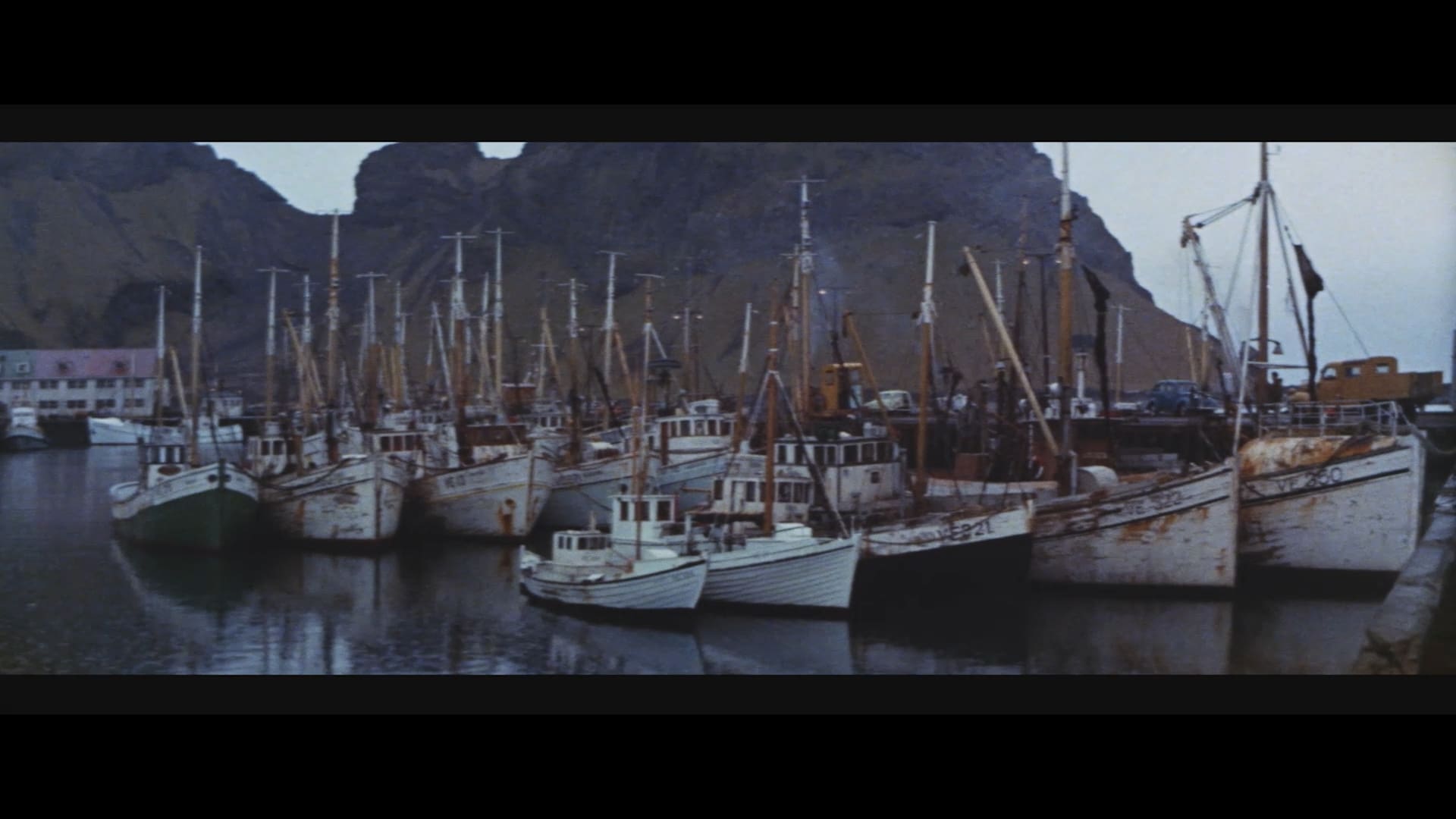
In general, the structure of Kjartan's films could be described as snapshots of the land and life there. Individual scenes can have a logical structure and are connected through specific narrative elements and lyrical moods that span the film. However, the progression is based more on Kjartan's drive to delight the audience with fun and memorable images rather than on logical progression or development. His artistic vision lay primarily in the beauty of the frame and its composition, where Kjartan could weave together contrasts in the same shot with incredible precision and create meaning with the perspective alone. An example can be taken from footage Kjartan shot of Eskifjörður for his film about the Eastfjords (KvSÍ: Kf 83-26, 12.), where he captures contrasts in a single shot and combines them into a meaningful whole. The shot is taken from east of the settlement, looking west up the fjord. The cluster of houses on the sandspit stands between high mountains, and the sky is just barely visible behind them. In the center of the frame, a boat is leaving port for the dangerous mid-ocean grounds to provide for the town, while in the foreground, children play carefree, creating a strong contrast with the boat and the surrounding mountains. All of this is combined in a single shot, creating a feeling in the viewer of the beauty of small-town life, bathed in a reddish evening light. Kjartan also depicts the gender division of the children's group extremely well. The boys are in a tug-of-war, competing to show their strength and power, and the male teacher watches them closely. The girls are playing a game that resembles a green meadow, where one of them is in the middle and the others hold hands and walk around her, all dressed in dresses. They form a contrast to the boys and capture Kjartan the Old's view of gender roles in a clear way. The male teacher shows interest in the boys' play but turns his back to the girls, who are also enjoying themselves in their own game.
Another example of such a composition, which is also a good confirmation of Kjartan's natural talent, is from his oldest surviving footage, which he shot in 1936. Have a good time While working for the Gutenberg State Printing House, Kjartan filmed recreational trips organized by the printing house's staff, which took place from 1936 to 1939. Great joy characterizes the subject matter, and Kjartan films his coworkers singing and having fun on a tour of the country, but a glimpse of Kjartan's style can be seen. In a shot from a stop at the Hvítá river in Árnessýsla, he composes a somewhat characteristic frame. In the foreground is the vegetation on the riverbank, the fast-flowing river is in the middle of the frame, and in the far distance and at the top of the frame, his traveling companions are against the sky. The composition is unusual, but with it, he captures the essence of the journey and the joy among his companions, weaving it together with the dramatic nature of Iceland.
Complete pictures
A possible reason why Kjartan's name is not more well-known than it is, is that no particular films he made captured the nation's favor and lived on in its memory. Establishment of the Republic of Iceland It could have been a signature film for him, but due to recording errors, it received a rather poor reception and has rarely been shown, despite efforts to fix it. Some of Kjartan's films could be called fully finished, with title and text cards and sometimes a narrator's voice describing what is seen. Have a good time (1936–1939), Thórsmörk and Öræfi (1940, originally named Thórsmörk in colors), Shining in the sun, Skagafjörður (1953), Luftleiðir – Flying Abroad (1961), Establishment of the Republic of Iceland (1946), Printmaking 500 Years (1940) and By the streams (1949) are some of the titles that could be mentioned.
The Red Cross children's film is one of Kjartan's most cohesive films. He made it from his own footage for the Red Cross of Iceland, along with recordings from the movement's special children's homes. He filmed the movie around 1944, and he most likely dubbed it while he was working at the Institute of the Republic of Iceland in the United States in 1945. The film is narrated in English, and the script was written by Bjarni Guðmundsson, a press officer for the Ministry of Foreign Affairs. It showed Icelandic children at Red Cross summer camps at Silungapoll, in Sel in Hveragerði, and in Reykholt, and was made as a symbol of friendship with the American Red Cross youth movement. It may be interesting to examine some aspects of the film more closely. After a brief introduction to the history of government in Iceland over footage of the Tjörnin and Austurvöllur in Reykjavík, the conversation turns to the large group of kids who go to the countryside for the summer and get to know the country in a way that city life does not offer. Not all children get a spot in the countryside, especially the younger ones, and so the summer camps are a good place for them to experience life outside the city. Here, the film changes pace, and we see some fairly traditional scenes of the countryside. Kjartan used many of them in other films, for example, a shot of a rider in the East Fjords that he took for the State Forestry Service in 1940, and a shot of a young girl feeding corn to chickens, which Kjartan also used in his films about rural life and livestock. The vignettes end at a summer camp by Silungapoll, where we see children walking together in a group through a rugged lava field with the house and the water in the background in a rather perfect establishing shot that could be called a typical multi-layered shot for Kjartan. Midway through the clip, a shot of a young girl in a sundress appears, who is said to be at the camp, but the footage is a poor fit with the composition of the kids in the lava field and is actually a recording of Kjartan's daughter, which can also be found in his family material. Editing is possibly Kjartan's greatest weakness, as the establishing shot of the girl suggests. His shots are often gorgeous and laden with meaning, but their composition is sometimes lacking. Many well-crafted visual sequences can certainly be found in Kjartan's work, especially within scenes. However, his films sometimes lack a greater sense of overall impact. Kjartan is a skilled craftsman, and this is not meant to question his professionalism; he makes excellent use of traditional narrative editing and knows how to cut from a wide shot to a close-up in an understandable way. What his films often lack is structure and narrative progression, which he sacrifices for the sake of beauty, making them quite impressionistic as a result. However, that was likely his goal: to create beautiful impressions of the land and its people.
The Red Cross film continues and we see boys playing with blocks, first in a wide shot, and then medium shots of individual boys as they enjoy building towers and cities. Next, we cut to Hveragerði where the Seli hosts the Red Cross summer camp. There we see a beautiful establishing shot of the house and children playing outside it on a sunny summer day; between the camera and the house, steam rises from the green grass, giving the shot a mysterious glow. Next, the children are brought outside, dressed in their pajamas, and made to bathe in the sun, many of them without clothes. Kjartan's juxtaposition of shots of the girls lying primly and chatting with shots of the boys piled together, wriggling and making a ruckus and unable to be still for a second could be taken as an example of his quality and intuition in editing within scenes. After more gorgeous shots of children at play and picking berries in Reykjadalur and at a summer camp in Reykholt, Kjartan ends the film with one of his trademarks, a shot of a sunset. Iconic final shots of sunsets can be found throughout his films as a conclusion, and although they are a rather obvious and emotionally charged way to end a film, they perfectly illustrate Kjartan's nature in expressing himself visually and dedicating himself to the meaning and beauty of his films.
The Legacy
Kjartan and his wife, Sesselja Einarsdóttir, moved to Denmark in 1951 and settled there following Kjartan's increased projects in that country and beyond. They had two daughters, Erla, who moved to the United States, and Auður, who was largely raised in Denmark. Kjartan lived in Denmark until his death on August 26, 1981 („Andlát“ 1981: 14). For some reason, his name disappeared from the awareness of scholars when it came to the history of Icelandic cinema, and his achievements were forgotten. In 1950, Kjartan was named, along with Óskar Gíslason, as one of the nation's foremost cinematographers for nature and industrial films and was often cited („„Seeing is Believing““) 1950: 2) in the same breath as the country's other most notable filmmakers. This omission may be due to the fact that he never made a feature film or because he moved to Denmark and lived there in his later years. He was also very independent and, for example, rarely screened his own films in Reykjavik, and so perhaps he was not on the radar of the right people. It hasn't helped that Kjartan left no particular titles or defined body of work. He also traveled and showed the films on his own, which left movie theaters with almost no opportunity to re-screen his films and create traditions. Also, Kjartan's method of editing the films—where he would take them apart, reuse shots, and often show multiple films at each screening—has meant that no single definitive title has been preserved as the film people remember. Establishment of the Republic of Iceland could have been his memorable film, but it failed for various reasons, and Sunshine Days in Iceland was not preserved, only the much more tourist-friendly one. This is Iceland which resulted from it. Regardless of such speculation, Kjartan's career is extremely fascinating, and his work promoting the country abroad is invaluable. He was among the very first filmmakers to take advantage of the institutionalization of filmmaking in Iceland, he made the first sound film for Icelanders, and was the first to work in the profession as a full-time job. He captured incredible perspectives of remarkable events such as the 1947 eruption of Mount Hekla and the riots at the Althingi in 1949. Not to mention his exhibitions of the Icelandic landscape and foreign locales, which spanned nearly two decades and a vast number of screenings around the world. His tours of Iceland were no less remarkable, showcasing a diverse range of footage from Iceland and from his many travels abroad.
Kjartan Ó. Bjarnason is probably the best-kept secret in the history of Icelandic cinema; he left behind great treasures of footage from a career spanning over 30 years. His work weaves together the threads of Icelandic film history, and he will hopefully be remembered as one of the nation's most prolific filmmakers and the first to take the leap and make filmmaking his life's work.
Afterword.
1. This article is part of research on the National Film Archive of Iceland, a project that received a flagship grant from the Collections Fund of the Collections Council in 2021, and is the result of the first phase of the research.
2. Unfortunately, the film has not been preserved and is considered lost today. The film was not the very first color film to be shot in Iceland; the Icelandic-American Harald Johnson took a primitive color photograph of the Althingi celebration in 1930. Kjartan's film is, however, the first to be taken in the country by an Icelandic photographer and shows this (Erlendur Sveinsson 1999: 854).
3. Reference is made here to Loft's *Iceland, in Living Pictures* (1925), which was sponsored by the Kveldúlfur shipping company, and *The 1930 Althing Festival* (1930), which was sponsored by the Egill Skallagrímsson Brewery.
4. These words should not be interpreted to mean that filming was only done by institutions and organizations. Many people filmed on their own and even showed their films to the public. However, filmmaking was generally not within the reach of ordinary people; instead, filmmakers managed to pursue their passion projects on their own between commissioned projects and almost always alongside other jobs. Therefore, it can be said that the foundation for mainstream filmmaking in the country was laid with the institutionalization of filmmaking in Iceland in 1935, which enabled filmmakers to subsequently pursue their craft in a broader context.
5. For more on the establishment of the republic in Iceland and the problems surrounding its creation, see: Gunnar Tómas Kristófersson. 2023. „Images for the Republic: On the Filming of the 1944 Republic Jubilee.“ Andvari 148 (1): 187–202.
Bibliography:
„Death.“ 1981. The Daily Newspaper. September 2.
„American Red Cross Gives the Board of Education 20 Children's Recordings.“ 1943. Vísir. January 9.
„The Danish-Icelandic Society.“ 1947. Vísir. February 28.
„The Jury of the Icelandic Touring Association's Photography Exhibition.“ 1937. Morgunblaðið. November 30.
„Table of Contents.“ 1930. Pearls 1 (1).
Erlendur Sveinsson. 2002. „Rather Bended Than Broken: On a Pioneer in Icelandic Filmmaking.“ No One Can Live Without Loft. Ed. Inga Lára Baldvinsdóttir. Reykjavík: National Museum of Iceland: 19–62.
Erlendur Sveinsson. 1988. „Iceland in Moving Pictures: The First Two Decades of the Century in Moving Pictures.“ Ný Saga 2 (1): 88–94.
Erlendur Sveinsson. 1999 (I). „National Vision – World Vision: The Promotional Power of the Cinema in the 1930s.“ The World of Film. Ed. Guðni Elísson. Reykjavík: Forlagið and Art.is: 852–858.
Erlendur Sveinsson. 1999 (II). „The Twelve Years Before Television and the Film Fund.“ The World of Film. Ed. Guðni Elísson. Reykjavík: Forlagið and Art.is: 868–873.
„Ferðafélag Íslands.“ 1945. Morgunblaðið. March 8.
„A book will be published about the republic celebration.“ 1944. Morgunblaðið. July 12.
Guðmundur Kamban. 1935. „Icelandic reconnaissance operations.“ Alþýðublaðið. June 26.
„One Hundred Years in the West.“ 1970. Lögberg-Heimskringla. April 9.
Iris Ellenberger. 2007. Icelandic films 1916–1966: Images, identity, and power. Reykjavík: The Institute of Historical Studies, University of Iceland.
Iris Ellenberger. 2008. „Icelanders in a World of the Future: The Films of Vigfús Sigurgeirsson and the Land Publicity Campaign, 1935–1940.“ The Nation, the Land, and the Republic. Ed. Inga Lára Baldvinsdóttir. Reykjavík: National Museum of Iceland: 27–48.
„An Icelandic film that attracts attention and receives praise abroad.“ 1950. Morgunblaðið. November 19.
„Icelandic film shown in nearly 90 Danish cities.“ 1952. Vísir. June 14.
„Icelandic film shown to a good reception.“ 1951. Vísir. February 12.
„Image of Iceland shown in Danish schools.“ 1950. Morgunblaðið. October 13.
„Icelandic Learns Filmmaking in the United States.“ 1945. Vísir. August 11.
„Icelandic color films shown.“ 1950. Vísir. February 1.
„The I.S.I. Sports Film.“ 1938. Morgunblaðið. November 29.
„Kjartan O. Bjarnason shows Icelandic films at Nýja Bíó.“ 1950. Alþýðublaðið, January 31.
„Kjartan Ó. Bjarnason.“ 1950. Morgunblaðið. May 13.
„Kjartan O. Bjarnason has exhibited „Sunny Days in Iceland“.“ 1956. Morgunblaðið. August 14.
„Kjartan Ó. Bjarnason on a touring exhibition.“ 1960. Morgunblaðið. September 17.
„Kjartan Ó. Bjarnason is working on the filming of a movie about the East Fjords.“ 1949. Morgunblaðið. January 21.
„Kjartan O. films and shows.“ 1959. Nýi tíminn. July 9.
KfSI: Kf 83-12, 1.
KvSÍ: Kf 17-12, 1.
KvSÍ Kf 83-26, 12.
KvSÍ: Kf 02-9, 1 and Kf 02-9, 2.
KvSÍ: Kf 02-9, 1 and Kf 02-9, 2.
„Movie Screening at the Icelandic Touring Association's Entertainment.“ 1948. Mánudagsblaðið. November 22.
„The movie “Sunny Days in Iceland' shown at Nýja Bíó this weekend." 1952. Alþýðublaðið. June 14.
„Kjartan Ó. Bjarnason's Films. Out in the Country.“ 1961. Tíminn. August 4.
„A movie about the Icelandic horse.“ 1947. Morgunblaðið. March 1.
„A color film has been made about the Icelandic settlements in the New World.“ 1956. Alþýðublaðið. August 24.
„Loftur Gudmundsson, photographer, has returned home. Getting new cameras for photography.“ 1945. Morgunblaðið. April 24.
„Loftur takes pictures for the town.“ 1943. Morgunblaðið. October 23.
Lögberg. August 18, 1955.
The Morning Newspaper. 1936. November 13.
The Morning Newspaper. 1945. January 21.
The Morning Newspaper. 1947. October 28.
„The Nordic Horticultural Exhibition in Copenhagen.“ 1937. Nýja dagblaðið. November 25.
„New promotional film for the embassies abroad.“ 1960. The People's Will. August 17, 1960.
„Easter Journey of the Mountain Men.“ 1942. Morgunblaðið. April 19.
„Voices Preserved on Steel Wire.“ 1951. Skinfaxi 42 (2): 94–95.
„Assembly.“ 1945. Tíminn. March 6.
Sigurjón Jóhannesson. 1998. „Centennial: Kristinn Bjarnason.“ Morgunblaðið. June 17.
„Seeing is believing.„ 1950. Mjölnir. June 28.
„Television.“ 1969. Tíminn. June 17.
„„Sunny Days in Iceland“ shown 2000 times in the Nordic countries.“ 1959. Vísir. April 16.
„The slalom competition yesterday.“ 1939. Morgunblaðið. March 26.
„Shows movies in Copenhagen.“ 1950. Vísir. May 23.
„Shows the country around.“ 1959. Tíminn. October 1.
„About 200 people at the Icelandic summer celebration in Copenhagen.“ 1950. Vísir. April 28.
„Working on a Skagfirðing film.“ 1951. Tíminn. March 11.
„The working people of Reykjavik show their unanimous support for the merger.“ 1938. The People's Will. October 4.
„Coming Soon: Machines and Materials for Color Photography of People.“ 1945. Vísir. April 23.
National Archives of Iceland. 1968. 1999 – B/7. Kjartan Bjarnason's microfilms from Iceland, box II, from January 1, 1960 to January 26, 1968: Letter from Kjartan O. Bjarnason to the Embassy of Iceland in Copenhagen. January 8.
1968. 1999 – B/7. Short films by Kjartan Bjarnason from Iceland, pk. II, from January 1, 1960 to January 26, 1968: Ministry of Foreign Affairs to the Embassy of Iceland in Copenhagen. January 11.
1968. 1999 – B/7. Short films by Kjartan Bjarniason from Iceland, pk. II, from January 1, 1960 to January 26, 1968: Embassy of Iceland in Copenhagen to the Ministry of Foreign Affairs. January 25.
„Thirty-sixth Annual Convention of the Icelandic National Society of America.“ 1955. Journal of the Icelandic National Society. January 1.
„The Youth League and the Socialist Society of Reykjavik are holding a joint entertainment event.“ 1945. The People's Will. February 9.
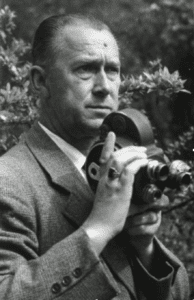
Kjartan Ó. Bjarnason is ready with his camera
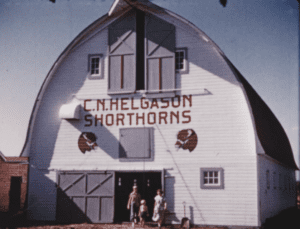
100 years in the New World: A Journey Through the United States, the Cattle Ranch of Western Icelanders
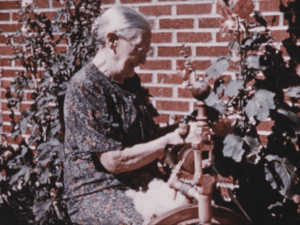
100 years in the West: An old woman spins wool in 1955 in the United States
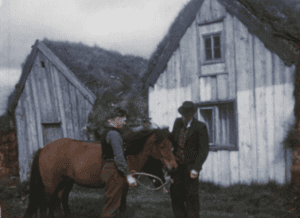
100 Years in the West: Staged Scenes, Livestock Sale
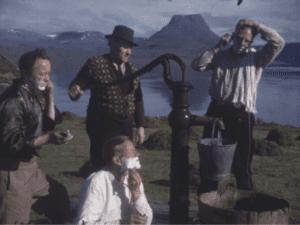
Men shave outdoors on Vigur in the Ísafjörður Fjord
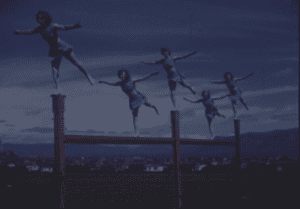
Gymnasts from Ármann perform balancing acts in Reykjavík
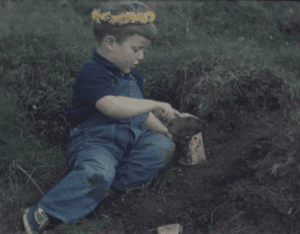
A boy at a summer camp in Reykholt in Borgarfjörður bakes a mud cake.
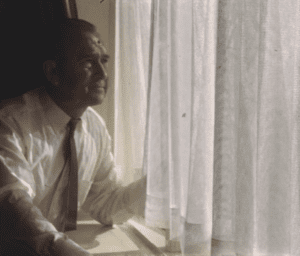
Kjartan O. Bjarnason in Denmark
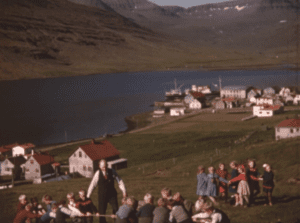
Eskifjörður. Kjartan's layered shot: Boys in a tug-of-war in the foreground, the teacher watches them, girls playing in the background, the town, a ship, the sea, and mountains form a shot that tells a great story.
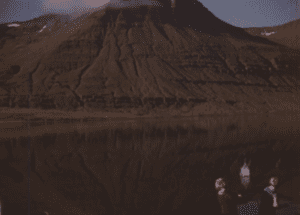
Boys throw stones into the sea. Kjartan gives the large mountain ample space, pairing it with the boys' smallness and their play in the foreground.
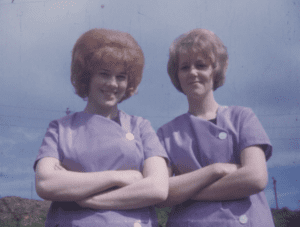
From the movie Icelandic girls which Kjartan put together and showed, among other places, in Norway: In the middle of a workday in Stöðvarfjörður.
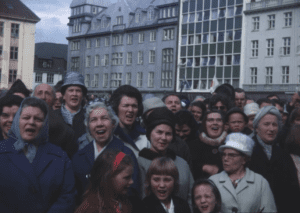
Austurvöllur: People enjoy Prince Philip's speech in 1964
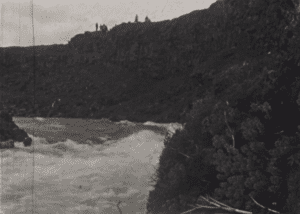
Good times: In Kjartan's first film, his layering of the frame can be seen: vegetation in the foreground, the rushing river, and then his companions at the top and farthest away.