Bauer-5
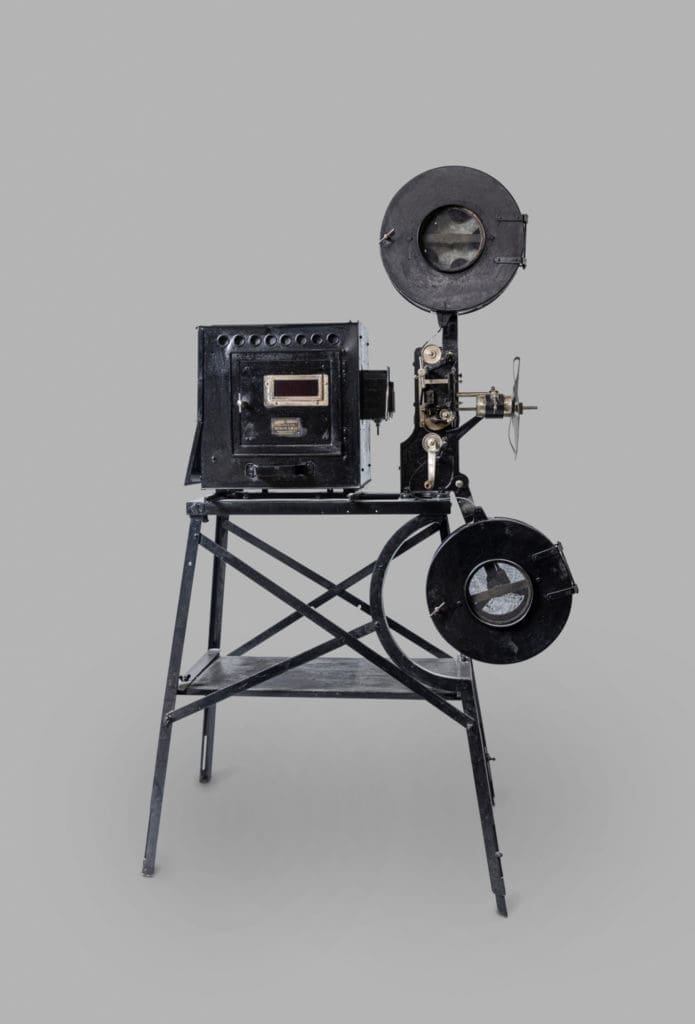
Bauer-5, a 35 mm film projector, manufactured around 1910–1920 in Berlin. The machine was not designed for sound, and therefore only silent films were shown on it. Manual power was used to operate the machine, and the projectionist had to maintain a steady pace to keep the speed correct. The reels, however, were short, about 10 minutes, but at that time, films were not much longer than that. In addition to hand-cranking the projector, the projectionist had to ensure the correct light was on the screen while he was cranking. The carbon-arc lamp, which was used to illuminate the film, was an open flame between two carbon rods that were brought together so that an arc was formed between them. The fire between the contacts was about 2000 degrees hot, but the film base was made of nitrate and burned at 80 degrees. The film could not be stopped because the light would then generate too much heat, which could ignite the film. If a fire broke out in the projector housing, there was a risk of an explosion, as nitrate is a highly flammable substance that does not require oxygen to burn. For this reason, nets were placed on the projector housings to prevent an explosion. The projector was used at Gamla Bíó (Borg) in Vestmannaeyjar and is the oldest known to have been preserved in the country that was used for a paid movie screening. Arnbjörn Ólafsson of Reyni and Sigurjón Högnason from Baldurshagi established a film operation in the building Borg and founded Gamla Bíó in 1918. The first film was shown on March 3, 1918, and was called Zirli. The residents of Westman Islands were big movie fans, and at that time, there were two operating movie theaters. Usually, movie screenings were held when boats came ashore; the fishermen would book a movie screening while they were unloading.
- Catalogue no.
- Ss 83–1, 1
- Category
- Movie projectors